
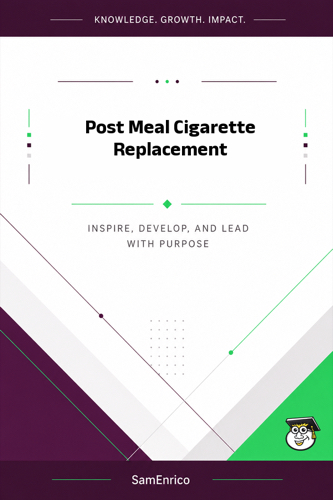
Non-FictionSelf-HelpPost-Meal Habits
Post Meal Cigarette Replacement eBook
Walk, brush teeth, or chew gum immediately after e
by Parra Jammie
Walk, brush teeth, or chew gum immediately after eating to break the meal-smoke link.
Formats
Free sample
Chapter 1: The Last Bite Paradox--–- The cigarette after a meal is not like other cigarettes. You know this. Every smoker knows this. You can go hours without smoking—through a movie, a meeting, a long flight—and feel fine. But finish a plate of spaghetti, and suddenly your hand is reaching for the pack before you've even swallowed the last bite.
You might have tried to quit before. You might have succeeded for days or weeks. But then came dinner. And then came the cigarette. And you told yourself you had no willpower.That is not the problem.The problem is that you have been trying to solve a biological puzzle with a moral framework.
You have been telling yourself to be stronger, to resist, to just say no. But willpower is not designed to win against a conditioned reflex that fires in milliseconds, triggered by something as innocent as an empty plate. This chapter will show you why the post-meal cigarette is the hardest to quit, why it is not your fault, and why the solution has nothing to do with trying harder.The Neurochemistry of the Full-Belly Craving Let us start with what happens inside your body after you eat. You sit down to a meal. You take the first bite, then another, then another.
Over the next fifteen to thirty minutes, your digestive system kicks into gear. Your stomach stretches. Your blood sugar rises. Your pancreas releases insulin to shuttle that sugar into your cells for energy. Your parasympathetic nervous system—often called the "rest and digest" system—activates.
Your heart rate slows slightly. Your blood pressure eases. You begin to feel something rare in modern life: genuine physiological relaxation.Now consider what has been happening with nicotine during that same meal. If you are a regular smoker, your body metabolizes nicotine at a fairly predictable rate. The half-life of nicotine in the bloodstream is approximately two hours.
But here is the crucial detail: during the thirty minutes you spend eating, you are not smoking. That means the nicotine level in your blood has been steadily declining. Not enough to trigger full withdrawal—you are not shaking or sweating—but enough to create a small but meaningful dopamine deficit.Your brain notices this deficit. The reward pathway, centered in the nucleus accumbens, is constantly monitoring dopamine levels. When those levels drop below your personal baseline, the brain generates a signal: something is missing.
Something needs to be restored. That signal feels like a craving.But here is where the post-meal cigarette becomes unique. The morning cigarette is driven by overnight withdrawal. After eight hours of sleep, your nicotine levels have dropped significantly, and your dopamine baseline is low. That craving is loud and urgent.
The stress cigarette is driven by cortisol. When you are anxious or angry, your body is flooded with stress hormones, and nicotine provides a temporary (and illusory) calming effect. That craving is sharp and reactive.The post-meal cigarette is different. It is not driven by withdrawal. It is not driven by stress.
It is driven by something far more insidious: conditioning.The Empty Plate as a Bell Ivan Pavlov, the Russian physiologist, famously demonstrated that dogs could be conditioned to salivate at the sound of a bell. He rang a bell, then gave the dogs food. After enough repetitions, the bell alone triggered salivation. The dogs were not hungry. There was no food present.
But the bell had become a cue that predicted food, and their bodies responded automatically.You have done the same thing with your post-meal cigarette. Every time you finished a meal and lit a cigarette, your brain created an association between two events: the empty plate and the nicotine reward. After hundreds or thousands of repetitions, the empty plate itself became a conditioned trigger. You do not need to feel withdrawal. You do not need to feel stressed.
You only need to see the last bite disappear from your fork, and your brain already knows what comes next. The craving is not a sign of weakness. It is a sign that your brain has learned its lessons well.This is why the post-meal cigarette feels more like a reward than a relief. The morning cigarette relieves withdrawal. The stress cigarette relieves anxiety.
But the post-meal cigarette feels like a dessert, a punctuation mark, a ceremony. You have done something good—you have nourished yourself—and now you deserve something good in return. That is the story your brain tells you. And it is a lie, but it is a very convincing lie.The Layered Reward: More Than Just Nicotine Let us pull apart the post-meal cigarette and look at its components. Most smokers think they smoke for the nicotine.
And they are not wrong. Nicotine is a powerfully addictive drug that reaches the brain in seven seconds and releases a surge of dopamine, the neurotransmitter of pleasure and reward. That is the chemical layer.But there are other layers. The first drag of a post-meal cigarette is accompanied by a deep, diaphragmatic exhale. You have just eaten.
Your stomach is full. A deep breath, held and then released, aids digestion by stimulating the vagus nerve, which runs from your brainstem to your abdomen. That exhale feels good. It feels like settling. It feels like completion.There is also the psychological layer.
The post-meal cigarette marks a transition. You have moved from the activity of eating to the next activity—whether that is returning to work, watching television, or going to bed. The cigarette is a ritual that says: this chapter is closed. Now we begin the next one. Without that ritual, many smokers feel unmoored, as if they have finished one task but have not been given permission to start another.So the reward of the post-meal cigarette is actually three rewards bundled together: a fast dopamine hit, a deep breath that aids digestion, and a psychological transition ritual.
When you try to quit using willpower alone, you are trying to give up all three rewards at once. No wonder it feels impossible.Why Willpower Always Fails After Meals Let us be honest about willpower. Willpower is not a character trait. It is a limited resource that depletes with use. The psychologist Roy Baumeister demonstrated this in a series of famous experiments.
In one study, participants were asked to resist eating freshly baked chocolate chip cookies while sitting in a room filled with their aroma. Later, those same participants gave up faster on a difficult puzzle than participants who had not been forced to resist the cookies. Their willpower had been used up.Now think about your day. You wake up. You make decisions all morning.
You resist distractions. You answer emails you do not want to answer. You are polite to people who annoy you. By the time you sit down for dinner, your willpower reserves are already low. You are tired.
Your guard is down. And then you finish your meal, and the conditioned trigger fires, and your brain says: you deserve this. You have been good all day. One cigarette won't hurt.This is not a failure of character. This is a failure of strategy.
You have been asking your exhausted, depleted, post-meal brain to do the hardest thing: resist a deeply conditioned reward. That…
This is the end of the free sample. Get the eBook to keep going. Buy now
About this book
Details
- Author
- Parra Jammie
- Publisher
- SamEnrico
- Language
- English
- Genre
- Non-Fiction, Self-Help, Post-Meal Habits
- Released
- 2026-06-05
- Pages (approx.)
- 140
- Available as
- eBook, Audiobook

Read better in the ZLOADR app
Your eBooks on your phone or tablet. Sign in with your SamEnrico account and start reading.
More by Parra Jammie
 Presentation Nerves Mastery GuideParra Jammie$11.99
 Obituary Writing GuideParra Jammie$11.99
 Parent of Teen DriversParra Jammie$11.99
 IBS And Fibromyalgia OverlapParra Jammie$11.99
 Teresas Visions of Christ HumanityParra Jammie$11.99
 Disappointment Journal PromptsParra Jammie$11.99
 Parenting on Night ShiftParra Jammie$11.99
 The Skyward Visionaries: Black Industrialists Who Built EmpiresParra Jammie$11.99
 The Phantom of the Opera House: Vienna's Blackmailing Maestro (1880s)Parra Jammie$11.99
 A Collector's Handbook to the Humber 16-50Parra Jammie$11.99
 Portfolio Career Contract TemplatesParra Jammie$12.99
 Delegation of Calendar ManagementParra Jammie$12.99
You may also like
 Hong Kong Handover 1997Dunn Johnnie$11.99
 Zumba For Postnatal Recovery CourseNeal Christian$11.99
 Zumba for BeginnersLadner Nikia$11.99
 YouTube Comment Mining GuideHumes Pandora$12.99
 Worry Box MeditationCarlin Rudy$11.99
 Workplace Stress MeditationNguyen Lynn$11.99
 Workplace Stress and Sleep RepairHawley Ivory$11.99
 Workplace Perfectionism CureDelaney Jeffry$11.99
 Workplace Injustice Anger GuideWallen Isabelle$11.99
 Work Addiction and Burnout LinkGreenwood Ester$11.99
 Women in Yoga and WellnessBeattie Galina$11.99
 Women in Stand Up ComedyChun Evangeline$11.99