
Non-FictionSelf-HelpCancer Recovery
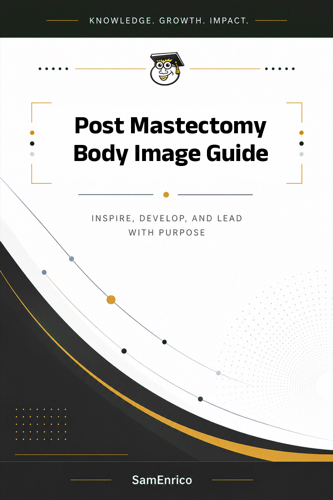
Post Mastectomy Body Image Guide eBook
Adjust to chest changes, explore prosthetics or fl
by Hitt Ehtel
Adjust to chest changes, explore prosthetics or flat pride, and reclaim intimacy and confidence.
Formats
Free sample
Chapter 1: The Stranger in the Mirror...--–- The first time you looked down after surgery, you didn't see a survivor. You saw someone you didn't recognize. The chest that had been yours—whether you loved it, tolerated it, or barely thought about it—was gone. In its place: a line of red or purple tissue, a flat expanse where curve used to be, or the foreign shape of a newly reconstructed mound that felt nothing like the original. This is not vanity.
This is not weakness. This is grief—and it has a name.This chapter is about meeting that stranger in the mirror and learning, slowly and without shame, to invite her in. We will explore why the loss of a breast can feel like the loss of a person, how the brain processes visual change as threat, and why the question "Do I still look like me?" is one of the most profound you will ever ask. Most importantly, you will begin the work of decoupling what you see from who you are—not by pretending the change doesn't matter, but by understanding exactly why it matters so much, and then choosing what to do with that knowledge.The Geography of Grief: Why a Body Part Can Feel Like a Person Grief is not reserved for death. It arrives for any significant loss—and the loss of a breast is significant.
But here is what most medical literature gets wrong: they describe it as "cosmetic concern" or "body image disturbance," as if you were complaining about a bad haircut. You are not. You are grieving the loss of a body part that may have been involved in pleasure, nursing children, sexual identity, gender expression, or simply the quiet comfort of feeling whole.Body part-specific grief is the term we will use throughout this book. Unlike general grief, which tends to diffuse over time, body part grief attaches to a specific absence. You don't just feel sad; you feel sad every time you reach for a bra that no longer fits, every time you shower and your hand lands on scar instead of skin, every time you catch your reflection from an angle that used to look familiar and now looks wrong.
This grief has triggers, and those triggers are everywhere.Research suggests that up to seventy percent of post-mastectomy patients report significant distress related to mirror-gazing in the first three months after surgery. This is not because you are shallow. It is because the human brain is wired to recognize patterns—and your own body is the most familiar pattern you have. When that pattern changes abruptly, the brain responds as it would to any unexpected threat: with alarm, hypervigilance, and a desperate attempt to make the pattern match again.The clinical term for this is visual dissonance—the gap between what you expect to see and what is actually there. Your brain holds an internal map of your body called the homunculus.
That map includes breasts. After mastectomy, the map still has a signal for "breast here," but the sensory input says "no breast here." That mismatch is neurologically distressing, not just emotionally so. Understanding this can be liberating: the distress you feel is not a character flaw. It is your brain doing exactly what it evolved to do, which is to notice when something has changed. The goal is not to eliminate that distress overnight.
The goal is to teach your brain a new map.The Five Stages of Chest Grief (And How They Show Up Differently Here)You may have heard of the Kübler-Ross grief model: denial, anger, bargaining, depression, acceptance. These stages were originally developed for terminal illness, but they have been adapted for loss of all kinds—including body part loss. However, post-mastectomy grief does not move through these stages in a straight line. You may cycle through all five in a single shower. You may never experience one stage at all.
Let us walk through how each stage specifically shows up after chest surgery.Denial often appears as avoidance. You stop looking in mirrors. You shower with the lights off. You wear oversized sweaters in July. You tell yourself "it's not that bad" or "I'll deal with it later." Denial is not weakness; it is a protective mechanism.
Your nervous system can only handle so much. The problem is when denial becomes permanent avoidance, which prevents healing. The first exercise at the end of this chapter will gently challenge denial without forcing you into territory you are not ready for.Anger is perhaps the most common stage, and it is also the most misdirected. You may be angry at cancer, at your doctors, at your body for betraying you, at your partner for looking at you differently (or for not looking at you differently enough), at other women with intact breasts, at yourself for caring so much about something "superficial." Anger is useful because it contains energy. The question is whether you direct that energy toward destruction or toward action.
Many of the later chapters in this book—on prosthetics, flat pride, tattooing, and intimacy—are designed to channel anger into transformation.Bargaining shows up as the "if only" thoughts. If only I had caught it earlier. If only I had chosen a different surgeon. If only I had kept my other breast for symmetry. If only I had gone flat instead of reconstructed, or reconstructed instead of going flat.
Bargaining is your brain's attempt to regain control by rewriting the past. It is exhausting because the past cannot be rewritten. The goal of this stage is to recognize bargaining thoughts without engaging them—to notice "if only" and say, gently, "that is a bargaining thought, and I do not need to follow it."Depression is the heaviest stage. It is the moment when denial, anger, and bargaining have all failed, and you are left with the raw fact of the loss. This is not clinical depression (though that can co-occur), but rather grief-depression: a profound sadness that has a clear cause.
You may cry without warning. You may lose interest in activities you used to enjoy. You may feel that nothing will ever feel good again. This stage is the most dangerous because it can lead to isolation. The most important thing to know is that grief-depression lifts—not because you stop caring, but because your nervous system eventually integrates the loss.
Integration takes time, usually longer than you want it to.Acceptance is not happiness. Acceptance is not "I love my new chest." Acceptance is simply the ability to look in the mirror without the immediate spike of distress. It is the ability to say "this is my body now" without the word "but" following. Acceptance may arrive for five minutes and then vanish for three days. That is normal.
Over time, the acceptance minutes grow longer, and the distress minutes grow shorter. The final chapter of this book will guide you toward your own definition of wholeness, which may look nothing like the cultural ideal and everything like peace.The Comparison Trap: Why Your Old Body Is Not a Fair Rival One of the most relentless sources of…
This is the end of the free sample. Get the eBook to keep going. Buy now
About this book
Details
- Author
- Hitt Ehtel
- Publisher
- SamEnrico
- Language
- English
- Genre
- Non-Fiction, Self-Help, Cancer Recovery
- Released
- 2026-06-09
- Pages (approx.)
- 123
- Available as
- eBook, Audiobook

Read better in the ZLOADR app
Your eBooks on your phone or tablet. Sign in with your SamEnrico account and start reading.
More by Hitt Ehtel
 Healthcare Professional Burnout Recovery WorkbookHitt Ehtel$11.99
 Demy Lola Musical ColorHitt Ehtel$11.99
 Childhood Insomnia GuideHitt Ehtel$11.99
 Self Esteem for Seniors with ArthritisHitt Ehtel$11.99
 The Star Charts of the Dogon: Ancient Cosmic CartographersHitt Ehtel$11.99
 Understanding Mental Retardation Unusual Facies Davis–lafer TypeHitt Ehtel$17.99
 EU Digital Markets Act GuideHitt Ehtel$12.99
 Stakeholder Interview Prompt ScriptsHitt Ehtel$12.99
 Speech TherapistHitt Ehtel$11.99
 Ultimate Handbook Guide to Xiangxiang : (China) Travel GuideHitt Ehtel$11.99
You may also like
 Hong Kong Handover 1997Dunn Johnnie$11.99
 Zumba For Postnatal Recovery CourseNeal Christian$11.99
 Zumba for BeginnersLadner Nikia$11.99
 YouTube Comment Mining GuideHumes Pandora$12.99
 Worry Box MeditationCarlin Rudy$11.99
 Workplace Stress MeditationNguyen Lynn$11.99
 Workplace Stress and Sleep RepairHawley Ivory$11.99
 Workplace Perfectionism CureDelaney Jeffry$11.99
 Workplace Injustice Anger GuideWallen Isabelle$11.99
 Work Addiction and Burnout LinkGreenwood Ester$11.99
 Women in Yoga and WellnessBeattie Galina$11.99
 Women in Stand Up ComedyChun Evangeline$11.99