
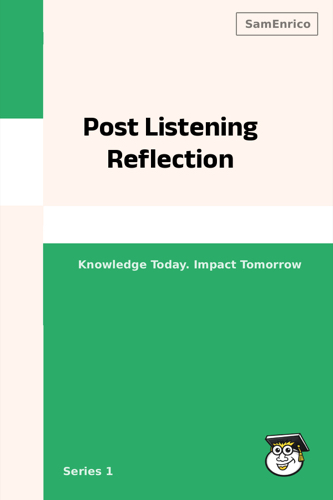
Post Listening Reflection eBook
Debriefs after hypnosis audio session.
Debriefs after hypnosis audio session.
Formats
Free sample
Chapter 1: The Golden Window--–- The recording ends. The hypnotist’s voice fades. You open your eyes, blink twice, and feel… something. Maybe you feel heavy. Maybe you feel light.
Maybe you feel nothing at all except the vague sense that you just spent twenty minutes lying down with headphones on. You check your phone. Three emails. A text from your partner. A notification from an app you don’t remember downloading.
You sit up, stretch, and get on with your day.And that, right there, is where everything falls apart.Not because the hypnosis was bad. Not because you did it wrong. Not because your subconscious is “resistant” or your brain is broken. But because you just made the single most common mistake in the history of self-hypnosis: you walked away from the Golden Window.This chapter is going to change how you think about every hypnosis audio you will ever listen to. By the time you finish reading it, you will understand why 90 percent of your previous sessions have produced exactly zero lasting change—and more importantly, you will know exactly how to fix that starting with your very next track.The Myth of Passive Transformation Let us name the lie right now.
The lie is this: that you can listen to a hypnosis audio while doing other things—driving, cleaning, scrolling, falling asleep—and still get the results you want. The lie is sold to you by every app, every You Tube channel, and every well-meaning hypnotist who promises “effortless change” and “automatic reprogramming.” The lie is seductive because it promises something we all desperately want: transformation without work.But here is the truth that no one in the self-help industry wants to admit: hypnosis audios are not magic spells. They are not downloads. They are not psychic injections that rewrite your brain while you fold laundry. They are, at their core, nothing more than a set of verbal suggestions delivered to a brain that has been temporarily shifted into a more receptive state.That receptivity is real.
The science is solid. Hypnosis produces measurable changes in brain wave activity, shifting you from the fast, choppy beta waves of normal waking consciousness to the slower, more rhythmic alpha and theta waves associated with relaxation, creativity, and heightened suggestibility. In this state, the critical factor—that internal gatekeeper that evaluates every incoming piece of information for truth and relevance—is partially bypassed. Suggestions that would normally be rejected as “silly” or “impossible” can slip through.But here is the catch that changes everything: the bypass is temporary. The critical factor does not stay asleep.
Within minutes of the audio ending, your conscious mind wakes back up, stretches its legs, and starts asking uncomfortable questions. “Did that actually work?” “I don’t feel any different.” “That was probably a waste of time.” And just like that, the suggestion that slipped through is examined, judged, and often discarded.This is where the 50/50 Rule enters.The 50/50 Rule: Your New Operating System The 50/50 Rule is the foundational principle of this entire book. It is simple enough to remember but profound enough to change everything. Here it is:The audio provides fifty percent of the mechanism—the suggestions themselves, delivered in a trance-inducing format. You provide the other fifty percent—the conscious reflection, the neural consolidation, and the active acceptance that transforms hearing into believing.Without your fifty percent, the audio is just noise.
Pleasant noise, maybe. Relaxing noise, certainly. But noise that will leave no more trace on your long-term behavior than the sound of rain on a roof.This is not a metaphor. This is neurobiology.When you listen to a hypnosis audio, the suggestions travel from your ears to your auditory cortex, where they are processed as sound. From there, they travel to the thalamus, then to various association areas, and finally—if the conditions are right—to the hippocampus and amygdala for memory encoding and emotional tagging.
But here is the critical detail: that final encoding step does not happen automatically. It requires a chemical and electrical environment that is present only during the Golden Window.The Golden Window: Your Ten-Minute Opportunity The Golden Window is the period immediately following the end of a trance state, lasting approximately ten minutes, during which your brain remains in a hybrid state of consciousness. Your brain waves are still oscillating in the alpha and theta ranges—slower than full waking beta, faster than deep sleep delta. In this state, neuroplasticity is heightened. Neural connections are more easily formed, strengthened, or weakened.
The molecular machinery of learning—things like BDNF (brain-derived neurotrophic factor) and long-term potentiation—is still active from the trance state.Think of it this way. When you exercise, your muscles are temporarily primed to grow stronger—but only if you consume protein within the “anabolic window” afterward. Miss that window, and the exercise is not wasted exactly, but it is drastically less effective. The Golden Window is the anabolic window for your subconscious mind.If you reflect during this window—if you journal, if you scan your body, if you actively engage with what you experienced—you are essentially feeding protein to your changing brain. The suggestions that were merely heard during the audio are now being actively encoded.
They are moving from short-term sensory buffers into long-term memory structures. They are being tagged as “important” and “relevant” by your conscious attention.If you do nothing during this window—if you check your phone, start your next task, or simply drift back to normal consciousness without any reflection—the suggestions fade like a dream upon waking. You might remember that you listened to something. You might even remember the general topic. But the specific, targeted suggestions that could have changed your behavior?
They are gone.This is not a matter of willpower or intelligence. This is simple neurobiology. State-dependent memory, the phenomenon first described by neuroscientist Donald Overton in the 1960s, tells us that information encoded in one brain state is best retrieved in that same brain state. The suggestions you heard in alpha-theta will be most accessible to you when you are in alpha-theta. Once you shift fully into beta—the normal waking state of emails, traffic, and grocery lists—those suggestions become increasingly difficult to access.The ten-minute Golden Window is your bridge.
It is the time during which you can consciously retrieve the subconscious material, write it down, feel it in your body, and in doing so, translate it into a form that your waking brain can carry with you.Hearing Versus Accepting: The Critical Distinction You have probably never thought about the difference between hearing and accepting. Most people don’t. But that difference is the entire key to making hypnosis work.Hearing is passive. It requires no effort, no engagement, no participation. You hear the sound of a car driving by.
You hear the hum of your refrigerator. You hear the voice on a hypnosis track. Your eardrums vibrate. Your auditory nerve fires. Your brain registers sound.
That is hearing.Accepting is active. It requires attention, intention, and conscious participation. Acceptance is the moment when you say, “Yes, this applies to me.” It is the moment…
This is the end of the free sample. Get the eBook to keep going. Buy now
About this book
Details
- Author
- Sorensen Albina
- Publisher
- SamEnrico
- Language
- English
- Genre
- Non-Fiction, Self-Help, Reflection
- Released
- 2026-06-05
- Pages (approx.)
- 149
- Available as
- eBook, Audiobook

Read better in the ZLOADR app
Your eBooks on your phone or tablet. Sign in with your SamEnrico account and start reading.
More by Sorensen Albina
 Widowed Dating After LossSorensen Albina$11.99
 Imposter Salary NegotiationSorensen Albina$11.99
 Reconstruction of Mass Shooting ScenesSorensen Albina$11.99
 Workplace Accommodation AdvocateSorensen Albina$11.99
 Pomodoro for AccountantsSorensen Albina$11.99
 Peg System For Psychology TheoriesSorensen Albina$11.99
 Dakota Fanning Child ActressSorensen Albina$11.99
 The Last Mile: How CRISPR Saved a Dying ChildSorensen Albina$11.99
 Cocoa: Harvesting Pods, Fermenting & Drying BeansSorensen Albina$11.99
 How to Produce DressersSorensen Albina$11.99
 Research Proposal STEM Laboratory GuideSorensen Albina$12.99
 College Essay Sample AnalysisSorensen Albina$12.99
You may also like
 Remote Work End of Day ReviewPoland Iliana$11.99
 The Empathy and Mirroring GuideMarlow Shizue$11.99
 Group Creative Pause GuideQuinones Sheilah$11.99
 Reflective Statement TechniqueRooney Maye$11.99
 Tide Pool StillnessBoling Alisha$11.99
 The Full Moon Over LakeMalloy Lamonica$11.99
 Atomic Habits For ReflectionCarlos Theriault$11.99
 Life Review Gratitude JournalCarmichael Carry$11.99
 Compulsive Spending Reflection CardsVerdin Tiesha$11.99
 Post Exam Reflection GuideDeleon Carmelita$11.99
 Goal Review Retrospective GuideMosby Salome$11.99
 Review and Reflect BlockDuarte Fanny$11.99