

Non-FictionSelf-HelpCreativity
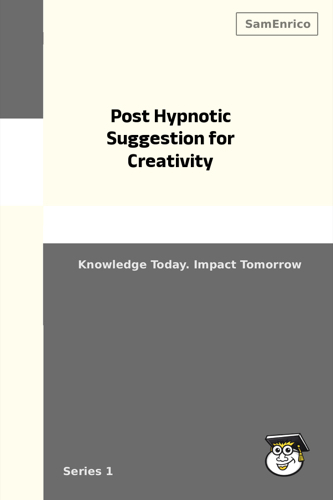
Post Hypnotic Suggestion for Creativity eBook
Trigger idea flow when facing a blank page or canv
by Allen Herman
Trigger idea flow when facing a blank page or canvas.
Formats
Free sample
Chapter 1: The Mirror Trap...--–- The blank page is not empty. That is the first lie. The second lie is that you are the one staring at it. In truth, the page stares back. It has been staring at you since the first time you sat down to create something important and felt your mind freeze like a computer with too many tabs open.
That freeze is not a lack of ideas. It is not a failure of talent. It is not a sign that you have run dry. That freeze is a trance—a specific, learnable, and deeply familiar hypnotic state that you have been practicing for years without knowing it. And like any trance, it can be broken.
More powerfully, it can be replaced.Let me say something that will sound strange at first, and then, by the end of this chapter, will sound like the most obvious truth in the world. You are already using post-hypnotic suggestion. You have been using it every time you sit down to work. The only question is whether the suggestion serves you or destroys you.Every creative person I have ever worked with—writers, painters, musicians, designers, entrepreneurs—has accidentally installed a negative post-hypnotic script. The script goes like this: When I see a blank page, my mind goes empty.
When my mind goes empty, I feel panic. When I feel panic, I freeze. When I freeze, I confirm that I have nothing to say. That script plays in a fraction of a second, below the level of conscious thought. You do not choose to run it.
It runs you. And then you call it "writer's block" or "creative block" or "the empty well" as if those were natural disasters rather than self-installed software bugs.This book is the uninstaller. But before we can delete the old program, we have to understand how it got there. That understanding begins with a single, radical reframe: the blank page is not a void. It is a mirror.The Mirror That Lies Imagine standing in front of a mirror that shows you not your face but your fear.
Every time you look, you see a version of yourself that is smaller, more anxious, less capable. That is what the blank page has become. You do not see infinite possibility when you look at white paper or an empty canvas. You see the memory of every time you struggled. You see the shadow of your Inner Editor leaning over your shoulder.
You see the faces of people you fear will judge your work. None of these things are actually on the page. They are reflections—projections of your own conditioned responses.This is the first and most important distinction of this entire book. The blank page has no inherent power. It has no emotional content.
It is cellulose and bleach and maybe a little cotton if you buy the expensive stuff. The fear you feel is not caused by the page. The fear is caused by the association your nervous system has built between the page and a history of pressure, judgment, and self-criticism.Here is what that means in practical terms. Every time you have sat down to create and felt stuck, your brain was doing exactly what brains evolved to do: it was protecting you from a predicted threat. The threat is not a tiger.
The threat is the possibility of producing something bad, something embarrassing, something that confirms your secret suspicion that you are a fraud. Your brain cannot tell the difference between a social threat (shame, judgment, rejection) and a physical one. So it triggers the same freeze response. Your muscles tense. Your breathing becomes shallow.
Your prefrontal cortex—the part of your brain responsible for creativity and abstract thinking—literally downregulates its activity. Blood flow shifts away from the areas that generate novel associations. You go into survival mode. And in survival mode, you do not paint symphonies or write sonnets. You hide.This is not a metaphor.
This is neurology. And neurology can be changed.The Negative Trance You Did Not Know You Installed Hypnosis gets a bad reputation. Most people think of stage shows where someone clucks like a chicken or falls asleep at the snap of a finger. That is performance hypnosis. Clinical hypnosis—and the self-hypnosis you will learn in this book—is something else entirely.
It is the deliberate induction of a focused state of attention in which the critical, filtering part of your mind (the Inner Editor) steps aside, allowing new associations and suggestions to reach the deeper, more automatic parts of your brain.Here is the uncomfortable truth. You do not need a hypnotist to enter this state. You enter it every day without trying. Have you ever driven home and realized you do not remember the last ten minutes of the road? That is a hypnotic trance.
Have you ever been so absorbed in a movie that you flinched when a character was slapped? That is a trance. Have you ever stared at a blank page and felt your mind go numb? That is also a trance. The difference is the content of the suggestion.In the driving trance, the suggestion is "stay on the road and follow the familiar pattern." In the movie trance, the suggestion is "this story is real enough to affect your body." In the blank page trance, the suggestion is "nothing is coming.
You are stuck. You have failed before you began."You installed that suggestion through repetition. Every time you sat down with high expectations and then struggled, your brain made a note. Blank page + effort = discomfort. After enough repetitions, the equation became automatic.
Now you do not even have to struggle. You just have to see the page, and the discomfort arrives ahead of schedule. This is classical conditioning, the same mechanism that made Pavlov's dogs salivate at the sound of a bell. The bell never fed them. But it predicted food.
The blank page never hurt you. But it predicts struggle. So your body prepares for struggle before you have written a single word.The good news is that what was learned through repetition can be unlearned through repetition. And it can be replaced with something better.The Open Loop Principle There is a concept in hypnosis called the "open loop." A closed loop is a completed cycle—a finished task, an answered question, a resolved problem. When a loop closes, your brain releases attention.
You stop thinking about it. An open loop is incomplete. It is a sentence without a period. It is a cliffhanger. It is the feeling of a word on the tip of your tongue.
Your brain hates open loops. The Zeigarnik effect, named after the Russian psychologist who discovered it, shows that people remember incomplete tasks far better than completed ones. Your subconscious will continue to work on an open loop long after your conscious mind has moved on to other things.The negative trance of the blank page is a closed loop. It goes like this: I see the page. I predict struggle.
I freeze. Confirmed. That is a complete, miserable cycle. But what if we could keep the loop open? What if…
This is the end of the free sample. Get the eBook to keep going. Buy now
About this book
Details
- Author
- Allen Herman
- Publisher
- SamEnrico
- Language
- English
- Genre
- Non-Fiction, Self-Help, Creativity
- Released
- 2026-06-09
- Pages (approx.)
- 135
- Available as
- eBook, Audiobook

Read better in the ZLOADR app
Your eBooks on your phone or tablet. Sign in with your SamEnrico account and start reading.
More by Allen Herman
 Alcoholism and Liver HealthAllen Herman$11.99
 Dream Symbol Personal DictionaryAllen Herman$11.99
 Feeling MisunderstoodAllen Herman$11.99
 Byzantium’s Golden Veil: The Splendor of the Eastern Roman CourtAllen Herman$11.99
 Ultimate Handbook Guide to Zhuhai : (China) Travel GuideAllen Herman$11.99
 Bank Rejection Reasons GuideAllen Herman$12.99
 How to Produce Clay SealantAllen Herman$11.99
 Software Quality EngineerAllen Herman$11.99
You may also like
 Hong Kong Handover 1997Dunn Johnnie$11.99
 Zumba For Postnatal Recovery CourseNeal Christian$11.99
 Zumba for BeginnersLadner Nikia$11.99
 YouTube Comment Mining GuideHumes Pandora$12.99
 Worry Box MeditationCarlin Rudy$11.99
 Workplace Stress MeditationNguyen Lynn$11.99
 Workplace Stress and Sleep RepairHawley Ivory$11.99
 Workplace Perfectionism CureDelaney Jeffry$11.99
 Workplace Injustice Anger GuideWallen Isabelle$11.99
 Work Addiction and Burnout LinkGreenwood Ester$11.99
 Women in Yoga and WellnessBeattie Galina$11.99
 Women in Stand Up ComedyChun Evangeline$11.99