
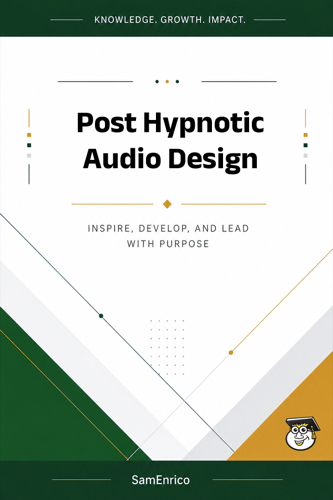
Non-FictionSelf-HelpSuggestion Engineering
Post Hypnotic Audio Design eBook
Crafts recordings that install lasting suggestions
Crafts recordings that install lasting suggestions for behavioral change after listening.
Formats
Free sample
Chapter 1: The Trance Trap...--Most people believe hypnosis ends when the recording stops.They imagine a swinging pocket watch, a voice saying "sleep," and then a dramatic awakening where the listener blinks back to normal reality, perhaps a little groggy but otherwise unchanged. This image is not only cartoonishly inaccurate—it is the single greatest reason why commercial hypnosis audio almost never produces lasting behavioral change.If you have ever downloaded a hypnosis track for better sleep, weight loss, confidence, or smoking cessation, only to feel vaguely relaxed during the listening session and then completely unchanged the next morning, you have experienced what I call the Trance Trap. You fell into a lovely, soothing state. You enjoyed the voice, the music, the permission to do nothing. And then you opened your eyes, and your habits remained exactly as they were.The Trance Trap is not your fault.
It is a design flaw embedded in nearly every hypnosis recording on the market. The creators of those tracks mistakenly believe that trance itself is the product. They sell you an experience of relaxation, a temporary escape, a few minutes of mental quiet. But trance without a bridge to waking life is just expensive napping.This book exists because that bridge exists. And building it requires understanding a single, counterintuitive truth: the most important part of a hypnosis recording happens after the listener opens their eyes.What a Post-Hypnotic Suggestion Actually Is Let us begin with a precise definition, because the term "post-hypnotic suggestion" has been so abused by stage hypnotists and internet marketers that it has nearly lost its meaning.A post-hypnotic suggestion is not an instruction given during trance.
It is not a command that the listener obeys while hypnotized. It is not a feeling of relaxation that lingers for a few minutes after the track ends.A post-hypnotic suggestion is a pre-programmed, future-oriented trigger that fires automatically in a specific context after the trance state has ended.Let me break that down into its components.Pre-programmed. The suggestion is not invented by the listener's unconscious in the moment. It is carefully scripted, tested, and embedded into the audio recording during the design phase. The listener is not cooperating with the suggestion—they are experiencing it as an automatic phenomenon.Future-oriented.
The suggestion does not refer to the present moment inside the trance. It refers to a specific future time, place, or situation. "And as you sit in that meeting next Tuesday..." is a post-hypnotic suggestion. "And as you relax now..." is not.Trigger. The suggestion is not a general wish or a vague affirmation.
It is attached to a specific cue—an event, a sensation, a word, a sound, or a physical action. The trigger is what pulls the suggestion out of storage and activates it.Automatic. The listener does not decide to respond. The response happens to them. They feel a sudden wave of calm.
They notice their hand moving toward their pocket instead of the cigarette pack. They experience a spontaneous shift in posture. The hallmark of a successful post-hypnotic suggestion is that the listener says, "I don't know why I did that—it just happened."After the trance ends. This is the most violated principle in commercial hypnosis. Most tracks try to deliver the suggestion during the trance, while the listener is still in a passive, receptive state.
But the unconscious mind is context-dependent. A suggestion learned in a lying-down, eyes-closed, deeply relaxed context may not automatically transfer to a standing-up, eyes-open, socially active context. The bridge between these contexts must be engineered.The Three-Phase Model of Post-Hypnotic Audio Every effective post-hypnotic audio recording follows a three-phase structure. If any phase is missing, the recording will fail to produce lasting behavioral change. Most commercial recordings include only Phase 1.Phase 1: Induction and Deepening This is the part everyone recognizes.
The listener is guided into a state of focused attention, reduced peripheral awareness, and increased responsiveness to suggestion. The induction may use progressive relaxation, visualization, counting, or any of a dozen traditional methods. The deepening phase amplifies the trance state using imagery (walking down stairs, floating on clouds) or sensory loading (binaural beats, isochronic tones).Phase 1 is necessary but not sufficient. It creates the conditions for suggestion work, but it does not do the suggestion work itself.Phase 2: Therapeutic Suggestion Work This is where the core behavioral change is introduced. The listener receives the embedded commands, future pacing, binding statements, and other linguistic structures that will become the content of the post-hypnotic suggestion.However—and this is crucial—Phase 2 does not contain the post-hypnotic trigger itself.
It contains the material that will later be triggered. Think of Phase 2 as loading the gun. The bullet is in the chamber, but the trigger has not yet been pulled.Phase 3: Exit Protocol and Trigger Installation This is the phase that almost everyone gets wrong. Phase 3 is where the post-hypnotic suggestion is actually installed.The exit protocol serves two functions. First, it gently returns the listener from the trance state to full waking consciousness, avoiding the disorientation or grogginess that often follows deep hypnosis.
Second, and more importantly, it bridges the suggestion from the trance context to the waking context.A proper exit protocol includes three elements:A linguistic marker that signals the transition ("And as you begin to return to full waking awareness...")A sensory bridge that anchors the suggestion to a future cue ("...you will notice that every time you touch your thumb to your forefinger...")A reward statement that reinforces the behavior ("...you will feel a wave of calm confidence that tells you the work is done.")Without Phase 3, the suggestion remains trapped inside the trance state. The listener may feel wonderful during the recording and amnesic for the experience afterward—but they will not change.The Trigger → Response → Reward Loop The engine of post-hypnotic suggestion is what I call the T-R-R Loop: Trigger → Response → Reward.Let me walk you through how this loop operates in the unconscious mind.Trigger. A specific cue occurs in the listener's environment. This could be an external event (a door closing, a phone ringing, someone speaking a particular word), an internal sensation (a craving, a spike of anxiety, a feeling of fatigue), or a deliberate self-initiated action (touching two fingers together, taking a deep breath, saying a word silently).The trigger must be discrete (the listener knows exactly when it has occurred), repeatable (it can happen many times), and contextually appropriate (it only fires where the behavior is wanted).Response. The trigger activates a pre-programmed behavioral, emotional, or cognitive response.
The response is not chosen by the listener. It unfolds automatically, below the threshold of conscious decision.The response may be inhibitory ("you feel no desire to smoke"), activational ("you feel a surge of energy"), or regulatory ("your breathing slows and deepens"). The response is the behavioral change itself.Reward. The response is followed by a positive reinforcement signal. This could be a feeling of relief, a wave of pleasant sensation, a sense of accomplishment, or simply the absence of a negative state (craving, anxiety, fatigue).The reward is essential because it closes the loop.
The unconscious mind learns to associate the trigger with the reward through the response. Over time, the trigger becomes sufficient…
This is the end of the free sample. Get the eBook to keep going. Buy now
About this book
Details
- Author
- Matheson Joel
- Publisher
- SamEnrico
- Language
- English
- Genre
- Non-Fiction, Self-Help, Suggestion Engineering
- Released
- 2026-06-07
- Pages (approx.)
- 150
- Available as
- eBook, Audiobook

Read better in the ZLOADR app
Your eBooks on your phone or tablet. Sign in with your SamEnrico account and start reading.
More by Matheson Joel
 French Vichy Regime ResistanceMatheson Joel$11.99
 Home Office Distraction ManagementMatheson Joel$11.99
 Financial Goal SettingMatheson Joel$11.99
 Dividend Coverage Ratio GuideMatheson Joel$11.99
 Child's Toys and BelongingsMatheson Joel$11.99
 Mindfulness for ChemotherapyMatheson Joel$11.99
 Burnout Recovery SupplementsMatheson Joel$11.99
 The Mosaic Masters of Ravenna: Byzantine Art in the Heart of the WestMatheson Joel$11.99
 The Scholars of Timbuktu: Guardians of the Golden ManuscriptsMatheson Joel$11.99
 Growing AdaMatheson Joel$11.99
 How to Start a Filament Tow Business (Beginners Guide)Matheson Joel$11.99
 A Collector's Handbook to the Nsu Prinz 1000Matheson Joel$11.99
You may also like
 Hong Kong Handover 1997Dunn Johnnie$11.99
 Zumba For Postnatal Recovery CourseNeal Christian$11.99
 Zumba for BeginnersLadner Nikia$11.99
 YouTube Comment Mining GuideHumes Pandora$12.99
 Worry Box MeditationCarlin Rudy$11.99
 Workplace Stress MeditationNguyen Lynn$11.99
 Workplace Stress and Sleep RepairHawley Ivory$11.99
 Workplace Perfectionism CureDelaney Jeffry$11.99
 Workplace Injustice Anger GuideWallen Isabelle$11.99
 Work Addiction and Burnout LinkGreenwood Ester$11.99
 Women in Yoga and WellnessBeattie Galina$11.99
 Women in Stand Up ComedyChun Evangeline$11.99