
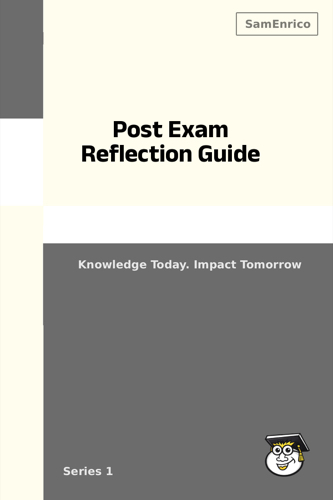
Post Exam Reflection Guide eBook
Learns from memory errors for next time.
Learns from memory errors for next time.
Formats
Free sample
Chapter 1: The Familiarity Trap--–- You are sitting in a quiet room, an exam booklet open in front of you. Your eyes land on a question. The terms look familiar. You have seen them before—on a flashcard, in a lecture slide, highlighted in your notes. A wave of relief passes through you.
I know this, you think. Your pen moves to the page. But then something strange happens. The words you expected to flow out do not arrive. You know that you know something, but you cannot seem to find what you know.
The answer sits somewhere just beyond reach, like a name you cannot quite remember at a party. You write something down anyway, hoping it is close enough. Weeks later, the exam comes back. The grade is lower than you expected. The question you felt so confident about?
You got it wrong. And you are left asking yourself a single, painful question: How could I have been so certain and so wrong at the same time?This moment is not a failure of effort. It is not a sign that you are bad at taking tests or that you did not study enough. It is something far more subtle and far more common. It is the illusion of knowing—a cognitive glitch that tricks your brain into mistaking recognition for recall, familiarity for mastery, and passive exposure for active knowledge.
Every year, millions of students fall into this trap. They walk into exams feeling prepared, only to discover that their confidence was built on a foundation of sand. And here is the cruelest part: the students who fall for this trap are often the ones who studied the hardest. They re-read their notes. They highlighted key terms.
They watched lecture videos twice. They did everything that felt like learning. And yet, when the exam demanded that they pull information out of thin air, their brains came up empty.This book exists to fix that. Not by telling you to study harder—that is not the problem. But by teaching you how to study smarter by learning from the mistakes you have already made.
The post-exam reflection is the single most underutilized tool in education. Most students look at their grade, feel a pang of disappointment or relief, and then shove the exam into a backpack, never to be seen again. That is like a pilot crashing a plane and never looking at the black box. The exam is not a verdict on your worth as a student. It is data.
It is a map of exactly where your memory failed. And if you learn to read that map, you can rewrite your study blueprint for the next time.This chapter focuses on the most common and most destructive memory failure: the gap between recognition and recall. By the time you finish these pages, you will understand why re-reading and highlighting create such convincing illusions, how to conduct a Familiarity Audit on your last exam, and why the simple question—Could I have taught this to someone else without notes?—is the single most powerful diagnostic tool you will ever own.The Two Faces of Memory To understand why you feel confident and still get the answer wrong, you need to understand something fundamental about how human memory works. Cognitive scientists divide memory into two broad systems that feel identical from the inside but are radically different in their reliability.The first system is recognition memory. This is the feeling of familiarity.
You see a face at a coffee shop and think, I have seen that person before. You hear a song on the radio and know you have heard it, even if you cannot name the artist. Recognition is passive. It requires a cue—the face, the song, the term printed on the exam page. Your brain does not have to work hard to generate recognition.
It simply matches incoming sensory information to existing memory traces. This is why multiple-choice questions feel easier than essay questions. In multiple-choice, you only need to recognize the correct answer among a list of options. Recognition is the shallowest form of memory.The second system is recall memory. This is the act of pulling information out of your brain without any external cues.
It is the difference between recognizing a friend's face on the street and describing that friend's face from memory to a police sketch artist. Recall is active. It requires effort, concentration, and mental reconstruction. When you write an essay answer, explain a concept to a study partner, or solve a problem from scratch, you are using recall. Recall is the deepest form of memory.Here is the problem.
Recognition feels like recall. When you look at a term on an exam and it looks familiar, your brain generates a feeling of fluency. I have seen this before, it whispers. I must know it. But familiarity is not knowledge.
You can be familiar with the shape of a word, the sound of a concept, the layout of a diagram, and still be completely unable to explain what it means. This is the familiarity trap—the single greatest source of false confidence in student history.Think about the last time you studied for an exam. Did you read a chapter and then immediately read it again? Did you highlight sentences that seemed important? Did you copy notes from a lecture slide into a notebook?
Every single one of these activities relies on recognition. When you re-read, you are not testing whether you know the material. You are testing whether the material looks familiar. And because it does, your brain rewards you with a hit of confidence. You close the book and think, I have got this.
But you do not. You have only seen it.The Research That Changed Everything In 2006, psychologists Henry Roediger and Jeffrey Karpicke published a study that shook the foundations of how educators think about studying. They asked students to read a passage of text. One group read the passage four times. Another group read the passage once and then practiced recalling the information three times—writing down everything they could remember without looking at the text.
A week later, both groups took a test on the passage. The results were staggering. The group that had re-read the passage four times—the group that felt the most confident because they had seen the material so many times—performed dramatically worse than the group that had practiced recall. Re-reading created the illusion of mastery. Retrieval practice created actual mastery.This finding has been replicated dozens of times.
It works for vocabulary, for math problems, for history facts, for science concepts. It works for children and for medical students. It works regardless of whether the student is a "visual learner" or an "auditory learner" (categories that research has also debunked, but that is a topic for another chapter). The pattern is relentless: recognition-based studying produces false confidence; recall-based studying produces real learning.And yet, surveys of college students consistently find that re-reading and highlighting are the most common study strategies. Students spend hours on activities that feel productive but are, from a cognitive science perspective, nearly useless.
Why? Because the illusion of knowing is self-reinforcing. The more you re-read, the more familiar the material becomes. The more…
This is the end of the free sample. Get the eBook to keep going. Buy now
About this book
Details
- Author
- Deleon Carmelita
- Publisher
- SamEnrico
- Language
- English
- Genre
- Non-Fiction, Self-Help, Reflection
- Released
- 2026-06-06
- Pages (approx.)
- 143
- Available as
- eBook, Audiobook

Read better in the ZLOADR app
Your eBooks on your phone or tablet. Sign in with your SamEnrico account and start reading.
More by Deleon Carmelita
 Manufactured Home RetirementDeleon Carmelita$11.99
 Franchising Your Local Brand Across Borders Export ControlsDeleon Carmelita$11.99
 Testosterone and Prostate Cancer RiskDeleon Carmelita$11.99
 Self Worth Before Partnership GuideDeleon Carmelita$11.99
 Alcoholism and Cardiovascular RecoveryDeleon Carmelita$11.99
 Tabata Protocol Training GuideDeleon Carmelita$11.99
 Male Fertility Master GuideDeleon Carmelita$11.99
 Sappho's Lost Lyrics: The Voice That Defied TimeDeleon Carmelita$11.99
 The First Arab Sports Chronicle: Al-Marsum Al-Riyadi in 19th Century EgyptDeleon Carmelita$11.99
 Mastering The Art of Drunken Monkey (醉猴)Deleon Carmelita$11.99
 UAE VAT Voluntary Registration PrimerDeleon Carmelita$12.99
 Remote Student Jobs Europe GuideDeleon Carmelita$12.99
You may also like
 Remote Work End of Day ReviewPoland Iliana$11.99
 The Empathy and Mirroring GuideMarlow Shizue$11.99
 Group Creative Pause GuideQuinones Sheilah$11.99
 Reflective Statement TechniqueRooney Maye$11.99
 Tide Pool StillnessBoling Alisha$11.99
 The Full Moon Over LakeMalloy Lamonica$11.99
 Atomic Habits For ReflectionCarlos Theriault$11.99
 Life Review Gratitude JournalCarmichael Carry$11.99
 Compulsive Spending Reflection CardsVerdin Tiesha$11.99
 Goal Review Retrospective GuideMosby Salome$11.99
 Review and Reflect BlockDuarte Fanny$11.99
 Post Listening ReflectionSorensen Albina$11.99