
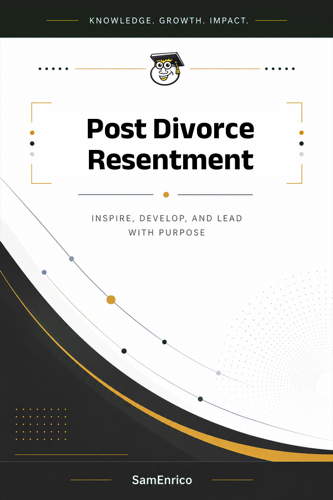
Non-FictionSelf-HelpDivorce Recovery
Post Divorce Resentment eBook
Let go of bitterness towards ex spouse for your ow
by Mercer Rosia
Let go of bitterness towards ex spouse for your own peace.
Formats
Free sample
Chapter 1: The Addiction Loop...--–- The first time you felt it, you probably didn’t recognize it as a high. It felt like clarity. Like justice. Like finally seeing the relationship for what it really was. You were sitting in your car, or lying in the dark, or standing at the kitchen sink, and suddenly the tape started playing: the argument, the betrayal, the moment they looked at you with cold eyes.
And as you replayed it, something strange happened. Your chest tightened, but you didn’t look away. Your jaw clenched, but you didn’t stop. Instead, you felt a surge of something that looked like anger but tasted like righteousness. You were right.
They were wrong. And for a few seconds, that felt better than almost anything else.Welcome to the addiction loop of post-divorce resentment. You are not broken. You are not weak. You are chemically hooked.The Neuroscience of Replay Let’s start with a truth that might unsettle you: your brain does not care whether you are happy or sad.
Your brain cares about one thing above all else—survival. And survival, in neurological terms, means predictability. The human brain is a prediction machine. It craves patterns because patterns mean safety. When your marriage ended, it shattered your brain’s most important prediction: that tomorrow would look roughly like today.
That you would wake up next to the same person. That you understood your role in the world. That you were safe.The divorce created what neuroscientists call a prediction error—a catastrophic gap between what your brain expected and what actually happened. Prediction errors feel terrible. They feel like anxiety, like free fall, like the floor disappearing beneath your feet.
Your brain will do almost anything to close that gap. And one of the most effective ways to close it is to create a story. A story that explains why the prediction failed. A story with a villain, a hero, and a clear moral.That story is resentment.When you replay your ex-spouse’s wrongdoings, your brain is not torturing you for no reason. It is desperately trying to restore order to a universe that stopped making sense.
But here is the catch: the mechanism your brain uses to restore order is the same mechanism used by addiction. Every time you replay the memory, your brain releases a cocktail of stress hormones—cortisol and adrenaline—that, paradoxically, feel energizing. You are not relaxing. You are not calming down. You are activating your sympathetic nervous system, the same system that prepares you to fight a predator or flee a fire.
And because there is no actual predator, no actual fire, that energy has nowhere to go. So it loops. And loops. And loops.This is why resentment is so hard to quit. Not because you are morally weak.
Because you are neurologically addicted.The Hijacking of Moral Superiority Let’s get more specific about what happens inside your skull. Neuroimaging studies of people experiencing resentment show consistent activity in three brain regions: the insula (which processes physical pain and social rejection), the anterior cingulate cortex (which detects conflict and errors), and the dorsolateral prefrontal cortex (which is involved in self-control and moral reasoning). In other words, resentment literally feels like pain, triggers your brain’s error-detection system, and then recruits your moral reasoning centers to justify the pain.Here is the dangerous part. The dorsolateral prefrontal cortex, once activated, does not easily shut down. It searches for evidence to support your conclusion.
It says: “Yes, you are right to be angry. Look at what they did. Look at what they said. Look at how they looked at you.” And every time it finds confirming evidence, it releases a small amount of dopamine—the same neurotransmitter involved in gambling, cocaine use, and scrolling social media. You are not just angry.
You are being rewarded for being angry.This is what distinguishes justice from vengeance. Justice is the desire for a fair outcome. It is forward-looking, solution-oriented, and finite. You want the court to rule fairly, or the custody agreement to be balanced, or the debt to be repaid. Once those outcomes are achieved, justice is satisfied.
Vengeance, by contrast, is the desire to see someone suffer. It is backward-looking, open-ended, and infinite. There is no amount of suffering that satisfies vengeance, because vengeance is not about outcomes. It is about the feeling of righteousness itself. And that feeling, as you now know, is chemically reinforced.You are not a bad person for wanting vengeance.
You are a human person whose brain has been hijacked by a survival mechanism that no longer serves you. But knowing that is the first step to breaking the loop.The Subconscious Shield There is another layer to this addiction, one that is harder to see because it hides beneath your conscious awareness. Resentment serves as a shield. A heavy, exhausting, damaging shield—but a shield nonetheless. Against what?
Against grief.Think about the last time you let yourself truly feel sad about the divorce, not angry. Sad about the lost future, the quiet mornings that will never come back, the person you used to be before the fights started. Sadness feels different than anger, doesn’t it? Sadness is slow. Anger is fast.
Sadness makes you want to lie down. Anger makes you want to stand up. Sadness is vulnerable. Anger feels invulnerable.Your brain knows this. And because your brain’s primary job is to keep you alive (not happy, not at peace, alive), it will choose anger over sadness every single time.
Why? Because sadness, in evolutionary terms, signals submission. It signals to predators that you are weak. Anger signals the opposite. Anger says: “I am still dangerous.
Do not approach.” Your brain does not know that there are no predators in your living room. It is running ancient software on a modern problem.So it feeds you resentment. It replays the tape. It keeps your jaw clenched and your heart rate elevated because that feels safer than the alternative. The alternative is sitting in the wreckage of your marriage and admitting that something you loved is gone.
The alternative is grieving. And grieving, for all its long-term necessity, is acutely painful in the short term.You are not stuck because you are angry. You are angry because it is easier than being sad. That is not a character flaw. That is a neurological shortcut.
But shortcuts that worked in the savanna do not work in the suburbs.The Distinction That Changes Everything Before we go any further, we need to draw a line that will run through every chapter of this book. The line is between pain and suffering. Pain is inevitable. Suffering is optional. The divorce caused pain.
The betrayal caused pain. The loneliness, the financial stress, the loss of your imagined future—all pain. You did not choose any of that. It happened to you.But resentment is not the pain. Resentment is what you do with the pain.
Resentment is the replay button. Resentment is the story you tell yourself at 2 a.m. Resentment is the choice (and it is a choice, even when…
This is the end of the free sample. Get the eBook to keep going. Buy now
About this book
Details
- Author
- Mercer Rosia
- Publisher
- SamEnrico
- Language
- English
- Genre
- Non-Fiction, Self-Help, Divorce Recovery
- Released
- 2026-06-08
- Pages (approx.)
- 97
- Available as
- eBook, Audiobook

Read better in the ZLOADR app
Your eBooks on your phone or tablet. Sign in with your SamEnrico account and start reading.
More by Mercer Rosia
 Discussing Remote Work NeedsMercer Rosia$11.99
 Metabolic Adaptation AppsMercer Rosia$11.99
 Francis and the Vernacular PreachingMercer Rosia$11.99
 IBS And Alcohol ManagementMercer Rosia$11.99
 Tailgating Anger SolutionsMercer Rosia$11.99
 Chief Joseph Nez Perce LegacyMercer Rosia$11.99
 Atomic Habit Building WorkbookMercer Rosia$11.99
 The Last Pharaoh's Gambit: Cleopatra's Untold War of WordsMercer Rosia$11.99
 Kaira: The Māori Warrior Who Conquered the RingMercer Rosia$11.99
 A Collector's Handbook to the Humber Super Snipe IiiMercer Rosia$11.99
 Service Providers Guide to Osteopathic MedicineMercer Rosia$11.99
 Operations Efficiency BlocksMercer Rosia$12.99
You may also like
 Hong Kong Handover 1997Dunn Johnnie$11.99
 Zumba For Postnatal Recovery CourseNeal Christian$11.99
 Zumba for BeginnersLadner Nikia$11.99
 YouTube Comment Mining GuideHumes Pandora$12.99
 Worry Box MeditationCarlin Rudy$11.99
 Workplace Stress MeditationNguyen Lynn$11.99
 Workplace Stress and Sleep RepairHawley Ivory$11.99
 Workplace Perfectionism CureDelaney Jeffry$11.99
 Workplace Injustice Anger GuideWallen Isabelle$11.99
 Work Addiction and Burnout LinkGreenwood Ester$11.99
 Women in Yoga and WellnessBeattie Galina$11.99
 Women in Stand Up ComedyChun Evangeline$11.99