
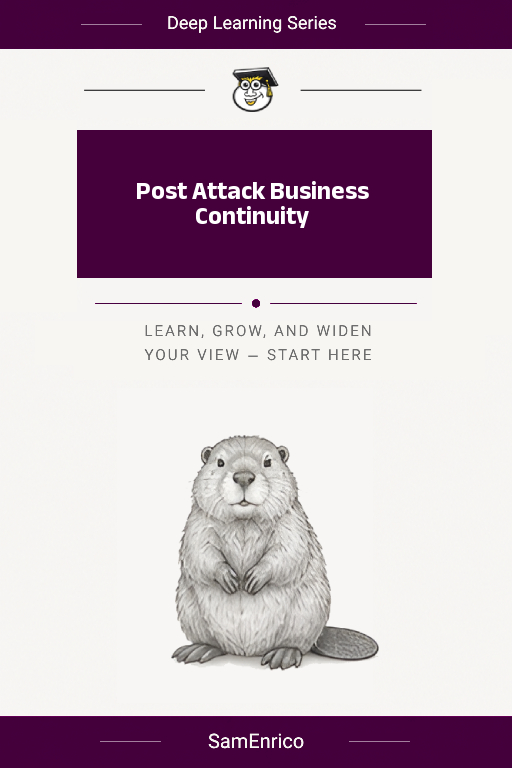
Non-FictionCrisis ManagementContinuity
Post Attack Business Continuity eBook
Resume operations after terrorist attacks while su
Resume operations after terrorist attacks while supporting traumatized employees. Restore systems, communicate reopening, and offer flexible work arrangements.
Formats
Free sample
Chapter 1: The Terrorism Variable...--The call came at 9:47 AM. Sarah Chen, Chief Operating Officer of a mid-sized logistics firm, was reviewing quarterly projections when her executive assistant burst through the door without knocking. "There's been an explosion at the downtown office. They're saying it's terrorism." Sarah's first thought was not about servers, supply chains, or insurance policies. Her first thought was about Jamal, her head of operations, who always arrived early to make coffee for the team.
Her second thought was about the forty-seven people who reported to him. Her third thought was that she had no idea what to do next.Sarah had a business continuity plan. It was 127 pages long, bound in a nice three-ring binder, and updated just six months ago. The plan covered hurricanes, power outages, ransomware, and even a pandemic. It did not cover terrorism.
Not really. The plan assumed that the disaster would end, that the building would eventually be safe, that employees would return when called, and that the biggest challenge would be restoring data from backups. The plan did not account for Jamal being dead. It did not account for the fact that the two-factor authentication for the company's bank accounts required a code sent to Jamal's phone. It did not account for the fear that kept every surviving employee from answering their cell phones for the next six hours.This chapter is about why standard disaster models fail when the disaster is a terrorist attack.
It is about the difference between a broken server and a broken person. And it introduces the framework that will guide every decision in the hours, days, and months after the unthinkable happens.The Limits of Standard Business Impact Analysis For decades, the gold standard of disaster preparedness has been the Business Impact Analysis, or BIA. A BIA asks a deceptively simple set of questions: What are your organization's critical functions? How much downtime can each function tolerate? What happens to revenue, customer satisfaction, and regulatory compliance for every hour the function is unavailable?
The answers produce a prioritized list of which systems to restore first, which teams to call back first, and how much to spend on redundancy.The BIA works beautifully for natural disasters. When a hurricane knocks out power, the BIA tells you that payroll must be restored within twenty-four hours, customer orders within forty-eight, and internal email within seventy-two. The assumptions baked into that model are that the disaster is geographically contained, time-bound, and neutral. The hurricane does not hate you. The flood does not want to hurt you again tomorrow.
The power outage does not leak false information to the press about how your company failed to protect its people.Terrorism breaks every one of those assumptions.First, terrorism introduces intent. Someone chose your building, your city, your industry. That intent creates a second-order effect that natural disasters do not: the possibility of a secondary attack. When a hurricane passes, it is gone. When a terrorist detonates a bomb, law enforcement immediately begins searching for a second device, a second shooter, a coordinated plot.
Your employees know this. Your customers know this. The media broadcasts it live.Second, terrorism introduces fear as a persistent operational variable. In a natural disaster, fear is primarily about physical safety during the event. After the event, fear subsides.
After a terrorist attack, fear persists for weeks or months. Employees fear returning to the office. Customers fear using your product if your brand is now associated with the attack. Investors fear liability. The BIA has no variable for fear, because fear does not appear on a server dashboard.Third, terrorism introduces reputational contagion.
When a hurricane damages your headquarters, the news story is about the hurricane. When a terrorist attacks your headquarters, the news story is about your company. Your logo appears next to images of ambulances and body bags. Your CEO is asked to comment on camera while clearly in shock. The phrase "business as usual" becomes an insult to the dead.The chapter opens with Sarah Chen's story for a reason.
She had a BIA. It told her to restore her ERP system within six hours. What she actually needed in the first six hours was a way to locate her employees, a script to tell their families, and a plan for what to do when the only person who could approve emergency wire transfers was lying in a trauma ward.Critical Functions Versus Critical People The most dangerous assumption in standard continuity planning is that functions and people are interchangeable. The BIA identifies the function—payroll processing, customer support, inventory management—and then assumes that any qualified person can perform that function from any location. This assumption is false after a terrorist attack, and it is catastrophically false when the attack has killed or traumatized the specific people who hold institutional knowledge, system access, or decision authority.Consider the difference between a server and a person.
A server can be replaced. You can fail over to a backup server in minutes. You can restore data from immutable backups. You can spin up a virtual machine in the cloud. The server does not experience fear, grief, or guilt.
The server does not wake up at 3 AM in a cold sweat. The server does flinch when someone drops a heavy box or slams a door.A person cannot be failed over. A lead accountant who witnessed a colleague's death cannot simply be swapped with an accountant from another branch. That person's cognitive bandwidth is now partially occupied by trauma. Their ability to make decisions, to focus on detailed work, to sit still in a chair for eight hours, is compromised not because they are weak but because they are human.
The BIA has no variable for cognitive load reduction. It assumes that if a person is physically present and not actively bleeding, they can perform their function at full capacity.This chapter introduces a concept that will appear throughout the book: the overlap between functional continuity and human continuity. Most continuity plans address these as separate tracks. IT restores systems. HR supports employees.
The two tracks do not meet. But after a terrorist attack, they must meet constantly, because the systems cannot be restored without the people, and the people cannot function if the systems are designed for a world that no longer exists.The 3-Pronged Initial Assessment Within the first hour of a terrorist attack, leaders must conduct an assessment that is fundamentally different from a standard BIA. This chapter introduces the 3-Pronged Initial Assessment, a triage framework that runs in parallel from the moment the attack is confirmed.Prong One: Physical Asset Damage This is the only prong that looks familiar to standard continuity planning. What buildings are damaged or inaccessible? What IT hardware is destroyed or compromised?
What inventory, vehicles, or equipment is lost? This assessment is relatively straightforward, though it is complicated by the fact that you cannot enter the facility to conduct it. Law enforcement will impose a forensic hold, preventing anyone from touching anything that might be evidence. Your physical assessment will come from aerial footage, police reports, and the observations of employees who were evacuated.The key insight of…
This is the end of the free sample. Get the eBook to keep going. Buy now
About this book
Details
- Author
- Jaramillo Jaquelyn
- Publisher
- SamEnrico
- Language
- English
- Genre
- Non-Fiction, Crisis Management, Continuity
- Released
- 2026-06-01
- Pages (approx.)
- 151
- Available as
- eBook, Audiobook

Read better in the ZLOADR app
Your eBooks on your phone or tablet. Sign in with your SamEnrico account and start reading.
More by Jaramillo Jaquelyn
 The Last Boat To FreedomJaramillo Jaquelyn$11.99
 Ambassador's Concession SpeechJaramillo Jaquelyn$11.99Ambassador's Concession SpeechJaramillo Jaquelyn$11.99
 Emergency Room Doctor StressJaramillo Jaquelyn$11.99
 Japanese American 442nd RegimentJaramillo Jaquelyn$11.99
 The Great Hollywood Heist: How Golden Age Stars Stolen from HistoryJaramillo Jaquelyn$11.99
 Tachyhydrite MiningJaramillo Jaquelyn$11.99
 How to Produce Bicycle Water Sport Board RacksJaramillo Jaquelyn$11.99
 How to Become a Machine MolderJaramillo Jaquelyn$11.99
You may also like
 Hong Kong Handover 1997Dunn Johnnie$11.99
 Zumba For Postnatal Recovery CourseNeal Christian$11.99
 Zumba for BeginnersLadner Nikia$11.99
 YouTube Comment Mining GuideHumes Pandora$12.99
 Worry Box MeditationCarlin Rudy$11.99
 Workplace Stress MeditationNguyen Lynn$11.99
 Workplace Stress and Sleep RepairHawley Ivory$11.99
 Workplace Perfectionism CureDelaney Jeffry$11.99
 Workplace Injustice Anger GuideWallen Isabelle$11.99
 Work Addiction and Burnout LinkGreenwood Ester$11.99
 Women in Yoga and WellnessBeattie Galina$11.99
 Women in Stand Up ComedyChun Evangeline$11.99