
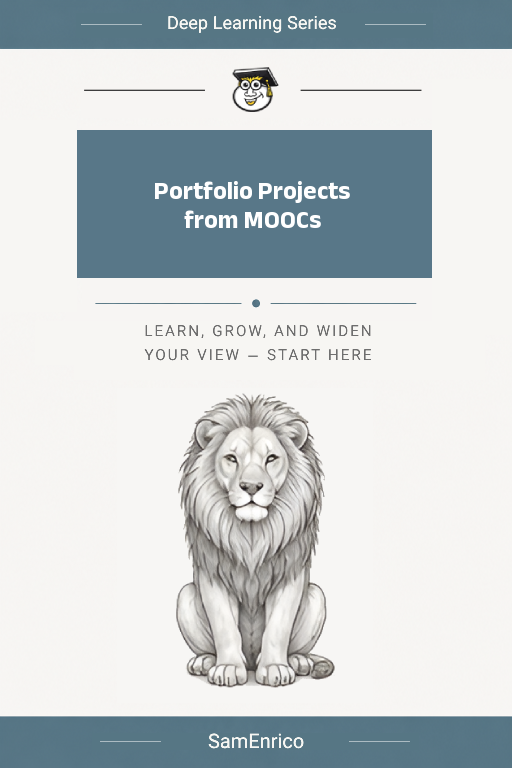
Portfolio Projects from MOOCs eBook
Transform MOOC assignments into portfolio projects
by Hartman Son
Transform MOOC assignments into portfolio projects that demonstrate skills to employers during interviews.
Formats
Free sample
Chapter 1: The Completion Myth--Let me tell you something that every hiring manager knows but almost no MOOC platform will admit: your fifty certificates of completion are worth less than the paper they’re printed on. Not “less than you hoped.” Not “less than a traditional degree.” Worthless. As in, zero. As in, the person deciding whether to call you for an interview would rather see a single working prototype built from a You Tube tutorial than a wall of badges from Coursera, ed X, and Udemy.I realize that sounds harsh. I also realize you have spent hundreds of hours and probably over a thousand dollars accumulating those certificates.
You stayed up late. You sacrificed weekends. You explained to your family that this course would finally be the one that opened the door. And now I am telling you that the door remains locked, and the key you’ve been forging is made of nothing but plastic and pixels.Here is the truth: employers do not buy certificates. They never have.
They buy solutions to their problems. And somewhere along the way, the massive open online course industry convinced you that completing a course was the same thing as becoming employable. It is not. It has never been. And it is getting worse.The Credential Graveyard Let me describe a reader I will call Maria.
Maria is thirty-two years old. She has a bachelor’s degree in an unrelated field, twelve years of work experience in retail management, and a burning desire to become a data analyst. Over the past eighteen months, she has completed twenty-three MOOCs. She has certificates in Python, SQL, Tableau, Excel, statistics, machine learning basics, and data visualization. Her Linked In profile lists every single one.
Her resume includes a section called “Professional Development” that runs half a page. She has applied to over two hundred data analyst jobs. She has received exactly three first-round interviews and zero offers.Maria is not lazy. Maria is not unintelligent. Maria is not failing to learn the material.
Maria is trapped inside the Completion Myth—the belief that finishing courses is the same thing as proving value. And Maria is surrounded by millions of identical learners who all made the same mistake.The Completion Myth is seductive because it offers a clear path. Take course. Learn skill. Earn certificate.
Get job. The MOOC platforms designed it this way on purpose. They are not charities. They are businesses that make money when you start courses, stay engaged, and tell your friends. Your employment outcome is not their primary metric.
Your completion rate is.But let me be even more direct. Hiring managers have told me, in surveys and interviews and back-channel conversations, that they actively ignore MOOC certificates. Not “discount.” Not “verify.” Ignore. They scroll past them on resumes. They uncheck the “Certifications” filter on Linked In.
They assume that a candidate who leads with certificates is a candidate who cannot demonstrate real skills.Why? Because certificates prove attendance, not ability. A certificate tells an employer that you watched the videos, clicked the checkboxes, and submitted something that satisfied an automated grader. It does not tell them whether you can solve a novel problem at two in the morning when the database is failing and your boss is pacing behind you. It does not tell them whether you can explain your decision-making process to a non-technical stakeholder.
It does not tell them whether you can finish what you start when no one is giving you a grade.Those are the things employers actually pay for.The Anatomy of the Completion Myth Let me break down exactly how the Completion Myth operates, because understanding its machinery is the first step to escaping it.The myth has three layers, each more damaging than the last.The first layer is the Platform Promise. Every MOOC platform communicates, either explicitly or implicitly, that completing courses leads to career outcomes. You see testimonials: “Maria switched careers after finishing the Google Data Analytics Professional Certificate.” You see statistics: “Eighty-seven percent of graduates report career benefits.” You see badges, shareable links, and Linked In integrations designed to make certificates feel like currency. None of this is exactly false. Some people do get jobs after MOOCs.
But the platforms systematically obscure the difference between correlation and causation. Did the certificate cause the job, or did the candidate already have the skills and the certificate merely documented them? Did the candidate get the job because of the certificate or despite it? The platforms do not ask these questions. They do not want you to ask them either.The second layer is the Sunk Cost Trap.
Once you have completed five courses and seen no results, it feels irrational to stop. You have invested time, money, and identity. Quitting would mean admitting those investments were wasted. So you do the only thing that feels productive: you take another course. The platforms know this.
They design email sequences and progress bars and gamification systems to keep you enrolled. Each completion triggers a dopamine hit that feels like progress but is actually just your brain rewarding you for checking a box. You confuse motion with movement. You confuse activity with achievement.The third layer is the Imposter Shield. Hiding behind certificates feels safer than building a portfolio.
A certificate is pass-fail. You either have it or you do not. A portfolio is exposed. Someone can look at your project and say “this is bad.” That vulnerability is terrifying. So you tell yourself that you are not ready to build a portfolio yet.
You need to learn more. You need to finish the advanced course first. You need just one more certificate. This is not humility. It is fear disguised as diligence.
And it will keep you stuck forever if you let it.I have seen this pattern in thousands of learners. The Completion Myth is not a knowledge problem. It is an emotional one. You already know, somewhere in your gut, that certificates are not enough. That is why you are reading this book.
The problem is not information. The problem is permission. You need permission to stop collecting and start building. Consider this chapter that permission.The 3-Pillar Framework If certificates are worthless, what actually works? The answer is simple to state and hard to execute: you need to demonstrate value, not learning.
That means replacing “proof of learning” with “proof of value.” And proof of value rests on three pillars.Pillar One: Technical Competence This is the baseline. Can you actually do the thing? Can you write the code, build the model, create the visualization, clean the data? Employers need to know that you possess the fundamental skills required for the role. But here is the crucial insight: technical competence is a threshold requirement, not a differentiator.
Once you have demonstrated that you can do the work, additional certificates proving the same thing add zero value.In portfolio terms, technical competence is demonstrated by working, functional, accessible artifacts. A Git Hub repository with a clean README. A deployed web application. A Tableau Public dashboard. A Jupyter notebook that runs without errors.
The key word is “working.” Half-finished projects demonstrate incomplete competence, which is worse than none at all because it signals…
This is the end of the free sample. Get the eBook to keep going. Buy now
About this book
Details
- Author
- Hartman Son
- Publisher
- SamEnrico
- Language
- English
- Genre
- Non-Fiction, Student's Shortcut
- Released
- 2026-05-30
- Pages (approx.)
- 134
- Available as
- eBook, Audiobook

Read better in the ZLOADR app
Your eBooks on your phone or tablet. Sign in with your SamEnrico account and start reading.
More by Hartman Son
 Remote Procrastination FixHartman Son$11.99
 Five Senses MindfulnessHartman Son$11.99
 Lonely Introvert Connection PlanHartman Son$11.99
 Teresa's Ecstasy DescriptionHartman Son$11.99
 The Hypnosis Audio Equipment GuideHartman Son$11.99
 Black Gold and Broken Chains: The Untold Saga of Queen Zingha of NdongoHartman Son$11.99
 Referral Program Pre LaunchHartman Son$12.99
 Learn to Play the Steirische HarmonikaHartman Son$11.99
 Area Vice PresidentHartman Son$11.99
 How to Become a Garde MangerHartman Son$11.99
You may also like
 Hong Kong Handover 1997Dunn Johnnie$11.99
 Zumba For Postnatal Recovery CourseNeal Christian$11.99
 Zumba for BeginnersLadner Nikia$11.99
 YouTube Comment Mining GuideHumes Pandora$12.99
 Worry Box MeditationCarlin Rudy$11.99
 Workplace Stress MeditationNguyen Lynn$11.99
 Workplace Stress and Sleep RepairHawley Ivory$11.99
 Workplace Perfectionism CureDelaney Jeffry$11.99
 Workplace Injustice Anger GuideWallen Isabelle$11.99
 Work Addiction and Burnout LinkGreenwood Ester$11.99
 Women in Yoga and WellnessBeattie Galina$11.99
 Women in Stand Up ComedyChun Evangeline$11.99