
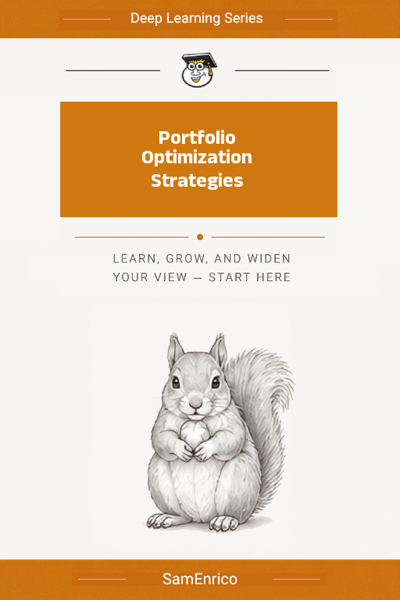
Non-FictionInformativeEducational
Portfolio Optimization Strategies eBook
A Coursebook on Portfolio Optimization Strategies
A Coursebook on Portfolio Optimization Strategies
Formats
Free sample
Chapter 1: The 90/10 Lie--–- The first lie you were told about investing isn't about stock picking, market timing, or hot tips. It's much deeper, and it's costing you a fortune.Sarah had done everything right. A chemical engineer by training, she approached her investment portfolio the same way she approached reactor design: methodically, analytically, and with obsessive attention to detail. Over the course of a decade, she spent roughly two hundred hours researching individual companies. She read annual reports.
She listened to earnings calls. She built discounted cash flow models for thirty-seven different stocks. She tracked insider buying patterns, short interest ratios, and relative strength indicators. She subscribed to three different investment newsletters and cross-referenced their "buy" lists against her own screens.Her friends called her the Oracle of Cincinnati. They asked for stock tips at dinner parties.
Her brother-in-law, a man who once bought a biotech company solely because its name reminded him of a medication that worked for his dog, treated her like a financial wizard.At the end of ten years, Sarah sat down to calculate her performance. She had kept meticulous records. Every trade, every dividend reinvestment, every commission fee—all logged in a color-coded spreadsheet that would have made a Six Sigma black belt weep with joy.The result? She had earned an average annual return of 6.8 percent.Over the same decade, the S&P 500—a mindless, unthinking, utterly passive index that simply buys everything and asks no questions—had returned 10.4 percent per year.Sarah had spent two hundred hours to underperform a monkey throwing darts by 3.6 percentage points annually. Compounded over ten years on a starting portfolio of 500,000,thatgaprepresentedmorethan500,000, that gap represented more than 500,000,thatgaprepresentedmorethan380,000 in foregone wealth.
Three hundred and eighty thousand dollars. For two hundred hours of work. That's an hourly wage of negative $1,900.Sarah had done everything right. And she had lost.This chapter dismantles the most persistent, damaging, and profitable (for Wall Street) lie in all of personal finance: the belief that security selection and market timing matter more than asset allocation. It reveals why your broker's obsession with "hot stocks" is a distraction, why your cousin's cryptocurrency windfall tells you nothing useful, and why the single most important investment decision you will ever make has nothing to do with picking winners.
By the end of this chapter, you will understand the 90/10 rule, the Four Pillars of durable portfolio construction, and why optimization is a process—not a product—that you will either master or be mastered by.The Three Games People Play (And Only One Matters)Walk into any financial advisor's office, open any investing app, or scroll through any finance Twitter feed, and you will encounter three distinct activities masquerading as the same thing. They are not the same. They are not even close. And confusing them is the first step toward financial mediocrity.Game One: Speculation.Speculation is the act of betting on price movements over short time horizons—days, weeks, or months—based on predictions about what other people will do next. It is not investing.
It is a transfer of wealth from the impatient to the patient, from the emotional to the mechanical, and from those who pay transaction costs to those who collect them.Consider the person who buys a cryptocurrency because "it's going to $100,000." Consider the trader who shorts a meme stock because "the fundamentals don't support this valuation." Consider the retiree who buys out-of-the-money options on a biotech company the day before FDA approval announcements. These are speculators. They may win. They may lose. But they are not building wealth—they are gambling, often with the odds stacked against them by bid-ask spreads, transaction fees, and the cold reality that the house (in this case, market makers and high-frequency trading firms) always has better information and faster execution.Speculation has its place.
It provides liquidity to markets. It can be fun, in the same way that a weekend in Las Vegas can be fun. But it is not a portfolio optimization strategy. It is entertainment. And like all entertainment, it should be budgeted for accordingly—which is to say, with money you can afford to lose completely without changing your life.Game Two: Stock Picking.Stock picking is the act of selecting individual securities based on fundamental analysis—earnings, cash flows, competitive advantages, management quality, valuation multiples—with the expectation of outperforming the broader market over multi-year horizons.
This is what Sarah was doing. This is what most people mean when they say they are "investing."Stock picking is seductive because it feels productive. You read a book about Warren Buffett. You learn to calculate free cash flow yield. You develop a thesis about why Company X will dominate its industry.
You buy the stock. When it goes up, you feel smart. When it goes down, you either double down (if you are brave) or sell in despair (if you are honest). The entire process mimics the dopamine loop of a slot machine, but with quarterly earnings reports instead of cherries and bells.The problem with stock picking is not that it never works. It works sometimes.
Warren Buffett made it work spectacularly. So did Peter Lynch, Benjamin Graham, and a handful of others whose names you recognize precisely because they are rare. The problem is that stock picking, for the vast majority of people who attempt it, fails to beat the market after taxes and fees. Not by a little. By a lot.The academic evidence on this point is as close to settled as anything in finance gets.
Studies of professional active fund managers—people with Ivy League degrees, Bloomberg terminals, and teams of analysts—consistently find that the majority underperform their benchmarks over ten-year horizons. The SPIVA (S&P Indices Versus Active) scorecard, published twice annually, has shown for two decades that approximately 85 percent of large-cap active fund managers fail to beat the S&P 500 over ten years. Not 51 percent. Eighty-five percent.If the professionals cannot do it, what chance does the rest of us have?Game Three: Asset Allocation.Asset allocation is the process of deciding how much of your portfolio to place into broad categories of assets—domestic stocks, international stocks, bonds, real estate, commodities, cash—and then rebalancing periodically to maintain those targets. It is boring.
It is mechanical. It cannot be turned into a cable television show or a viral tweet. And it is responsible for approximately 90 percent of the variability in your portfolio's long-term returns.This 90 percent figure comes from a series of landmark studies conducted by Gary Brinson, Randolph Hood, and Gilbert Beebower in the 1980s and 1990s, later confirmed by Roger Ibbotson and Paul Kaplan. They analyzed large pension funds and asked a simple question: what determines the difference in performance between one fund and another? Is it market timing?
Stock selection? Something else?The answer shocked the financial world. More than 90 percent of the variation in a fund's returns over time came from its asset allocation policy—the decision to be 60 percent stocks and 40 percent bonds, for example. Market timing contributed less than 2 percent. Security selection contributed less than 5 percent.
The rest was noise.Let that sink in. Everything you hear about on financial television—the hot stock tips, the technical analysis…
This is the end of the free sample. Get the eBook to keep going. Buy now
About this book
Details
- Author
- Schmitt Dagny
- Publisher
- SamEnrico
- Language
- English
- Genre
- Non-Fiction, Informative, Educational
- Released
- 2026-06-02
- Pages (approx.)
- 147
- Available as
- eBook, Audiobook

Read better in the ZLOADR app
Your eBooks on your phone or tablet. Sign in with your SamEnrico account and start reading.
More by Schmitt Dagny
 Shame Trigger RecoverySchmitt Dagny$11.99
 Progressive Relaxation Trance MethodSchmitt Dagny$11.99
 Geothermal Capital GuideSchmitt Dagny$11.99
 Gut Directed Yoga ProtocolSchmitt Dagny$11.99
 Strength Training Injury PreventionSchmitt Dagny$11.99
 Headache Diary WorkbookSchmitt Dagny$11.99
 Sam Sheppard Trial TimelineSchmitt Dagny$11.99
 Social Media Time BlockingSchmitt Dagny$11.99
 Angry With Anxious PartnerSchmitt Dagny$11.99
 The Trans-Saharan Caravans: The Gold Route of the Soninke TradersSchmitt Dagny$11.99
 The Last Dance of the Sun: How a 19th-Century Eclipse United the WorldSchmitt Dagny$11.99
 The House of Morgan: When Money Moved the WorldSchmitt Dagny$11.99
You may also like
 Hong Kong Handover 1997Dunn Johnnie$11.99
 Zumba For Postnatal Recovery CourseNeal Christian$11.99
 Zumba for BeginnersLadner Nikia$11.99
 YouTube Comment Mining GuideHumes Pandora$12.99
 Worry Box MeditationCarlin Rudy$11.99
 Workplace Stress MeditationNguyen Lynn$11.99
 Workplace Stress and Sleep RepairHawley Ivory$11.99
 Workplace Perfectionism CureDelaney Jeffry$11.99
 Workplace Injustice Anger GuideWallen Isabelle$11.99
 Work Addiction and Burnout LinkGreenwood Ester$11.99
 Women in Yoga and WellnessBeattie Galina$11.99
 Women in Stand Up ComedyChun Evangeline$11.99