
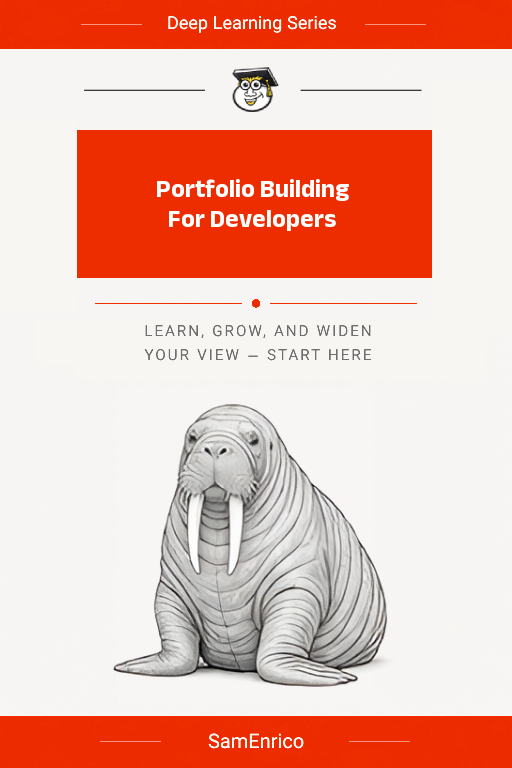
Non-FictionZero-to-One CreatorDeveloper Guide
Portfolio Building For Developers eBook
Build a coding portfolio with zero professional pr
Build a coding portfolio with zero professional projects. This guide covers personal projects, open source contributions, and spec work that passes technical interviews.
Formats
Free sample
Chapter 1: The Resume Lie--Your resume is a lie.Not literally, of course. You probably haven't fabricated a degree or invented a job title that doesn't exist. But here's the uncomfortable truth that career coaches won't tell you: for a developer with zero professional experience, your resume is fundamentally incapable of doing what you need it to do. It lists what you don't have—job titles, years of experience, professional references—while hiding what you do have. It's a document designed to highlight absence, not presence.Every day, thousands of developers with solid skills and genuine potential submit applications into black holes.
They write carefully crafted resumes, customize cover letters, and hit "submit" with hope in their hearts. Then nothing happens. Or worse, they receive the automated rejection: "After careful consideration, we have decided to move forward with other candidates."The problem isn't their ability to code. The problem is that they're playing a game they cannot win. They're competing against candidates who have professional experience, and on a resume, experience always wins.
A junior developer with six months at a startup has something you don't: proof. A bootcamp grad who interned at a local agency has something you don't: a reference. A self-taught coder who built one production app for a real client has something you don't: a story with stakes.But here's what those candidates don't have—and what you can build starting today: a portfolio that makes their experience look irrelevant. Because while a resume asks recruiters to trust you, a portfolio shows them why they should. And that difference is everything.This chapter will completely reframe how you think about your job search.
You're about to discover why your Git Hub portfolio matters more than any resume ever could, how technical recruiters actually evaluate candidates with no professional experience, and why a candidate with a 2.5 GPA and an active Git Hub consistently beats a 4.0 student with an empty profile. More importantly, you'll learn to see your portfolio not as a collection of code, but as a narrative—a story about who you are as an engineer and where you're going.By the end of this chapter, you will have conducted a complete audit of your current Git Hub presence, identified exactly what hiring managers see when they find you, and established a baseline score that you will improve throughout this book. You will understand, perhaps for the first time, that you already have everything you need to start building a career in software development. You just haven't been looking at it the right way.Why Your Resume Is Working Against You Let's start with a simple exercise. Open your resume right now—or imagine the one you would create if you had to.
What does it actually say about you?For most developers with no professional experience, the resume follows a predictable pattern. At the top, your name and contact information. Then an "Education" section listing your degree, bootcamp certificate, or self-directed learning. Then a "Skills" section—a laundry list of programming languages and frameworks you've touched. Then maybe a "Projects" section with three to five bullet points describing things you've built.
Then perhaps "Volunteer Work" or "Leadership" if you're trying to fill space.Now here's the painful question: what does any of that actually prove?Your education section proves you showed up. It proves you completed assignments, passed exams, and satisfied a curriculum designed by people who may not have worked in industry for a decade. It does not prove you can ship code that real users depend on. It does not prove you can debug a production issue at 2 AM. It does not prove you can collaborate with a team of engineers who disagree with your approach.Your skills section proves even less.
Listing "React, Node.js, Postgre SQL, Docker, AWS" on a resume is the digital equivalent of saying "I own a set of kitchen knives"—it doesn't mean you can cook a meal, let alone run a restaurant. Recruiters know this. They see hundreds of resumes with identical skill sections. They've learned to ignore them.Your projects section comes closest to proving something, but even here, the resume format fails you. A bullet point that says "Built a full-stack e-commerce application with user authentication and payment processing" is just words.
Anyone can write those words. There's no evidence that the application actually works, that the authentication is secure, that the payment processing doesn't leak sensitive data, or that you wrote the code yourself rather than copying it from a tutorial.This is the resume problem in a nutshell: your resume asks recruiters to trust you. But in a competitive market with hundreds of applicants for every junior position, trust is the most expensive currency. You don't have it yet. You need to earn it.
And you can't earn it with a PDF full of claims.The 3-5 Minute Rule That Changes Everything Here's what actually happens when you apply for a job.Your application lands in a tracking system alongside two hundred others. A recruiter—often non-technical, always overworked—needs to reduce that two hundred to a shortlist of maybe ten candidates who will proceed to a technical screen. They have perhaps thirty seconds per application if they're thorough. Most spend far less.But here's the pattern that changes everything: for technical roles, recruiters have learned that resumes are unreliable predictors of engineering ability. So they've developed a workaround.
They open your resume, scan for basic qualifications (do you know what a programming language is?), and then they go straight to your Git Hub.Not your Linked In. Not your personal website. Your Git Hub.And they don't spend thirty seconds there. According to hiring data from several major tech companies, technical recruiters spend an average of three to five minutes on a candidate's Git Hub before they decide whether to proceed. Three to five minutes.
That's longer than they spend on your resume. That's longer than they spend on your cover letter. That's longer than they spend on any other single artifact in your application.What are they looking for in those three to five minutes? Let me walk you through the mind of a recruiter opening your Git Hub profile for the first time.First, recency of activity. When was your last commit?
If it was more than three months ago, recruiters will assume you've stopped coding. If it was more than six months ago, they'll assume you never really started. Consistent activity signals that you're engaged, learning, and treating development as a craft rather than a chore. A green contribution graph—even with small commits—is a powerful signal.Second, quality of READMEs. This is the first thing they'll open.
They won't clone your repository—they don't have time. They won't run your code—they don't have the environment set up. They will read your README. If it's empty, incomplete, or clearly copied from a tutorial template, you've already lost them. If it's clear, comprehensive, and professional, you've passed the first test.
(We'll spend all of Chapter 6 on exactly how to write a README that gets you hired.)Third, organization of repositories. Do you have one repository called "misc-projects" containing…
This is the end of the free sample. Get the eBook to keep going. Buy now
About this book
Details
- Author
- Houghton Roxana
- Publisher
- SamEnrico
- Language
- English
- Genre
- Non-Fiction, Zero-to-One Creator, Developer Guide
- Released
- 2026-05-30
- Pages (approx.)
- 144
- Available as
- eBook, Audiobook

Read better in the ZLOADR app
Your eBooks on your phone or tablet. Sign in with your SamEnrico account and start reading.
More by Houghton Roxana
 Gambia Independence 1965Houghton Roxana$11.99
 Fisetin Brain Aging GuideHoughton Roxana$11.99
 Migraine and Pregnancy GuideHoughton Roxana$11.99
 Elderly Parent Financial GuideHoughton Roxana$11.99
 Validation Phrases HandbookHoughton Roxana$11.99
 Feelings Vocabulary BuilderHoughton Roxana$11.99
 Assertiveness for Introverts CourseHoughton Roxana$11.99
 Endowment Effect ExplainedHoughton Roxana$11.99
 First Date Nonverbal GuideHoughton Roxana$11.99
 Whirlwind Prophecy: The Storm That Split a KingdomHoughton Roxana$11.99
 The Silk Road Conspiracy: How a Darknet Kingpin FellHoughton Roxana$11.99
 Bones of the Forgotten: The Hound of PompeiiHoughton Roxana$11.99
You may also like
 Hong Kong Handover 1997Dunn Johnnie$11.99
 Zumba For Postnatal Recovery CourseNeal Christian$11.99
 Zumba for BeginnersLadner Nikia$11.99
 YouTube Comment Mining GuideHumes Pandora$12.99
 Worry Box MeditationCarlin Rudy$11.99
 Workplace Stress MeditationNguyen Lynn$11.99
 Workplace Stress and Sleep RepairHawley Ivory$11.99
 Workplace Perfectionism CureDelaney Jeffry$11.99
 Workplace Injustice Anger GuideWallen Isabelle$11.99
 Work Addiction and Burnout LinkGreenwood Ester$11.99
 Women in Yoga and WellnessBeattie Galina$11.99
 Women in Stand Up ComedyChun Evangeline$11.99