
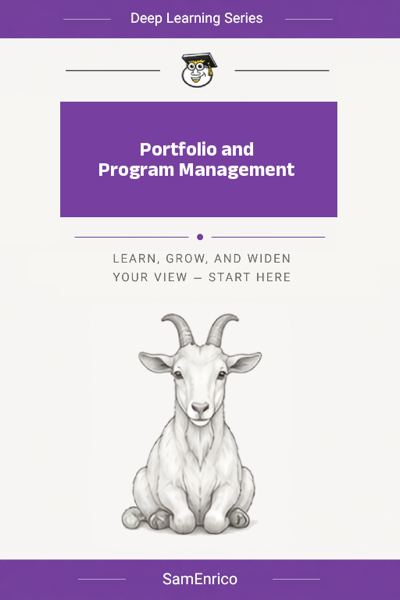
Non-FictionInformativeEducational
Portfolio and Program Management eBook
A Coursebook on Portfolio and Program Management
A Coursebook on Portfolio and Program Management
Formats
Free sample
Chapter 1: The Strategy Trap--–- The email arrived at 11:47 PM on a Tuesday. Maya Chen had been staring at her screen for fourteen hours, watching red after red after red flash across her portfolio dashboard. Forty-seven active projects. Sixty-three percent behind schedule. A projected budget overrun of $12 million.
And the CEO, fresh from a disastrous board meeting, had just given her seventy-two hours to “fix it.” The message was brief, brutal, and unsigned: “Come to my office Friday at 8 AM. Bring answers. Not excuses.”Maya leaned back in her chair and looked at the framed photo on her desk—her team at the annual innovation awards, two years ago, when everything had felt possible. They had just launched a product that worked perfectly. On time.
Under budget. The celebration had lasted a week. Then the sales numbers came in. Zero. Not slow.
Zero. The product solved a problem that the market had quietly stopped caring about three months before launch, but no one had told Engineering. No one had asked Marketing. No one had looked up from their Gantt charts long enough to ask the only question that mattered: Are we building the right thing?That was the day Maya first understood the difference between managing projects and managing a portfolio. The project team had done everything right.
The portfolio had done everything wrong.The High Cost of Flawless Execution Every week, somewhere in the world, a project team celebrates a perfect delivery. They hit every milestone. They respected every budget. Their post-implementation review is a glowing testament to disciplined project management. And then, six months later, the project is quietly retired.
No one uses the software. The new process is ignored. The expected cost savings never materialize. The company writes off millions and moves on, never quite connecting the dots between their celebration and their disappointment.This phenomenon is so common that it has a name in portfolio management circles: the successful failure.A successful failure occurs when a project meets all its tactical objectives—on time, on budget, to specification—but fails to deliver any strategic value to the organization. The project was done right.
But it was the wrong project to do in the first place.Consider the case of a global consumer goods company that spent $87 million over eighteen months to build a state-of-the-art inventory management system. The project was a textbook example of disciplined execution. Requirements were signed off. Testing was rigorous. The system went live with fewer than twenty critical defects.
The project manager received a bonus and a promotion. Six months later, the system was being used at less than 15 percent of its intended capacity. Why? Because during those eighteen months, the company had shifted its go-to-market strategy from wholesale distribution to direct-to-consumer e-commerce. The inventory system was designed for a business model that no longer existed.
The project succeeded. The strategy failed.This is the central problem that portfolio management exists to solve. Project management answers the question: Are we doing things right? Portfolio management answers a more fundamental question: Are we doing the right things? And until you can answer the second question with confidence, the first question is almost irrelevant.Defining the Hierarchy: Projects, Programs, and Portfolios Before we can fix what is broken, we need a shared language.
The discipline of strategic execution rests on three distinct but interconnected concepts. Confusing them is the first step toward the strategy trap.The Project: A Finite Container of Work A project is a temporary endeavor undertaken to create a unique product, service, or result. It has a defined beginning and end. It operates within constraints of scope, time, cost, and quality. It delivers an output—something tangible, measurable, and verifiable.Examples of projects include:Building a new warehouse Implementing a software module Launching a marketing campaign Redesigning a website Obtaining a regulatory certification Projects are the atomic units of work in any organization.
They are how strategy gets executed. But they are also dangerously myopic. A project manager is rewarded for delivering the output. No project manager is ever rewarded for asking: But should we be building this at all? That is not their job.
That is the job of portfolio management.The Program: Coordinated Change for Strategic Benefit A program is a collection of related projects managed in a coordinated way to obtain benefits and control not available from managing them individually. Programs exist to achieve something that a single project cannot—typically, a significant strategic outcome that requires multiple capabilities to come together.A digital transformation program might include:A project to replace legacy customer databases (IT)A project to retrain frontline staff (HR)A project to redesign customer touchpoints (Marketing)A project to update privacy policies (Legal)Each project delivers its own output. But the program delivers something larger: an outcome. In this case, the outcome might be “seamless omnichannel customer experience.” And from that outcome, the organization realizes benefits—measurable improvements in performance, such as 20 percent higher customer retention or $5 million in reduced service costs.The critical distinction here is between outputs (what projects produce), outcomes (what programs achieve), and benefits (the measurable value those outcomes generate). We will spend an entire chapter on benefits realization later in this book.
For now, understand this: projects produce. Programs coordinate. Portfolios prioritize.The Portfolio: The Strategic Container A portfolio is a collection of all projects and programs within an organization, grouped together to facilitate effective management and strategic alignment. The portfolio is not just a bucket. It is a decision-making engine.
The portfolio answers three questions continuously:Selection: Of all possible initiatives, which ones should we fund?Prioritization: Given our limited resources, what order should we do them in?Optimization: As conditions change, what should we stop, start, or change?The portfolio is owned by the organization’s leadership—not by any single project or program manager. While a project manager cares about their specific deliverable, and a program manager cares about their coordinated outcome, the portfolio manager (or Portfolio Direction Group, as we will explore in Chapter 2) cares about the whole system. They are the only role in the hierarchy whose primary responsibility is saying no.The Strategic Execution Framework Now that we have defined the building blocks, we can assemble them into the framework that guides this entire book. The Strategic Execution Framework has four stages, and every stage connects to the next. Break any connection, and the entire system fails.Stage 1: Strategy Strategy is the set of choices an organization makes about where to compete and how to win.
It answers questions like: What markets do we serve? What differentiates us? What are our five-year goals? Strategy is the input to the entire execution engine. Without a clear strategy, portfolio management is impossible—you cannot align work to a destination you have not defined.Most organizations have a strategy document.
Many have beautiful strategy documents. The problem is not the absence of strategy. The problem is the gap between strategy and the work that follows.Stage 2: Portfolio The portfolio is the bridge from strategy to execution. The portfolio management function takes the strategy as input and produces a prioritized, resourced, and approved set of initiatives as…
This is the end of the free sample. Get the eBook to keep going. Buy now
About this book
Details
- Author
- Arrington Zandra
- Publisher
- SamEnrico
- Language
- English
- Genre
- Non-Fiction, Informative, Educational
- Released
- 2026-06-02
- Pages (approx.)
- 151
- Available as
- eBook, Audiobook

Read better in the ZLOADR app
Your eBooks on your phone or tablet. Sign in with your SamEnrico account and start reading.
More by Arrington Zandra
 Venture Capitalist Stress GuideArrington Zandra$11.99
 The St Bartholomew Day MassacreArrington Zandra$11.99
 Pre Surgery RelaxationArrington Zandra$11.99
 Imposter to Owner MindsetArrington Zandra$11.99
 Chronic Constipation GuideArrington Zandra$11.99
 Shamanic Journey Leadership CourseArrington Zandra$11.99
 Spouse Listening RepairArrington Zandra$11.99
 Self Talk For FibromyalgiaArrington Zandra$11.99
 Kenya Tourism Grant GuideArrington Zandra$11.99
 The Silent Choir: The Unseen Influence of the Raëlian MovementArrington Zandra$11.99
 The First Cosmic Seers: Ancient Astronomers and the Birth of the UniverseArrington Zandra$11.99
 The Battle of Talas: The Silk Road's Turning PointArrington Zandra$11.99
You may also like
 Hong Kong Handover 1997Dunn Johnnie$11.99
 Zumba For Postnatal Recovery CourseNeal Christian$11.99
 Zumba for BeginnersLadner Nikia$11.99
 YouTube Comment Mining GuideHumes Pandora$12.99
 Worry Box MeditationCarlin Rudy$11.99
 Workplace Stress MeditationNguyen Lynn$11.99
 Workplace Stress and Sleep RepairHawley Ivory$11.99
 Workplace Perfectionism CureDelaney Jeffry$11.99
 Workplace Injustice Anger GuideWallen Isabelle$11.99
 Work Addiction and Burnout LinkGreenwood Ester$11.99
 Women in Yoga and WellnessBeattie Galina$11.99
 Women in Stand Up ComedyChun Evangeline$11.99