
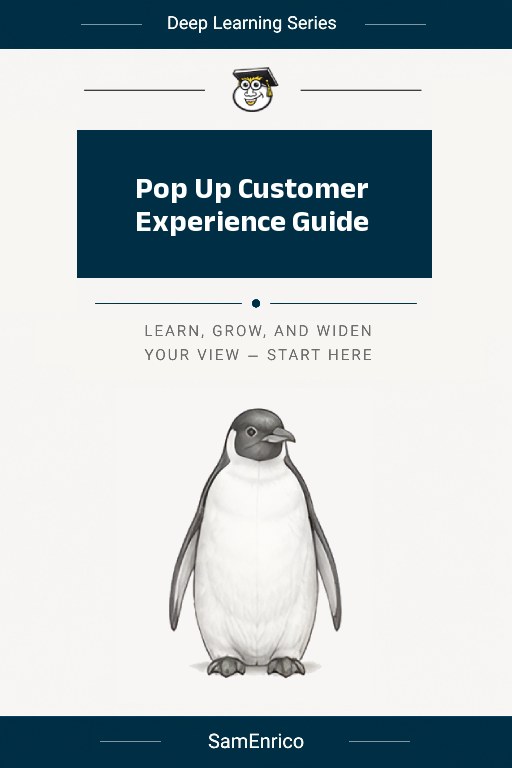
Non-FictionBusiness BriefCustomer Experience
Pop Up Customer Experience Guide eBook
Designs memorable customer journeys for temporary
Designs memorable customer journeys for temporary stores across three cities including product testing, photo ops, and loyalty sign-ups.
Formats
Free sample
Chapter 1: The Funeral Loophole--–- The morning my flagship store died, I learned why temporary always beats permanent.The email arrived at 6:42 AM on a Tuesday. "Final walkthrough scheduled for 10 AM. Please bring keys." That was it. Eleven months earlier, I had cut a ribbon in front of that store. Two hundred and seventeen thousand dollars in build-out costs.
A ten-year lease I had personally guaranteed. And now I was being asked to bring keys—not to celebrate an anniversary, but to surrender a corpse.The store was beautiful. White oak floors, custom millwork, perfect lighting. We had hired the same firm that designed Warby Parker's first locations. We had a coffee bar.
We had a lounge with velvet chairs. We had everything except one thing: customers who came back after the first week.Opening day was chaos in the best way. Line around the block. Influencers posing everywhere. We sold out of three SKUs before lunch.
The team was ecstatic. I remember standing in the back room, watching the inventory spreadsheet turn green, thinking "This is it. This is the proof." We framed the first dollar bill. We took a hundred photos. We posted the obligatory "pinch me" caption on Instagram.Then week two happened.
Foot traffic dropped by 60 percent. Week three, another 30 percent. By month two, we were paying rent for a space that felt like a mausoleum. The velvet chairs were full—of people on their phones, not buying. The coffee bar was busy—with people who took their free latte and left.
We had built a beautiful hangout spot. We had not built a machine that acquired customers.The post-mortem was brutal. We analyzed everything: the location, the signage, the product assortment, the pricing. We hired consultants. We ran surveys.
We changed the window display three times. Nothing worked. The store had become invisible to the people who walked past it every day. Not because it was ugly—because it was permanent.That is the lie that the retail industry has been selling for a hundred years. The lie is that permanence builds trust, that a long-term lease signals stability, that customers want to know you'll be there tomorrow.
The truth is the opposite. Permanence breeds complacency—in the customer and in the brand. When a store is always there, there's no reason to go today. When a store is always there, there's no urgency, no excitement, no FOMO. When a store is always there, it becomes furniture.
And nobody gets excited about furniture.The funeral of my flagship store was attended by exactly three people: me, my lawyer, and the landlord's property manager. No ribbon cutting. No influencers. No "pinch me" captions. Just a man with a key ring and a clipboard, noting the scuff marks on the white oak floors.
I walked out with a cardboard box of personal items and a realization that would take me three more years to fully articulate: the most valuable store is the one that disappears.This is the Funeral Loophole.The Scarcity Paradox Let me be precise about what I mean, because "scarcity" is one of those words that gets thrown around so often it loses meaning. I am not talking about artificial scarcity—the fake "only 3 left" countdown timers on Shopify that everyone knows are automated lies. I am talking about structural scarcity: the kind that emerges naturally when something is designed to end.Behavioral economists have known this for decades. In a famous study by Worchel, Lee, and Adewole (1975), researchers gave participants cookies from two identical jars. One jar had ten cookies.
The other had two. Participants rated the cookies from the near-empty jar as significantly more desirable—even though the cookies were exactly the same. The scarcity wasn't in the product. It was in the context.This is the principle that pop-ups exploit, but most brands get it backwards. They think scarcity means "limited quantity." So they launch a "limited edition" product, sell out in an hour, and pat themselves on the back.
That's not scarcity. That's just small batch production. The real power of scarcity comes from limited time, not limited units. Because time scarcity affects the customer's behavior directly: if the store closes in three days, you cannot procrastinate. You must go now, or you lose the opportunity forever.My flagship store had no closing date.
It was a permanent fixture in the neighborhood. That meant every customer who walked past it could think, "I'll go next week." And then next week became next month. And next month became never. The store was always there, so it was never urgent.The pop-up, by contrast, announces its own death at the moment of its birth. The closing date is on the invitation.
The ephemerality is the marketing. And that ephemerality creates a psychological condition that permanent retail cannot replicate: the customer knows that if they don't act, the opportunity vanishes.This is the Funeral Loophole. You build something beautiful, you open the doors, and then you tell everyone exactly when it will die. And that death date becomes the engine of your success.The Four Strategic Objectives Not every pop-up should be built the same way. In my years of studying this space—and in the painful process of learning from my own failures—I have identified four distinct strategic objectives for temporary retail.
These are adapted from the academic framework developed by Warnaby and Shi, but I have translated them from academic language into something you can actually use.Objective One: Testing You have a new product. You think it's going to be huge. Your focus groups say yes. Your internal team is excited. But focus groups are liars.
People tell you what they think you want to hear. They are polite. They are hypothetical. They have never had to hand over their credit card.A testing pop-up solves this by observing behavior instead of asking for opinions. You set up a physical space, you put the product in front of real people, and you watch what they do.
Do they pick it up? How long do they hold it? Do they look at the price tag and flinch? Do they seek out a staff member with questions? Do they buy?The testing pop-up is not designed to maximize sales.
In fact, low sales in a testing pop-up are valuable data—they tell you to kill the product before you spend millions on production. The testing pop-up is designed to answer one question: does this product deserve to exist?Objective Two: Launching You have a product that is already validated. Maybe it's your core offering. Maybe it's a collaboration with a celebrity or another brand. The goal here is not to test—you already know people want it.
The goal is to create a cultural moment.A launching pop-up is a media event disguised as a store. It is designed to generate buzz, attract influencers, and create content that spreads across social platforms. The physical space is secondary to the digital footprint it produces. You are not selling products; you are selling the story of the products.This is the kind of pop-up that Glossier perfected. Their pop-ups were not about inventory turnover.…
This is the end of the free sample. Get the eBook to keep going. Buy now
About this book
Details
- Author
- Pacheco Farrah
- Publisher
- SamEnrico
- Language
- English
- Genre
- Non-Fiction, Business Brief, Customer Experience
- Released
- 2026-05-29
- Pages (approx.)
- 138
- Available as
- eBook, Audiobook

Read better in the ZLOADR app
Your eBooks on your phone or tablet. Sign in with your SamEnrico account and start reading.
More by Pacheco Farrah
 The DESC Script MethodPacheco Farrah$11.99
 HRT For Women With Seizure Disorders CoursePacheco Farrah$11.99
 Creative Starvation DietPacheco Farrah$11.99
 Walking Program for Back HealthPacheco Farrah$11.99
 Telemedicine Capital ForecastPacheco Farrah$11.99
 Panic in the Petting Zoo: The Great San Diego Escape of 1985Pacheco Farrah$11.99
 PayPal Withdrawal Methods GuidePacheco Farrah$12.99
 Understanding Peroxisomal DefectsPacheco Farrah$17.99
 Technical Sales Support AssociatePacheco Farrah$11.99
 How to Start a Tire Retreading BusinessPacheco Farrah$11.99
You may also like
 Hong Kong Handover 1997Dunn Johnnie$11.99
 Zumba For Postnatal Recovery CourseNeal Christian$11.99
 Zumba for BeginnersLadner Nikia$11.99
 YouTube Comment Mining GuideHumes Pandora$12.99
 Worry Box MeditationCarlin Rudy$11.99
 Workplace Stress MeditationNguyen Lynn$11.99
 Workplace Stress and Sleep RepairHawley Ivory$11.99
 Workplace Perfectionism CureDelaney Jeffry$11.99
 Workplace Injustice Anger GuideWallen Isabelle$11.99
 Work Addiction and Burnout LinkGreenwood Ester$11.99
 Women in Yoga and WellnessBeattie Galina$11.99
 Women in Stand Up ComedyChun Evangeline$11.99