
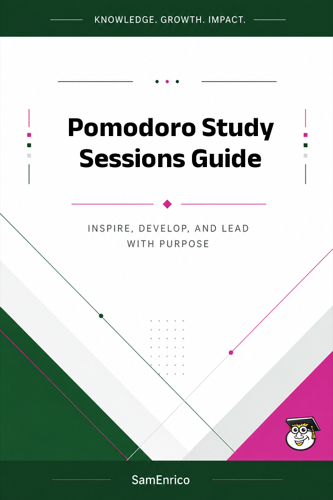
Non-FictionSelf-HelpTime Management
Pomodoro Study Sessions Guide eBook
Structure study time into focused intervals with b
Structure study time into focused intervals with breaks to optimize concentration.
Formats
Free sample
Chapter 1: The Marathon Lie--–- Jordan was a straight-A student until sophomore year of college. Then something broke. He would walk into the library at 6:00 PM, spread his textbooks across a massive oak table, open his laptop to a blank document, and declare war on organic chemistry. Four hours later, at 10:00 PM, he would pack up his bags, having accomplished roughly forty-five minutes of actual study. The rest of the time was a fog of phone checks, You Tube rabbit holes, snack runs, and staring at the same paragraph seventeen times without understanding a single word.Jordan's crime was not laziness.
He was not scrolling Tik Tok because he lacked discipline. He was scrolling because he believed, with every fiber of his academic conditioning, that good students study for hours without stopping. His high school teachers had praised him for "putting in the time." His parents bragged about his late-night study sessions. His college roommate measured success by how many coffee cups accumulated on the desk.Jordan was running a marathon he was never designed to finish.And so are you.This book exists because the marathon model of studying is not just inefficient—it is actively destructive. It burns out your brain, ruins your retention, and convinces you that you are lazy when in fact you are simply human.
The Pomodoro Technique, which you will master over the next twelve chapters, is not a productivity hack. It is a cognitive workout plan. And like any workout plan, it requires intervals of intense effort followed by deliberate rest.But before we get to the solution, we must fully understand the problem. Because you cannot fix what you refuse to see.The Cultural Addiction to Duration Let us name the enemy. Call it the Marathon Myth—the deeply embedded belief that longer study sessions produce better results.
This myth is reinforced everywhere you look.In high school, you were told to study for "two hours per night" without any guidance on what studying actually means. In college, the library stays open until 2:00 AM, as if the universe were rewarding your sleep deprivation. On social media, "study with me" videos show students sitting at desks for twelve-hour stretches, their time-lapsed videos compressing a day of suffering into ninety seconds of inspiration.Here is what those videos do not show: the seventeen bathroom breaks, the forty-three phone checks, the ninety minutes of staring blankly at a textbook while thinking about lunch, and the crushing guilt that follows a day of "studying" that produced almost nothing.The Marathon Myth operates on a seductive logic: more time equals more learning. If I study for four hours, I will learn four times as much as someone who studies for one hour. This seems mathematically sound.
It is also catastrophically wrong.Decision Fatigue: The Hidden Drain In 1998, the social psychologist Roy Baumeister conducted a now-famous experiment. He placed two groups of people in a room filled with the smell of freshly baked chocolate chip cookies. One group was allowed to eat the cookies. The other group was told to eat radishes instead—while the cookies sat on the table, inches away, taunting them. Afterward, both groups were given a set of difficult puzzles to solve.The cookie-eaters worked on the puzzles for about nineteen minutes on average.
The radish-eaters—the ones who had to exert willpower to resist the cookies—gave up after barely eight minutes.Baumeister called this ego depletion, now more commonly known as decision fatigue. The radish-eaters had already spent their limited supply of self-control resisting cookies. They had nothing left for the puzzles.Your brain works exactly the same way during a study session.Every time you force yourself to stay focused, resist a distraction, or push through boredom, you are burning a finite resource. This resource is not metaphorical. The prefrontal cortex—the part of your brain responsible for focus, decision-making, and impulse control—runs on glucose.
Intense cognitive work consumes glucose at a remarkable rate. After about ninety minutes of continuous focus, your prefrontal cortex begins to signal fatigue. Not because you are weak. Because you are metabolically empty.The Marathon Myth tells you to push through this fatigue. That is like telling a marathon runner to keep sprinting after their legs have given out.
You can do it for a short time, but the cost is enormous. Your focus becomes shallow. Your retention collapses. And you begin making mistakes you would never make when fresh.Attentional Residue: The Invisible Tax There is another, even more insidious cost to long study sessions: something researchers call attentional residue.Here is how it works. Imagine you are writing an essay.
Then you stop to check a text message. You read the message, maybe respond, then return to your essay. How long does it take for your brain to fully re-engage with the essay?The answer, according to research by Sophie Leroy at the University of Washington, is that a piece of your attention remains stuck on the previous task. You might be reading words on the screen, but part of your cognitive processing is still thinking about that text message. This is attentional residue.
It accumulates like layers of dust on a window. After enough task switches, you are not really focused on anything. You are just cycling through shallow attention states.Here is the cruel math: a four-hour study session with frequent task-switching might contain less than ninety minutes of actual focused attention. The other two and a half hours are lost to residue, recovery time, and the slow erosion of your cognitive capacity.The Pomodoro Technique, which you will learn in detail throughout this book, solves this problem not by eliminating distractions—that is impossible—but by structuring them. You will learn to work in short, intense sprints followed by deliberate breaks.
During the sprint, nothing exists except the task. During the break, you are free to check your phone, stretch, or daydream. The key is that the boundary between focus and rest is clean. No residue. No guilt.
No slow death by a thousand interruptions.The Dopamine Trap There is a reason you check your phone every few minutes, and it is not because you lack discipline. It is because your brain has been hijacked by one of the most powerful chemical feedback loops ever engineered.Dopamine is often described as the "pleasure chemical," but that is not quite right. Dopamine is the anticipation chemical. It is released when your brain expects a reward, not necessarily when you receive one. This is why checking your phone feels so compelling: the possibility of a new notification—a like, a message, a ping—creates a small spike of dopamine.
The uncertainty makes it even more powerful. Will there be something? Maybe. Better check.Now consider what happens during a long study session. You are bored.
Your dopamine baseline drops. The phone on your desk promises a quick spike. You check it. Nothing important. But the act of checking has already released a small burst of dopamine.
Your brain learns: the phone = dopamine. So you check again. And again.This is not a moral failure. This is neurochemistry.The problem is that dopamine spikes…
This is the end of the free sample. Get the eBook to keep going. Buy now
About this book
Details
- Author
- Mccorkle Jannette
- Publisher
- SamEnrico
- Language
- English
- Genre
- Non-Fiction, Self-Help, Time Management
- Released
- 2026-06-09
- Pages (approx.)
- 129
- Available as
- eBook, Audiobook

Read better in the ZLOADR app
Your eBooks on your phone or tablet. Sign in with your SamEnrico account and start reading.
More by Mccorkle Jannette
 The Therapist Body ScanMccorkle Jannette$11.99
 Kigali CleanTech Startup ManualMccorkle Jannette$11.99
 Secondhand Stress Immunity BuildingMccorkle Jannette$11.99
 The Sea Surgeon: Dr. Victor Chang and the Heart Transplant Revolution in the Indian OceanMccorkle Jannette$11.99
 Testosterone and Kidney DiseaseMccorkle Jannette$11.99
 The Last Call: The Untold Story of the 2008 Financial Crisis' Secret BailoutMccorkle Jannette$11.99
 Understanding Charcot–Marie–tooth Disease, X-linked Type 2, RecessiveMccorkle Jannette$17.99
 How to Become a BurnerMccorkle Jannette$11.99
 Front Counter Crew MemberMccorkle Jannette$11.99
 Tourism Cooperative GuideMccorkle Jannette$12.99
 Perth Study And PR GuideMccorkle Jannette$12.99
You may also like
 Hong Kong Handover 1997Dunn Johnnie$11.99
 Zumba For Postnatal Recovery CourseNeal Christian$11.99
 Zumba for BeginnersLadner Nikia$11.99
 YouTube Comment Mining GuideHumes Pandora$12.99
 Worry Box MeditationCarlin Rudy$11.99
 Workplace Stress MeditationNguyen Lynn$11.99
 Workplace Stress and Sleep RepairHawley Ivory$11.99
 Workplace Perfectionism CureDelaney Jeffry$11.99
 Workplace Injustice Anger GuideWallen Isabelle$11.99
 Work Addiction and Burnout LinkGreenwood Ester$11.99
 Women in Yoga and WellnessBeattie Galina$11.99
 Women in Stand Up ComedyChun Evangeline$11.99