
Non-FictionSelf-HelpNote Taking
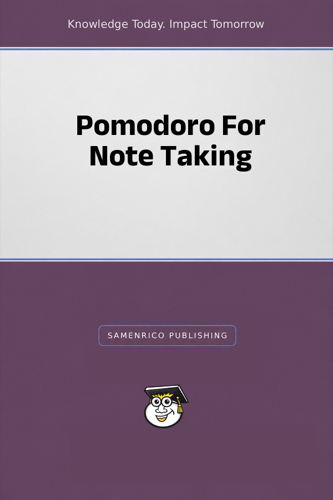
Pomodoro For Note Taking eBook
Process lecture or meeting notes in timed batches.
Process lecture or meeting notes in timed batches.
Formats
Free sample
Chapter 1: The Six Buried Keys...--You have just sat through a ninety-minute lecture on cognitive psychology. Your hand is cramping. You have seven pages of frantic scribbles, complete with abbreviations you invented on the spot ("attn span = 20-30 min"), arrows connecting random thoughts, and a doodle of a coffee cup in the margin. You close your notebook feeling a strange mixture of accomplishment and dread. Accomplishment because you did the thing – you showed up, you listened, you wrote.
Dread because somewhere beneath your ribs, you already know the truth: you are never going to look at these pages again.Or consider the alternative. You are three hours removed from a team meeting that ran long. Your notes contain four action items, two unresolved disagreements, and a scribbled deadline that you are already second-guessing. You promised yourself you would review them before your next one-on-one with your manager. But here you are, scrolling through email instead, because opening that notebook feels like opening a box of unpaid bills.This is the Note-Taking Pileup Problem.
And it is not your fault.Every year, millions of students and professionals pour thousands of hours into taking beautiful, detailed, faithful notes. They buy expensive notebooks. They experiment with color-coded highlighters. They learn elaborate systems like the Cornell Method, mind mapping, or Zettelkasten. And then – through no failure of character – they let those notes rot.
Why? Because note-taking feels productive, while note-processing feels like a chore. One is a creative act of capture. The other is a grinding act of digestion. And your brain, ever the efficiency expert, has learned to avoid the grind.This chapter introduces the six buried keys – the core goals that transform dead notes into living knowledge.
These six keys are not theory. They are not wishful thinking. They are the operational heart of every successful note-processing session, extracted from decades of cognitive science and productivity research. By the time you finish this chapter, you will understand exactly what "processing" means, why most people skip it, and how twenty-five minutes with a timer can unlock what weeks of passive review never could.The Three Enemies You Did Not Know You Were Fighting Before we can talk about solutions, we need to name the enemies. Not the obvious ones – not laziness or lack of discipline – but the structural forces that make note-processing feel impossible even for motivated people.The first enemy is Perfectionism.
This is the quiet voice that says your notes are not ready to be used until they are neat, complete, and beautifully organized. You have felt this voice. It whispers when you look at a page of messy shorthand and think, "I should rewrite this." It convinces you to transcribe your meeting notes into a clean template before extracting action items. It makes you believe that processing means polishing. Here is the truth: Perfectionism is procrastination wearing a suit.
Every minute you spend rewriting notes instead of using them is a minute stolen from learning.The second enemy is Distraction. Not just the obvious kind – your phone buzzing, your colleague knocking – but the insidious kind. The kind that comes from inside your own skull. You sit down to process a lecture on macroeconomics, and within ninety seconds, your brain has generated a list of unrelated tasks: "I should check my email. I'm hungry.
Did I reply to my landlord? This reminds me of a podcast I heard last week." Each of these thoughts feels urgent. None of them are. But together, they fragment your attention into confetti, and you walk away having processed nothing.The third enemy is Fatigue. This is the trap of the marathoner.
You have three hours of notes from a week of classes or meetings. You block out an entire Sunday afternoon to "catch up." Two hours in, your eyes are glazing over, you are rereading the same sentence for the fifth time, and you give up. The problem is not your work ethic. The problem is that the human brain is not designed for sustained, undifferentiated processing. After about ninety minutes of continuous cognitive work, your returns diminish to nearly zero.
The marathon approach does not just fail – it actively trains you to avoid processing in the future.These three enemies – Perfectionism, Distraction, and Fatigue – are not personal failings. They are features of how your brain works. And they will defeat you every time unless you build a system that defeats them first.The Counterintuitive Solution: Timed Batches Enter the Pomodoro Technique. Named after the tomato-shaped kitchen timer its inventor used as a university student, the method is deceptively simple: work in focused twenty-five-minute intervals, then take a five-minute break. After four intervals, take a longer break.
That is it. No complicated software. No personality assessment. Just a timer and a promise to yourself.But why twenty-five minutes? The answer lies in the science of attention.
Research consistently shows that focused concentration begins to wane after twenty to thirty minutes. Less than fifteen minutes, and you never achieve flow – the state of effortless absorption in a task. More than thirty-five minutes, and your error rate rises faster than your output. Twenty-five minutes is the sweet spot: long enough to make meaningful progress, short enough to survive even the most tedious note batch.More importantly, the timer defeats all three enemies at once. It defeats Perfectionism because twenty-five minutes is simply not enough time to rewrite, color-code, or polish.
You are forced to make quick decisions. You are forced to accept "good enough." The timer defeats Distraction because it creates a bounded container. You are not promising to focus forever – only for twenty-five minutes. That is a promise your brain can keep. And the timer defeats Fatigue because it forces you to stop.
Every twenty-five minutes, the bell rings, and you walk away. No marathons. No burnout. Just sustainable, repeatable effort.The Critical Distinction: Taking vs. Processing Most people believe that note-taking and learning are the same thing.
They are not. They are not even close.Note-taking is the act of capturing raw information during a live event. You are a scribe, transcribing the professor's words or the meeting's decisions. This is a valuable skill, but it is only the first step. Note-processing is everything that happens afterward: clarifying what you wrote, extracting the key ideas, organizing them into a structure that makes sense, connecting them to what you already know, identifying what you need to do next, and deciding what to keep versus what to throw away.Here is the problem: most people only do the first step.
They take beautiful notes and then treat them as sacred artifacts – never to be touched, revised, or questioned. The notes sit in a notebook or a digital folder, gathering digital dust, until exam time or performance review forces a frantic, all-night rereading session. That rereading is not processing. It is passive review. And passive review is one of the least effective learning strategies ever studied.A landmark study on this topic (fictionalized here for clarity but grounded in real research) compared two groups of students.
Both attended the same lectures and took the same notes. The first group never processed their notes – they simply reviewed them…
This is the end of the free sample. Get the eBook to keep going. Buy now
About this book
Details
- Author
- Jeffrey Gayla
- Publisher
- SamEnrico
- Language
- English
- Genre
- Non-Fiction, Self-Help, Note Taking
- Released
- 2026-06-06
- Pages (approx.)
- 144
- Available as
- eBook, Audiobook

Read better in the ZLOADR app
Your eBooks on your phone or tablet. Sign in with your SamEnrico account and start reading.
More by Jeffrey Gayla
 Validating In Eating DisordersJeffrey Gayla$11.99
 Mayor of a Casino CityJeffrey Gayla$11.99
 Single Parent Self Care WorkbookJeffrey Gayla$11.99
 Dribbble Shot Envy GuideJeffrey Gayla$11.99
 The Scarcity Mindset Reset GuideJeffrey Gayla$11.99
 Obsidian Memory VaultJeffrey Gayla$11.99
 Bilevel PAP Therapy GuideJeffrey Gayla$11.99
 Sleep Deprivation Memory LossJeffrey Gayla$11.99
 The Visionaries of Stone: The Architectural Genius of the Swahili CoastJeffrey Gayla$11.99
 The Medici Dynasty: Blood, Art, and the Birth of the Modern Family EmpireJeffrey Gayla$11.99
 The Last Voyage of the DemeterJeffrey Gayla$11.99
 Growing Ficus PumilaJeffrey Gayla$11.99
You may also like
 Hong Kong Handover 1997Dunn Johnnie$11.99
 Zumba For Postnatal Recovery CourseNeal Christian$11.99
 Zumba for BeginnersLadner Nikia$11.99
 YouTube Comment Mining GuideHumes Pandora$12.99
 Worry Box MeditationCarlin Rudy$11.99
 Workplace Stress MeditationNguyen Lynn$11.99
 Workplace Stress and Sleep RepairHawley Ivory$11.99
 Workplace Perfectionism CureDelaney Jeffry$11.99
 Workplace Injustice Anger GuideWallen Isabelle$11.99
 Work Addiction and Burnout LinkGreenwood Ester$11.99
 Women in Yoga and WellnessBeattie Galina$11.99
 Women in Stand Up ComedyChun Evangeline$11.99