
Non-FictionSelf-HelpManagement
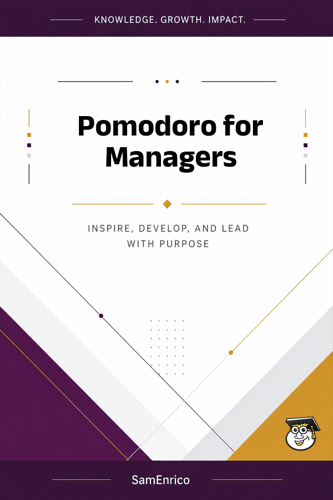
Pomodoro for Managers eBook
Fits technique into meeting heavy days.
Fits technique into meeting heavy days.
Formats
Free sample
Chapter 1: The Zombie Manager--The average manager attends 32 hours of meetings per week, speaks for approximately 14 of those hours, makes roughly 87 decisions, and at 5:00 PM on Friday cannot name a single meaningful thing they accomplished.This is not a failure of willpower, intelligence, or work ethic. It is a failure of container design.You are not lazy. You are not disorganized. You are not secretly bad at your job. You are leading inside a system that was built for a different century, a different role, and a different brain.
The factory clock that gave us the 60-minute meeting block was designed for assembly lines and shift changes, not for executive function, strategic thinking, or the delicate architecture of human attention. And yet you have inherited it as if it were natural law.Let me introduce you to a term you will recognize instantly, even if you have never named it before. The Zombie Manager is the leader who walks from meeting to meeting, speaks intelligently in each one, nods, decides, delegates, and then at the end of the day realizes they have no memory of what they actually produced. They are busy. Deeply, authentically, exhaustingly busy.
But they are not productive. And the gap between those two words—busy and productive—is where this book lives.The Zombie Manager is not a permanent condition. It is a symptom of a broken relationship between time, attention, and leadership. And like any symptom, once you name it, you can begin to treat it.The Confession That Every Manager Recognizes I want you to perform a small experiment before you read another paragraph. Think back to yesterday.
Write down, on a scrap of paper or in your phone, every single task you completed that required focused, uninterrupted thought. Not meetings. Not email replies. Not quick Slack messages. Real thinking.
The kind where you close your door, turn off notifications, and wrestle with a problem until it surrenders.How many did you list? Be honest.Now think about how many meetings you attended. How many decisions you made under time pressure. How many times someone knocked on your door, real or virtual, with a question that could not wait.If you are like the five hundred managers we surveyed while researching this book, your ratio looks something like this: thirty-two hours of meetings, four hours of unscheduled time, and less than ninety minutes of actual deep work across an entire week. Ninety minutes.
That is the length of a mediocre movie. That is the time it takes to watch The Lego Movie and scroll through Instagram during the slow parts. And that is the total weekly allowance of focused thinking that most managers allocate to strategy, planning, mentorship, and their own professional development.The rest is reaction. Important reaction, often. Skilled reaction, certainly.
But reaction nonetheless.This is the Zombie Manager condition. You are present in body but absent in agency. You are responding to the world rather than shaping it. And the cruelest part is that you cannot simply "fix" this by working harder or blocking more time, because the moment you declare an hour of focus, someone schedules a meeting over it, a crisis erupts, or your own guilt pulls you back into the inbox.You are not the problem. The container is the problem.The Two Schedules That Cannot Peacefully Coexist In 2009, the computer scientist and essayist Paul Graham published a short essay titled "Maker's Schedule, Manager's Schedule." It has been read millions of times, nodded at by thousands of managers, and then promptly ignored by almost all of them because the problem it describes feels unsolvable.Graham observed that there are two fundamentally different ways of organizing time.
The Manager's Schedule is measured in hours. A manager's day is a wall of one-hour blocks. Meeting at 10 AM, meeting at 11 AM, lunch at noon, meeting at 1 PM, and so on. You can bounce from one hour to the next because each hour is a discrete container. When a meeting ends, you reset and move to the next one.
This schedule works beautifully for decision-making, coordination, and rapid response. It is terrible for thinking.The Maker's Schedule is measured in half-days. Makers—programmers, writers, strategists, designers, anyone who creates something from nothing—need blocks of at least half a day to do their best work. A maker cannot write a strategy document in twenty-minute fragments stolen between budget reviews. They cannot design a product architecture in the ten minutes before a one-on-one.
The maker needs to descend into a problem, get lost in it, wrestle with it, and then climb back out. This takes time. Usually at least four hours.Here is the tragedy that Graham identified and that every manager lives: you are a maker and a manager at the same time. You need the maker's schedule to think deeply about strategy, to mentor your team, to plan for the quarter ahead. But you are forced to live on the manager's schedule because your role demands that you be available for decisions, for coordination, for the thousand small fires that flare up every day.The result is not a compromise.
It is a fracture. You live on the manager's schedule, which leaves no room for making, and then you feel guilty that you are not making enough. Or you try to carve out maker time, which gets scheduled over, and then you feel resentful. Or you work nights and weekends to get your maker work done, and then you feel exhausted.This fracture is not your fault. It is a structural problem.
And structural problems require structural solutions, not willpower.The Neurological Toll of Context Switching Before we build a new container, we need to understand why the old one is killing your productivity. The answer lies in a phenomenon that neuroscientists call the "switching cost."Every time you shift your attention from one task to another, your brain must perform a complex sequence of operations. It must disengage from the previous task (saving your progress, noting where you left off), activate the rules and goals of the new task, and then reorient your attention to the new information. This takes time. More time than you think.The classic study on this topic, conducted by Gloria Mark at the University of California, Irvine, found that it takes an average of twenty-three minutes and fifteen seconds to fully return to a task after an interruption.
Twenty-three minutes. That means if you are interrupted three times in an hour, you may spend the entire hour recovering from interruptions rather than making progress.But the cost is not just time. It is cognitive quality.When you switch contexts frequently, your brain becomes shallower. You stop thinking deeply because deep thinking requires sustained attention. You start thinking reactively, jumping from surface to surface without ever diving below.
This is why you can spend an entire day in back-to-back meetings and remember almost nothing from any of them. You never had time to process, to connect, to reflect. You just surfed.The research is even more alarming for managers specifically. A study published in the Journal of Experimental Psychology found that people in leadership roles who experienced frequent…
This is the end of the free sample. Get the eBook to keep going. Buy now
About this book
Details
- Author
- Jacoby Shanel
- Publisher
- SamEnrico
- Language
- English
- Genre
- Non-Fiction, Self-Help, Management
- Released
- 2026-06-05
- Pages (approx.)
- 146
- Available as
- eBook, Audiobook

Read better in the ZLOADR app
Your eBooks on your phone or tablet. Sign in with your SamEnrico account and start reading.
More by Jacoby Shanel
 Imposter Promotion GuideJacoby Shanel$11.99
 Crime Scene Reconstruction SoftwareJacoby Shanel$11.99
 Bladder Before HypnosisJacoby Shanel$11.99
 Widowed Parent Child GuideJacoby Shanel$11.99
 Shelter Access for Disabled HomelessJacoby Shanel$11.99
 Peg System For Periodic TableJacoby Shanel$11.99
 Janet Jackson Control after FameJacoby Shanel$11.99
 The Condottieri Gambit: How a Mercenary Army Could Have Changed the Italian WarsJacoby Shanel$11.99
 The Master Thief of the Louvre: How a WWII Spy Stole Europe’s Art TreasuresJacoby Shanel$11.99
 How to Produce Drawing and Painting KitsJacoby Shanel$11.99
 Citronella: Grass Harvesting For Oil DistillationJacoby Shanel$11.99
 10 Ways to Use Basil (Recipe Book)Jacoby Shanel$11.99
You may also like
 Hong Kong Handover 1997Dunn Johnnie$11.99
 Zumba For Postnatal Recovery CourseNeal Christian$11.99
 Zumba for BeginnersLadner Nikia$11.99
 YouTube Comment Mining GuideHumes Pandora$12.99
 Worry Box MeditationCarlin Rudy$11.99
 Workplace Stress MeditationNguyen Lynn$11.99
 Workplace Stress and Sleep RepairHawley Ivory$11.99
 Workplace Perfectionism CureDelaney Jeffry$11.99
 Workplace Injustice Anger GuideWallen Isabelle$11.99
 Work Addiction and Burnout LinkGreenwood Ester$11.99
 Women in Yoga and WellnessBeattie Galina$11.99
 Women in Stand Up ComedyChun Evangeline$11.99