
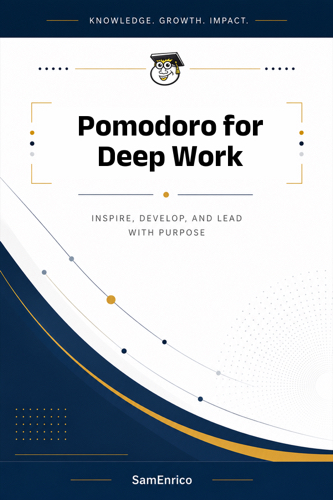
Non-FictionBusiness BriefTime Blocking
Pomodoro for Deep Work eBook
Adapt 25 minute sprints into 90 minute blocks for
Adapt 25 minute sprints into 90 minute blocks for cognitive tasks.
Formats
Free sample
Chapter 1: The Twenty-Five Minute Lie--Let me tell you something that might make you uncomfortable: the most popular productivity technique of the past thirty years has been quietly sabotaging your best work.I discovered this not in a laboratory or a academic paper, but in my own exhaustion. For years, I was a devoted disciple of the Pomodoro Technique. My kitchen timer sat on my desk like a shrine. Twenty-five minutes of work, five minutes of rest. Repeat.
The system had pulled me out of procrastination purgatory. It had helped me write articles, answer emails, and clear to-do lists that once seemed insurmountable. I recommended it to everyone.And then one day, I looked up from my timer and realized something disturbing. I was busy. I was checking boxes.
I was completing ten or twelve Pomodoros per day. But my most important projects—the book I wanted to write, the strategic plan I needed to develop, the complex problem I was paid to solve—were barely moving. I had confused motion with progress. I had optimized myself into a state of shallow busyness that looked productive from the outside but felt hollow from the inside.The problem was not my effort. The problem was not my discipline.
The problem was the unit of work itself. Twenty-five minutes, it turns out, is a terrible length of time for doing anything that matters.This chapter will show you why. We will explore the neuroscience of attention, the psychology of task completion, and the hidden costs of fragmentation that most productivity gurus never mention. By the time you finish reading, you will understand why the original Pomodoro Technique is a brilliant tool for shallow work but a silent enemy of depth—and you will be ready for a fundamentally different approach.The Fifteen-Minute Tax You Never Knew You Were Paying Let me ask you a question. When you sit down to work on a difficult cognitive task—writing a report, debugging code, analyzing data, learning a new skill—how long does it take before you are actually in the work?Not the first few minutes of orientation.
Not the time spent rereading what you wrote yesterday or scrolling back through your notes. I mean the moment when you forget about yourself, when the external world recedes, when the work becomes effortless and absorbing. Psychologist Mihaly Csikszentmihalyi called this flow. You have probably called it "being in the zone."Here is what the research says. For most people, on most complex tasks, entering a flow state requires between ten and twenty minutes of uninterrupted concentration.
The first five minutes are orientation. The next five to ten minutes are engagement. Only after that—typically around the fifteen-minute mark—does your brain shift into the high-performance mode where your best thinking happens.Now consider the classic Pomodoro. Twenty-five minutes of work, then a forced break. If you are like most people, you spend the first ten to fifteen minutes of each Pomodoro simply getting to the starting line of deep focus.
That leaves you with ten to fifteen minutes of actual productive work before the timer rings and you are forced to stop.This is the fifteen-minute tax. For every twenty-five minute block you complete, you lose fifteen minutes to orientation and context-switching. Your effective deep work time is not twenty-five minutes. It is ten minutes. Maybe less.Over the course of an eight-hour day, the math is devastating.
Sixteen Pomodoros, each with ten minutes of genuine depth, equals just over two and a half hours of deep work—the rest consumed by the overhead of starting and stopping. And that is the optimistic calculation. The reality, as we will see, is often worse.Attention Residue: The Hidden Cost of Stopping In 2009, University of Washington professor Sophie Leroy published a study that should have changed how we think about productivity. She discovered something she called attention residue.Here is how it works. When you are working on Task A and you stop before completion, your attention does not fully transfer to Task B.
A portion of your cognitive resources remains stuck on Task A—like a residue that clings to the glass of your mind. This residue reduces your performance on Task B, sometimes dramatically.Leroy found that the more incomplete Task A feels, the more attention residue lingers. A task stopped in the middle generates far more residue than a task stopped at a natural completion point. And here is the kicker: even a brief interruption—a timer ringing, a notification buzzing, a colleague tapping your shoulder—creates measurable residue that persists for ten to twenty minutes.Now apply this to the Pomodoro Technique. Your timer rings.
Even if you ignore it and keep working (which defeats the purpose of the technique), the interruption has already occurred. Your brain registers the break in continuity. When you return after your five-minute rest, you are not starting fresh. You are carrying residue from the previous block. You spend the first part of the next Pomodoro not making progress, but recovering from the interruption.The five-minute break is not long enough to clear attention residue.
It is not even close. Research on cognitive restoration suggests that recovering from sustained focus requires at least fifteen to twenty minutes of genuine rest—not scrolling social media, not checking email, but actual mental downtime. The classic Pomodoro gives you five minutes of pseudo-rest, which is neurologically insufficient.This means that the typical Pomodoro user is in a persistent state of low-grade attention residue throughout the day. They never fully clear their cognitive decks. They never achieve the clean mental slate that precedes genuine depth.
They are always working with a hangover from the previous block.The Dopamine Trap: Why It Feels So Good to Be So Unproductive If the Pomodoro Technique is so inefficient for deep work, why does it feel so productive? Why do millions of people swear by it? Why did I love it for years before realizing its limits?The answer lies in a small molecule called dopamine.Dopamine is often misunderstood as the "pleasure chemical," but neuroscientists know it better as the motivation and reward prediction chemical. Dopamine surges when you anticipate a reward, and it surges again when you receive one—especially when the reward arrives sooner or better than expected.The Pomodoro Technique is, whether by accident or design, a dopamine delivery system. Each twenty-five minute block is a small, achievable unit.
Completing it triggers a small dopamine release—a micro-reward that feels satisfying. When you complete four blocks in a row, you get a larger dopamine hit from the "set" completion. By the end of the day, you may have checked off ten or twelve boxes, each one providing a tiny jolt of satisfaction.This is not inherently bad. For shallow work—the kind of repetitive, low-cognitive-load tasks that require motivation more than depth—dopamine micro-rewards are genuinely helpful. They keep you moving through the drudgery of email, data entry, scheduling, and other administrative necessities.The problem is that dopamine does not care what you are completing.
It rewards completion frequency, not completion quality. Your brain cannot tell the difference between finishing an important strategic analysis and…
This is the end of the free sample. Get the eBook to keep going. Buy now
About this book
Details
- Author
- Fries Kasandra
- Publisher
- SamEnrico
- Language
- English
- Genre
- Non-Fiction, Business Brief, Time Blocking
- Released
- 2026-06-06
- Pages (approx.)
- 150
- Available as
- eBook, Audiobook

Read better in the ZLOADR app
Your eBooks on your phone or tablet. Sign in with your SamEnrico account and start reading.
More by Fries Kasandra
 Goodreads Reading Challenge GuideFries Kasandra$11.99
 Leonard Cohen Tower of SongFries Kasandra$11.99
 Senate Cloakroom ConversationsFries Kasandra$11.99
 Freelancing After Job LossFries Kasandra$11.99
 Scripting for Memory ImprovementFries Kasandra$11.99Scripting for Memory ImprovementFries Kasandra$11.99
 Focus Music ScienceFries Kasandra$11.99
 The Lost Tapestries of the Renaissance: How Medieval Sports Art Inspired a Cult FollowingFries Kasandra$11.99
 The Southern Star: New Zealand’s Cosmic PioneersFries Kasandra$11.99
 How to Produce Dog BedsFries Kasandra$11.99
 How to Become a Account ExecutiveFries Kasandra$11.99
 Exploring India: Painting & SculptureFries Kasandra$11.99
You may also like
 Hong Kong Handover 1997Dunn Johnnie$11.99
 Zumba For Postnatal Recovery CourseNeal Christian$11.99
 Zumba for BeginnersLadner Nikia$11.99
 YouTube Comment Mining GuideHumes Pandora$12.99
 Worry Box MeditationCarlin Rudy$11.99
 Workplace Stress MeditationNguyen Lynn$11.99
 Workplace Stress and Sleep RepairHawley Ivory$11.99
 Workplace Perfectionism CureDelaney Jeffry$11.99
 Workplace Injustice Anger GuideWallen Isabelle$11.99
 Work Addiction and Burnout LinkGreenwood Ester$11.99
 Women in Yoga and WellnessBeattie Galina$11.99
 Women in Stand Up ComedyChun Evangeline$11.99