
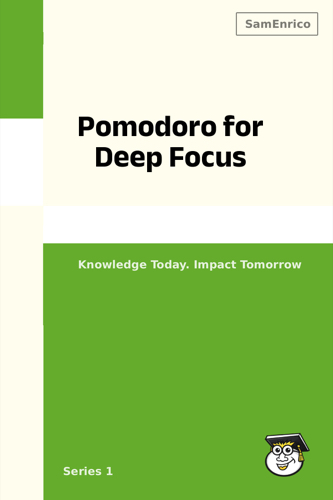
Pomodoro for Deep Focus eBook
Adapts technique for uninterrupted concentration.
by Dyer Else
Adapts technique for uninterrupted concentration.
Formats
Free sample
Chapter 1: The Attentional Bankruptcy--–- Imagine you wake up one morning to find that your bank account has been quietly draining for years. Not through any single large purchase you approved, but through a thousand tiny, invisible fees. A dollar here for a notification. Fifty cents there for an email check. Another dollar for a quick scroll through social media.
You never felt the individual withdrawals, but the cumulative effect is devastating. You are cognitively bankrupt.This is the state of the modern knowledge worker. Your attention—the single most valuable asset you own—has been siphoned away by forces you barely notice. The average office worker checks email thirty-six times per hour. The average smartphone user touches their device 2,617 times per day.
The average computer user switches between applications every forty-five seconds. Each of these micro-actions is a withdrawal from your attentional bank account. And unlike money, attention cannot be earned back. Once a moment of focus is lost, it is gone forever.This chapter makes a provocative claim that will shape everything that follows: your inability to focus is not a personal failing. It is a predictable, normal response to an abnormal environment.
You were not designed to work this way. No human was.We will explore the neuroscience of why your brain rebels against prolonged focus. We will uncover the hidden costs of what researchers call "attention residue" and "context switching." We will name the enemy—not your lack of discipline, but an economic system built on extracting your focus for profit. And we will plant the seed of the solution: a simple, ancient technology called a timer, wielded with intentionality, that acts as a circuit breaker for your overwhelmed cognitive circuits.By the end of this chapter, you will stop blaming yourself for being distracted. You will start blaming the architecture of your workday.
And you will be ready to rebuild that architecture from the ground up.The Great Exhaustion Let us begin with a question. When was the last time you worked on a single task for sixty minutes without checking anything—no phone, no email, no chat, no browser tab? If you are like ninety-nine percent of knowledge workers, the answer is "I cannot remember" or "never."This is not hyperbole. A study by the University of California, Irvine, placed employees in a real office environment and tracked their every move. The researchers found that the average employee worked on a single task for only eleven minutes before being interrupted or switching voluntarily.
And after each interruption, it took an average of twenty-three minutes to return to the original task at full focus.Let me pause here so you can feel the weight of that number. Twenty-three minutes. If you are interrupted every eleven minutes, you never fully return. You are in a permanent state of partial attention, bouncing from fragment to fragment, never diving deep enough to do your best work.This phenomenon has a name: the Great Exhaustion. It is not clinical burnout, though it can lead there.
It is a low-grade, chronic fatigue of the attention system. You feel it as a vague fog in the afternoon, a reluctance to start hard tasks, a tendency to check your phone "just for a second" that somehow becomes ten minutes. You tell yourself you are lazy. You are not. You are exhausted.The Great Exhaustion has been building for decades.
It began with email in the 1990s, which brought other people's agendas directly into your workspace at any time of day. It accelerated with instant messaging and SMS, which created an expectation of immediate response. It exploded with the smartphone, which put the entire distraction machine in your pocket, available 24/7. And it reached its current peak with social media apps optimized by thousands of engineers to be as addictive as possible.You are not fighting a fair fight. You are a single human brain with a finite attentional budget, competing against trillion-dollar industries whose entire business model depends on you looking away from what matters and looking at their screen.
The only way to win is to stop playing their game on their terms. The only way to win is to change the structure of your environment.The Myth of Multitasking Before we go further, we need to kill a beloved cultural myth. The myth is that some people can multitask effectively. The myth is that you, with enough practice, can learn to do two things at once without losing quality. The myth is supported by no scientific evidence whatsoever.Here is what the research actually shows.
The human brain does not multitask. It task-switches. When you think you are doing two things at once—listening to a podcast while answering email, for example—your brain is actually rapidly alternating attention between the two tasks. This alternation happens so quickly that you do not perceive the gaps. But the gaps are there.
And they are costly.The cost appears in three forms: time, accuracy, and mental energy.First, time. Every time you switch tasks, your brain must perform a "goal shifting" operation (deciding to stop Task A) followed by a "rule activation" operation (loading the context for Task B). These operations take measurable time. Research from the University of Michigan found that even brief switches of a few seconds add up to a forty percent loss of productive time over the course of a day. That is nearly half of your working hours, vaporized.Second, accuracy.
When you switch tasks, you make more mistakes. A study of medical professionals found that interruptions during medication administration doubled the rate of errors. A study of drivers found that talking on a phone—even hands-free—made crashes as likely as drunk driving. A study of software developers found that an interruption of just a few minutes increased the probability of introducing a bug by more than fifty percent.Third, mental energy. Task switching is metabolically expensive.
Your brain consumes glucose and oxygen to perform the switching operations. The more you switch, the more energy you burn. And unlike physical energy, which can be restored with a snack, cognitive energy recovers slowly. By late afternoon, after hundreds of switches, your brain is running on fumes. This is why you feel exhausted even on days when you did not "do" much.
You switched too much.The myth of multitasking persists because it feels productive. It feels like you are getting more done. But the feeling is an illusion, a dopamine-driven sense of busyness that masks the underlying inefficiency. The most productive people do not multitask. They monotask.
They do one thing at a time, with full attention, until it is done or until a planned break arrives.Attention Residue: The Ghost in the Machine Now we arrive at the most important concept in this entire book. If you remember nothing else, remember this. Attention residue is the cognitive drag that remains when you switch from Task A to Task B. Part of your mind stays stuck on Task A, still processing, still holding context, still using mental bandwidth. You never fully arrive at Task B because you never fully left Task A.The concept comes from the research of Sophie…
This is the end of the free sample. Get the eBook to keep going. Buy now
About this book
Details
- Author
- Dyer Else
- Publisher
- SamEnrico
- Language
- English
- Genre
- Non-Fiction, Self-Help, Focus
- Released
- 2026-06-05
- Pages (approx.)
- 140
- Available as
- eBook, Audiobook

Read better in the ZLOADR app
Your eBooks on your phone or tablet. Sign in with your SamEnrico account and start reading.
More by Dyer Else
 Imposter Family Origin GuideDyer Else$11.99
 Macaulay Culkin Home Alone AfterDyer Else$11.99
 Reconstruction of Sharp Force InjuriesDyer Else$11.99
 The Startup Benchmarking GuideDyer Else$11.99
 Wheelchair Accessible Bus FightDyer Else$11.99
 PAO Person Action Object SystemDyer Else$11.99
 Lying Down vs Sitting for HypnosisDyer Else$11.99
 The Casino Kingpins: Latin America's High-Stakes Gambit in Las VegasDyer Else$11.99The Casino Kingpins: Latin America's High-Stakes Gambit in Las VegasDyer Else$11.99
 The Golden Scalpel: Black Surgeons Who Shaped Modern MedicineDyer Else$11.99
 How to Produce Porch SwingsDyer Else$11.99
 How to Produce Drain FramesDyer Else$11.99
You may also like
 Hong Kong Handover 1997Dunn Johnnie$11.99
 Zumba For Postnatal Recovery CourseNeal Christian$11.99
 Zumba for BeginnersLadner Nikia$11.99
 YouTube Comment Mining GuideHumes Pandora$12.99
 Worry Box MeditationCarlin Rudy$11.99
 Workplace Stress MeditationNguyen Lynn$11.99
 Workplace Stress and Sleep RepairHawley Ivory$11.99
 Workplace Perfectionism CureDelaney Jeffry$11.99
 Workplace Injustice Anger GuideWallen Isabelle$11.99
 Work Addiction and Burnout LinkGreenwood Ester$11.99
 Women in Yoga and WellnessBeattie Galina$11.99
 Women in Stand Up ComedyChun Evangeline$11.99