
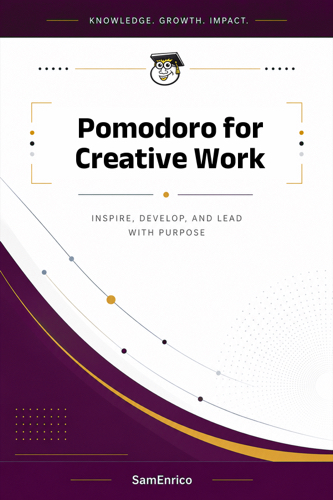
Non-FictionSelf-HelpCreative Process
Pomodoro for Creative Work eBook
Adapt sprints to ideation, drafting, and revision
Adapt sprints to ideation, drafting, and revision phases of creative projects.
Formats
Free sample
Chapter 1: The Tomato Trap--–- The first time the timer ruined my best work, I was three paragraphs from the end of a short story that had taken me six months to find. The words were coming not as typing but as dictation from some deeper, wiser part of my brain that rarely bothered to answer the phone. My fingers moved faster than my conscious thought. The protagonist, who had been mute with grief for thirty pages, finally spoke. Her first word appeared on the screen.
Then the second. Then—BEEP BEEP BEEP.The kitchen timer on my desk screamed. Twenty-five minutes. The sacred Pomodoro. I had followed the rules perfectly.
I had worked in focused bursts, taken five-minute breaks, protected my attention like a lifeguard watching a riptide. I was being productive. I was doing everything right.And I had just slaughtered my own creative flow at its most vulnerable moment.I sat there, finger hovering over the keyboard, while the timer continued its mechanical tantrum. The protagonist's third word hung in the neural space between my brain and my hands, already fading like a dream after waking. By the time I silenced the alarm, she was gone.
The story wouldn't find her again for another three weeks.That was the day I realized that the Pomodoro Technique—beloved by programmers, students, and anyone drowning in administrative tasks—had a dark secret. It was designed for a type of work that creative professionals almost never do. And we had been using it wrong the entire time.The Promise That Seduced Us The original Pomodoro Technique, developed by Francesco Cirillo in the late 1980s, is elegant in its simplicity. Work for twenty-five minutes. Take a five-minute break.
After four "Pomodoros," take a longer break of fifteen to thirty minutes. The timer creates urgency. The breaks prevent burnout. The structure transforms daunting projects into manageable slices.For repetitive, execution-focused tasks—returning emails, data entry, coding routine functions, grading papers—it works brilliantly. The twenty-five-minute sprint aligns perfectly with the brain's natural attention cycles when performing procedural work.
You don't need creative insight to process a spreadsheet. You just need sustained, moderate focus.But somewhere along the way, the technique escaped its original habitat. Writers adopted it. Designers embraced it. Painters, composers, architects, and filmmakers began setting timers on their desks, convinced that if the technique could help a programmer ship code, it could help them ship art.It cannot.
Not in its original form. And the evidence of this failure is everywhere: the half-finished novel whose author hit a wall at chapter four, the design project that produced fifty competent but lifeless concepts, the song that has every note correct and zero emotional resonance. These are not failures of talent or effort. They are failures of temporal architecture—using a time management system designed for execution to manage a process that requires something entirely different: creative cognition.The Three Ways the Timer Betrays You After studying hundreds of creative professionals across writing, design, music, and visual arts, I have identified three fundamental mismatches between the classic Pomodoro and creative work. These are not minor inconveniences.
They are structural incompatibilities that explain why so many artists feel like failures when the timer goes off.Mismatch One: The Context Switching Tax The human brain does not switch tasks instantly. When you shift from one cognitive mode to another, there is a latency period—a neural recalibration—during which your processing power is significantly reduced. For routine tasks, this latency lasts only a few seconds. For creative work, it can last ten to fifteen minutes.This is because creativity depends heavily on what neuroscientists call the default mode network (DMN). The DMN is a set of interconnected brain regions that becomes active when you are not focused on external tasks—when you are daydreaming, reflecting, or allowing your mind to wander.
Paradoxically, the DMN is also essential for creative insight. It is the neural substrate of "diffuse thinking," the state where disparate ideas connect, where analogies form, where the solution to a problem arrives not through brute force but through sudden illumination.Here is the problem: the DMN takes time to activate. When you sit down to write, sketch, or compose, your brain does not instantly enter diffuse mode. It takes approximately ten to fifteen minutes of uninterrupted, low-pressure cognition for the DMN to fully engage. During those first minutes, you are still in "focused mode"—analytical, linear, detail-oriented.
Focused mode is excellent for editing, debugging, and following instructions. It is terrible for generating novel connections.Now consider what happens during a classic twenty-five-minute Pomodoro. Minutes 0–10: you are ramping up, still in focused mode, fighting the urge to check your phone, wondering if the timer is working. Minutes 10–15: the DMN begins to engage. You feel the first stirrings of flow.
Minutes 15–20: you are deep in creative immersion, making connections you couldn't see five minutes earlier. And then—BEEP BEEP BEEP.The timer interrupts you precisely at the moment your brain becomes most creative. You take a five-minute break (checking email, scrolling social media, grabbing coffee). Your DMN deactivates. When you return for the next Pomodoro, you start from zero.
The ten-to-fifteen-minute ramp-up resets. You spend your entire creative session climbing a hill you never reach the top of.This is the Context Switching Tax, and it is the single greatest hidden cost of using short, rigid sprints for creative work. Each interruption does not just cost you the time of the interruption itself. It costs you the ten to fifteen minutes of neural reactivation that follows. A day of six twenty-five-minute Pomodoros—two and a half hours of work—can cost you an additional hour of ramp-up time.
And crucially, you never experience the sustained flow that produces your best work.Mismatch Two: The Blank Page Problem For a programmer starting a new function, the twenty-five-minute timer creates healthy urgency. There is a clear input (the cursor blinking in an empty file) and a clear output (fifteen lines of working code). The path from start to finish is linear and predictable.For a writer facing a blank page, the same timer creates something else entirely: performance anxiety.The Blank Page Problem emerges when the pressure of a ticking clock meets the inherent uncertainty of creative generation. Unlike execution tasks, creative tasks have no guaranteed output. You cannot simply "write faster" when you are stuck.
The muse does not respond to urgency; she responds to safety, to spaciousness, to the permission to fail.I have watched dozens of creative professionals react to a timer with the same physiological responses as a threat: increased heart rate, shallow breathing, tension in the shoulders and jaw. Their brains interpret the ticking clock not as a helpful structure but as a judge delivering a verdict: You are not producing fast enough. You are wasting time. You are failing.This anxiety triggers the brain's salience network, which redirects cognitive resources away from creative generation and toward threat monitoring. Instead of connecting ideas, you begin monitoring your own output.
Instead of exploring possibilities, you fixate on the single "right" answer that will satisfy the timer. The result is not better work.…
This is the end of the free sample. Get the eBook to keep going. Buy now
About this book
Details
- Author
- Buckley Christena
- Publisher
- SamEnrico
- Language
- English
- Genre
- Non-Fiction, Self-Help, Creative Process
- Released
- 2026-06-11
- Pages (approx.)
- 117
- Available as
- eBook, Audiobook

Read better in the ZLOADR app
Your eBooks on your phone or tablet. Sign in with your SamEnrico account and start reading.
More by Buckley Christena
 Being Blamed Anger Triggers CourseBuckley Christena$11.99
 Rainy Day Indoor Walking PlanBuckley Christena$11.99
 Cooperative Loan Application ProcessBuckley Christena$11.99
 Workplace Assertiveness Training GuideBuckley Christena$11.99
 The Octopus That Outsmarted the Navy: The Untold Story of Clever HansBuckley Christena$11.99
 Understanding Omodysplasia Type 1Buckley Christena$17.99
 Financial Leverage for Creators and FoundersBuckley Christena$11.99
 GitHub Remote Internship GuideBuckley Christena$12.99
 Amwell SWOT GuideBuckley Christena$12.99
 A Beginners Guide to Flight archery (Volume 1)Buckley Christena$11.99
You may also like
 Hong Kong Handover 1997Dunn Johnnie$11.99
 Zumba For Postnatal Recovery CourseNeal Christian$11.99
 Zumba for BeginnersLadner Nikia$11.99
 YouTube Comment Mining GuideHumes Pandora$12.99
 Worry Box MeditationCarlin Rudy$11.99
 Workplace Stress MeditationNguyen Lynn$11.99
 Workplace Stress and Sleep RepairHawley Ivory$11.99
 Workplace Perfectionism CureDelaney Jeffry$11.99
 Workplace Injustice Anger GuideWallen Isabelle$11.99
 Work Addiction and Burnout LinkGreenwood Ester$11.99
 Women in Yoga and WellnessBeattie Galina$11.99
 Women in Stand Up ComedyChun Evangeline$11.99