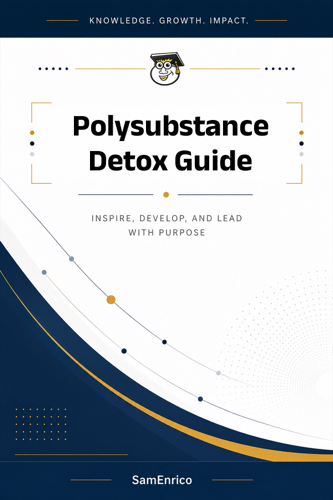
Polysubstance Detox Guide eBook
Manage withdrawal from multiple drugs with medical
Manage withdrawal from multiple drugs with medical supervision using this complex guide.
Formats
Free sample
Chapter 1: The Hidden Epidemic–- The first time Marcus tried to stop using, he did it the way everyone told him to: he picked one drug. “Just focus on the heroin,” his well-meaning counselor said. “Get clean from that, then we’ll worry about the rest.” Marcus was using heroin daily, yes. But he was also drinking a pint of vodka every night to sleep, taking benzodiazepines his dealer sold as “sleep aids,” and smoking methamphetamine on weekends to stay functional for his construction job. When he stopped heroin, the opioid withdrawal hit exactly as expected—sweats, vomiting, bone pain.
But what no one predicted was that his alcohol and benzodiazepine dependence, unmasked by the absence of opioids, would trigger a grand mal seizure on day three. He woke up in an ICU, intubated, with a nurse telling his mother, “We didn’t know he was drinking that much. His COWS score was low, so we thought he was stable.” Marcus had been failed not by bad intentions, but by a treatment system still organized around the fiction of the single substance.This is the hidden epidemic of polysubstance use—not the Hollywood image of someone who “does everything,” but the quiet, pervasive reality of millions who mix drugs intentionally or unintentionally, often without even knowing it. If you are reading this book, you or someone you love is likely among them. You have tried to stop one thing only to find that another drug’s withdrawal ambushes you.
You have been to detox programs that seemed confused by your lab results. You have been told, “We don’t treat alcohol here” or “We don’t prescribe methadone for that.” And you have left sicker than when you arrived. This chapter exists to name that experience, to provide the first clear map of a territory that medicine has only begun to understand, and to offer something that no single-substance guide ever can: a framework for understanding how multiple drugs interact inside one body, and why detox must be managed differently from the ground up.The Definition Problem: What Polysubstance Use Really Means Polysubstance use sounds like a clinical term, but it describes something simple: using two or more psychoactive substances within a period where their effects overlap. That period can be hours (taking cocaine and heroin together in a “speedball”), days (drinking heavily while tapering off benzodiazepines), or even weeks (using methamphetamine to function while physically dependent on opioids). The medical field has historically divided polysubstance use into two categories, and understanding this distinction is your first step toward safety.Intentional polysubstance use occurs when a person deliberately combines drugs to achieve a specific effect.
The most common intentional combinations include: opioids with benzodiazepines (to intensify the “nod”), cocaine with heroin (to balance the stimulant crash with opioid sedation), alcohol with cocaine (to produce cocaethylene, a more cardiotoxic metabolite), and methamphetamine with GHB or alcohol (to manage the comedown). People who use intentionally often develop sophisticated dosing schedules, convinced they have found a “safe” balance. The danger is that tolerance to one drug does not transfer equally to others, and the synergistic effects can cause organ failure at doses that would be survivable with either drug alone.Unintentional polysubstance use has exploded in the past decade due to a contaminated drug supply. A person who buys cocaine expecting a pure stimulant may receive a powder laced with fentanyl, xylazine (a veterinary tranquilizer), or levamisole (an anti-parasitic drug that causes agranulocytosis). A person who takes a counterfeit Xanax bar may actually be consuming etizolam, flualprazolam, or a fentanyl analogue.
The user does not choose to combine—the supply chain does it for them. This form of polysubstance use is particularly dangerous because the person has no opportunity to adjust their behavior and may not even know what substances are in their system when they present for detox.The clinical reality is that the distinction matters less than the outcome. Whether intentional or unintentional, the body experiences the same total toxin load. Withdrawal from one substance unmasks dependence on another. And the standard detox protocols, designed for patients using a single drug, fail catastrophically in this context.The Numbers That Demand Your Attention Before we go further, you need to understand the scale of what we are facing.
These are not abstract statistics—they represent real people, real families, and real failures of the medical system.According to the Centers for Disease Control and Prevention (CDC), over 107,000 drug overdose deaths occurred in the United States in 2022. Of those, more than 85 percent involved at least two substances. The most common combination was fentanyl with stimulants (cocaine or methamphetamine), accounting for nearly 40 percent of all stimulant-involved deaths. Benzodiazepines were present in over 25 percent of opioid-related deaths. Alcohol was a contributing factor in nearly 15 percent of all drug overdoses, often in combination with cocaine or prescription opioids.But overdose deaths are only the most visible outcome.
For every fatal overdose, there are an estimated 10 to 20 non-fatal overdoses requiring emergency medical care. And for every non-fatal overdose, there are hundreds of people attempting detoxification at home, in underfunded treatment centers, or in hospital settings not designed for their needs. A 2021 study in the Journal of Addiction Medicine found that 68 percent of patients admitted for alcohol withdrawal had at least one other substance in their toxicology screen, yet only 12 percent received a withdrawal protocol that addressed more than alcohol. The rest were treated for alcohol alone while opioid or stimulant withdrawal went unrecognized and unmanaged.These numbers tell a clear story: polysubstance use is not a niche problem. It is the dominant pattern of substance use in the United States and increasingly worldwide.
Any detox program, any hospital, any family member attempting to help a loved one must operate from the assumption that multiple substances are involved until proven otherwise.Why the “One Drug, One Problem” Model Persists—And Why It Fails To understand why polysubstance detox is so poorly managed, you have to understand the history of addiction treatment. The modern detox model was built in the 1960s and 1970s, when the most visible drug problems were single-substance epidemics: heroin in urban centers, alcohol in suburban and rural areas, and later crack cocaine in the 1980s. Treatment programs specialized. You went to a methadone clinic for opioids, a residential program for alcohol, a 28-day rehab for cocaine. The funding streams, the licensing requirements, and the training of physicians all reinforced the idea that patients had *a* drug problem, not a drug-use pattern.This model persists for three reasons, none of which serve patients.First, regulatory silos.
In the United States, medications for opioid use disorder (buprenorphine, methadone) are regulated separately from medications for alcohol use disorder (naltrexone, disulfiram). A clinic licensed to dispense methadone may not have a physician authorized to prescribe baclofen or topiramate for alcohol cravings. A hospital detox unit may have a protocol for CIWA-Ar (alcohol withdrawal) but no protocol for managing stimulant-induced psychosis. The result is that patients are forced to choose which drug to prioritize, often with devastating consequences.Second, reimbursement structures. Insurance companies, including Medicare and Medicaid, typically reimburse detox as a per-day or per-episode payment based on a primary diagnosis.…
This is the end of the free sample. Get the eBook to keep going. Buy now
About this book
Details
- Author
- Fitch Cherryl
- Publisher
- SamEnrico
- Language
- English
- Genre
- Non-Fiction, Health & Wellness, Polysubstance
- Released
- 2026-06-06
- Pages (approx.)
- 156
- Available as
- eBook, Audiobook

Read better in the ZLOADR app
Your eBooks on your phone or tablet. Sign in with your SamEnrico account and start reading.
More by Fitch Cherryl
 Immigrant Grandparents SeparationFitch Cherryl$11.99
 Cultural Shame HealingFitch Cherryl$11.99
 SAS Stirling OriginFitch Cherryl$11.99
 The Siege of Pataliputra: The Mauryan Empire's Last StandFitch Cherryl$11.99
 How to Produce Climbing Chalk BagsFitch Cherryl$11.99
 Scalable Hiring Process BlueprintFitch Cherryl$12.99
 Tax Compliance ManagerFitch Cherryl$11.99
 How to Become a Back WasherFitch Cherryl$11.99