
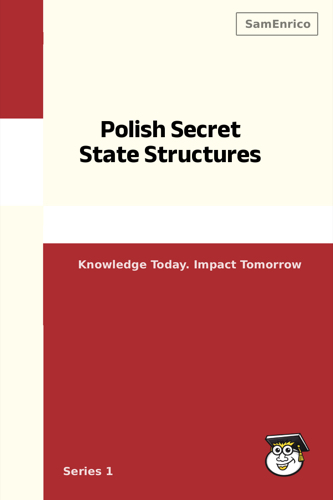
Polish Secret State Structures eBook
Run an underground government with courts schools
Run an underground government with courts schools and military.
Formats
Free sample
Chapter 1: The Unsurrendered Republic...--On September 17, 1939, at four o'clock in the morning, the Soviet Union invaded Poland from the east. The Polish government had been fighting Nazi Germany for barely sixteen days. Its armies were already in retreat. Its cities were burning. And now, without a declaration of war, without any pretense of negotiation, Joseph Stalin's Red Army crossed the border to claim its share of the corpse.
The Polish officer corps, caught between two totalitarian giants, faced an impossible choice: surrender to the Germans or surrender to the Soviets. Most chose the Germans, believing that Nazi brutality, however terrible, would be preferable to Soviet systematic extermination. They were wrong on both counts. But in that moment of catastrophic defeat, something unexpected happened. The Polish government refused to surrender.
Not a single authorized signature was appended to any instrument of capitulation. Legally, diplomatically, and constitutionally, the Polish Republic continued to exist. It had no territory. It had no army that could fight in the open. It had no treasury that the occupiers had not looted.
But it had a constitution, a president, a prime minister, and an unshakeable conviction that occupation does not transfer sovereignty. This conviction became the bedrock of the Polish Secret State—the most elaborate underground government in modern history.The question that opens this book is simple, and yet it has haunted political philosophers, military strategists, and resistance fighters for centuries: What is a state? Is it territory? Is it an army? Is it the recognition of other states?
Or is it something more fundamental—the consent of the governed, expressed through institutions that continue to function even when their buildings are occupied, their records confiscated, and their officials forced into hiding? The Polish Underground State offers an answer. Between 1939 and 1945, while Nazi Germany and the Soviet Union competed to erase Poland from the map, a parallel nation operated in secret. It ran schools where universities had been closed. It issued verdicts where German courts had imposed only terror.
It published newspapers where the Gestapo had banned every word of Polish. It commanded an army of 400,000 soldiers who wore no uniforms, carried no identification, and could be executed on sight. And it did all of this not as a ragtag collection of partisans but as a structured, hierarchical, legally continuous entity that traced its authority directly to the pre-war Polish constitution. This chapter tells the story of how that state was born—not in victory, but in defeat. Not in hope, but in desperation.
Not in the light of liberation, but in the darkness of occupation.The Double Invasion To understand the Polish Secret State, one must first understand the shock of September 1939. Nazi Germany invaded on September 1. The Polish army, though outnumbered and outgunned, fought ferociously. At the Battle of Bzura (September 9-19), Polish forces mounted a counteroffensive that briefly stunned the German command. But the Luftwaffe controlled the skies.
The panzer divisions moved faster than Polish cavalry—despite the persistent myth, Polish horsemen never charged German tanks with lances; they fought on horseback against German infantry and were mowed down by machine guns like every other army of the era. By September 16, the Polish government had evacuated to the southeastern border region, hoping to hold a "Romanian Bridgehead" while awaiting promised French and British aid. That aid never came. France and Britain, having declared war on Germany on September 3, did nothing substantial for eight months—the period German generals called the Sitzkrieg (sitting war). Poland stood alone.Then came the Soviet invasion.
The Non-Aggression Pact between Nazi Germany and the Soviet Union, signed on August 23, 1939, had contained a secret protocol dividing Poland between them. Stalin waited just long enough to ensure that Polish resistance had been crushed before sending his armies in. The Polish border protection corps, stationed in the east, was utterly unprepared. Some units fought; most were overrun. Polish officers captured by the Soviets faced a different fate than those captured by the Germans.
The Germans, for all their barbarism, generally followed the Geneva Convention toward Polish prisoners in 1939 (this would change dramatically in later years). The Soviets did not. They separated officers from enlisted men, shipped them to special camps, and in the spring of 1940, murdered approximately 22,000 of them in the Katyn Forest and other sites—a crime the Soviet Union denied for half a century. The Polish government-in-exile would not learn the truth until 1943, and even then, the Western Allies suppressed the information to maintain the alliance with Stalin.By early October, organized Polish resistance had collapsed. The last major Polish unit surrendered at Kock on October 6.
The country was partitioned once again: Germany annexed the western provinces outright (Silesia, Pomerania, Greater Poland) and established a rump "General Government" in the center and east, ruled by the Nazi lawyer Hans Frank. The Soviet Union annexed the eastern provinces (Kresy) into the Ukrainian and Belorussian SSRs. Poland had vanished from the map. But the Polish government had not surrendered. President Ignacy Mościcki, interned in Romania, resigned and transferred authority to Władysław Raczkiewicz, who formed a government-in-exile in Paris (and later London) under Prime Minister General Władysław Sikorski.
This government commanded the loyalty of the Polish armed forces that had escaped to France and Britain—eventually numbering over 200,000 soldiers, sailors, and airmen. And it commanded the loyalty of the millions of Poles still trapped under occupation. The question was: how could that loyalty be organized into something effective?The Illegality Principle The conceptual breakthrough came from international law. The Hague Conventions of 1899 and 1907, which codified the laws of war, stated clearly that occupation does not transfer sovereignty. The occupying power has the right to maintain order and use the occupied territory's resources for its army, but it does not become the legitimate government.
The legitimate government continues to exist, even in exile. This is not a technicality. It is the foundation upon which all resistance movements—from the French Resistance to the Norwegian resistance to the Polish Underground—legally justify their actions. If the occupier's law were legitimate, then resistance would be rebellion, punishable by execution without trial. But if the occupier's law is not legitimate, then resistance is simply the continuation of lawful self-defense.The Polish government-in-exile took this principle to its logical extreme.
In a series of decrees issued in late 1939 and early 1940, it declared that all German and Soviet administrative acts in occupied Poland were null and void. German courts were not courts; they were criminal enterprises. German schools were not schools; they were indoctrination centers. German police were not police; they were death squads. The Polish underground, therefore, was not an insurgency.
It was the continuation of the Polish state operating under conditions of foreign occupation. This was not merely propaganda. It had concrete legal consequences. Polish underground courts, as we will see in Chapter 4, did not try collaborators for "violating German law." They tried them for violating Polish law—the same law that had been in effect before the war, which had never been repealed because no legitimate authority had repealed it. A Pole who denounced a neighbor to the Gestapo was not a "German collaborator" in the moral sense alone; he…
This is the end of the free sample. Get the eBook to keep going. Buy now
About this book
Details
- Author
- Ritter Vannesa
- Publisher
- SamEnrico
- Language
- English
- Genre
- Non-Fiction, History, Government
- Released
- 2026-06-07
- Pages (approx.)
- 141
- Available as
- eBook, Audiobook

Read better in the ZLOADR app
Your eBooks on your phone or tablet. Sign in with your SamEnrico account and start reading.
More by Ritter Vannesa
 The Empathy Development HandbookRitter Vannesa$11.99
 Active Listening CourseRitter Vannesa$11.99
 Senior Mentoring Self Esteem CourseRitter Vannesa$11.99
 Adolescent Body Image RescueRitter Vannesa$11.99
 Orpheus and the Lyre That Conquered DeathRitter Vannesa$11.99
 Litigation LawyerRitter Vannesa$11.99
 Understanding Macular Degeneration, Age-relatedRitter Vannesa$17.99
 Data Presentation Mistakes GalleryRitter Vannesa$12.99
 A Beginners Guide to Drum and bugle corps (modern) (Volume 1)Ritter Vannesa$11.99
You may also like
 Hong Kong Handover 1997Dunn Johnnie$11.99
 Zumba For Postnatal Recovery CourseNeal Christian$11.99
 Zumba for BeginnersLadner Nikia$11.99
 YouTube Comment Mining GuideHumes Pandora$12.99
 Worry Box MeditationCarlin Rudy$11.99
 Workplace Stress MeditationNguyen Lynn$11.99
 Workplace Stress and Sleep RepairHawley Ivory$11.99
 Workplace Perfectionism CureDelaney Jeffry$11.99
 Workplace Injustice Anger GuideWallen Isabelle$11.99
 Work Addiction and Burnout LinkGreenwood Ester$11.99
 Women in Yoga and WellnessBeattie Galina$11.99
 Women in Stand Up ComedyChun Evangeline$11.99