
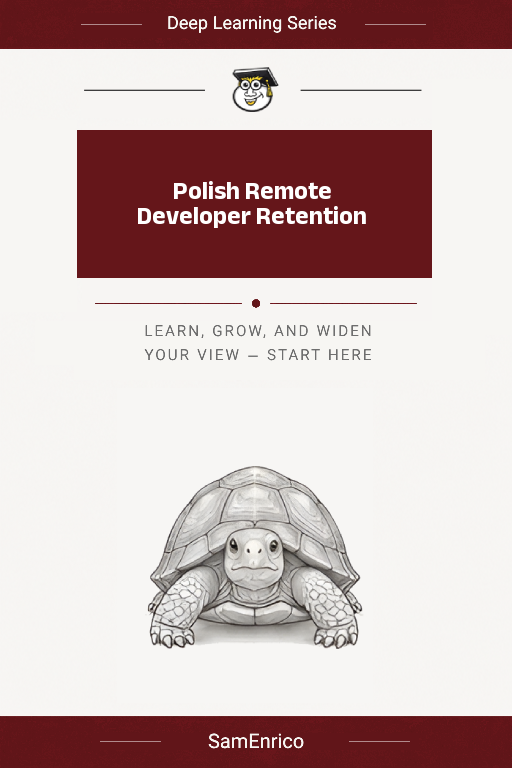
Polish Remote Developer Retention eBook
Reduce churn among Polish software engineers with
by Strong Allyn
Reduce churn among Polish software engineers with career growth paths, European holiday schedules, and competitive benefits.
Formats
Free sample
Chapter 1: The Upgrade Economy--The resignation arrived at 11:47 AM on a Tuesday. No warning. No awkward conversation with HR. Just a two-sentence email from Marek, a senior backend engineer who had been with the company for twenty-six months — exactly two months past the average Polish developer's tenure clock."We need to talk about my transition plan. My last day will be March 15th, per the three-month notice period in my contract."His manager, a well-intentioned VP of Engineering in Austin, Texas, stared at the screen in disbelief.
Marek had received a "Exceeds Expectations" rating on his last review. His salary had been adjusted to the 75th percentile of market data — not top of band, but competitive. He had a new Mac Book Pro. He had attended the company offsite in Barcelona. What went wrong?The answer, uncovered in the exit interview three weeks later, was both simple and devastating: Marek wasn't unhappy.
He was upgrading."When I joined, I was excited about the microservices migration," he explained. "We finished that in month eight. Then I spent twelve months maintaining it. Then six months migrating the migration. The last time I learned something new was when I taught myself Rust on my own time, on my own machine, using my own internet.
The new company lets me write Rust every day. They're paying me less, actually. But I'll learn more in six months there than I would in two more years here."This is not an isolated story. It is not a cautionary tale. It is the new normal of the Polish software engineering labor market — a market that Western companies have mistakenly treated as a source of "cost-effective talent" when they should have been treating it as a pool of aggressive, self-directed career capitalists who view every employer as a stepping stone to the next level of competence.This chapter establishes the foundational reality that every subsequent chapter in this book builds upon: Polish engineers don't quit — they transition.
And until you understand the difference, every retention strategy you deploy will be fighting the wrong war.The 17% Problem That Isn't What You Think Let us begin with the number that terrifies every VP of Engineering with a Polish remote team: 17 percent.That is the average annual attrition rate for software engineers in Poland's IT sector, according to the 2024 report from the Polish Digital Economy Forum. For senior engineers — those with five to ten years of experience — the number climbs to 24 percent. For engineers with specialized skills in machine learning, cloud architecture, or modern systems programming (Rust, Go, Elixir), attrition exceeds 30 percent in some sub-sectors.To put this in perspective, the average voluntary turnover rate for software engineers in the United States hovers around 13 percent. In Western Europe, it is approximately 11 percent. In India, a market often compared to Poland, it is 15 percent.Poland is not an outlier by accident.
Poland is an outlier by design.The conventional interpretation of these numbers — the one offered by well-meaning but misinformed HR consultants — is that Polish engineers are "job hoppers" or "mercenaries" motivated primarily by salary. This interpretation is wrong. Worse, it is dangerous, because it leads companies to solve the wrong problem.If salary were the primary driver, we would expect to see two patterns. First, Polish engineers would leave for offers that are significantly higher than their current compensation. Second, counteroffers matching or slightly exceeding those external offers would successfully retain them.
Neither pattern holds consistently in the data.A 2023 study by No Fluff Jobs (Poland's largest tech job platform) surveyed 1,200 engineers who had changed jobs within the previous 12 months. Only 31 percent cited "higher salary" as their primary motivation. A full 47 percent cited "more interesting projects" or "learning new technologies." Twenty-two percent cited "better work-life balance" or "remote flexibility" — categories that include respect for holidays, async work, and home office support, which we will explore in later chapters.When asked whether they would have stayed if their current employer had matched the external salary offer, 68 percent said no. When asked why, the most common responses were "I had already stopped learning" and "The work had become repetitive."This is not job hopping. This is career upgrading.The 50,000to50,000 to 50,000to90,000 Reality: Debunking the Cheap Labor Myth Let us address the elephant in the room.
Some Western executives still believe — quietly, perhaps, but genuinely — that hiring in Poland is a way to get "European quality at Indian prices." This myth is at least five years out of date, and clinging to it is a fast path to losing every engineer worth keeping.Here are the actual market rates as of 2024-2025, expressed in USD annual compensation for full-time equivalent roles (including benefits, not just base salary):Junior Engineer (0-2 years experience): 30,000–30,000 – 30,000–45,000Mid-level Engineer (2-5 years): 45,000–45,000 – 45,000–70,000Senior Engineer (5-8 years): 65,000–65,000 – 65,000–90,000Staff / Principal Engineer (8+ years): 85,000–85,000 – 85,000–130,000Engineering Manager (people leader): 80,000–80,000 – 80,000–120,000Distinguished Fellow / Architect: 110,000–110,000 – 110,000–160,000These figures place Poland firmly in the upper tier of Central and Eastern European salaries, comparable to the Czech Republic and Slovenia, and approximately 20-30 percent below Germany or the Netherlands — a gap that is narrowing every year.But raw numbers tell only part of the story. The critical nuance is how Polish engineers prefer to be paid.Approximately 62 percent of senior engineers in Poland work on B2B contracts (self-employment, business-to-business). Under this arrangement, the engineer invoices the company monthly, pays their own taxes and social security (ZUS), and retains the ability to deduct business expenses. The net financial outcome is that a senior engineer on B2B earning 25,000 PLN monthly (approximately $6,250 gross) takes home roughly the same as an employee on Uo P (employment contract) earning 30,000 PLN monthly. The difference is substantial and intentional.Why does this matter for retention?
Because Polish engineers who have chosen the B2B path have already signaled something important: they value autonomy, optimization, and control over their financial lives. They are not looking for a paternalistic employer who will "take care of them." They are looking for a partner who will respect their business.This mindset — the engineer-as-business — is the cultural key that unlocks everything else in this book.The Job Changer Mentality: A National Phenomenon Poland has a secret weapon that Western HR departments don't understand: a hyper-efficient internal mobility infrastructure that makes changing jobs almost frictionless.Consider Sii Poland, one of the country's largest IT service providers with over 7,000 employees. Sii developed an internal tool called "Job Changer" that allows any engineer to browse open projects across the entire organization and request a transfer — without involving their current manager. The approval process is standardized and takes no more than 15 days. The engineer keeps their seniority, benefits, and tenure.
The company retains talent that would otherwise leave.This tool is not unique. Most large Polish tech employers — from Capgemini to EPAM to Allegro — have similar systems. But the real innovation is not the software. It is the cultural expectation that engineers should move internally every 12 to 24 months.The average tenure of a Polish engineer at a single company is 2.8 years. For engineers under 35, it is 2.1 years.
For engineers working remotely for foreign companies, it is 1.9 years.These numbers are not signs of disloyalty. They are signs of a mature labor market where engineers have…
This is the end of the free sample. Get the eBook to keep going. Buy now
About this book
Details
- Author
- Strong Allyn
- Publisher
- SamEnrico
- Language
- English
- Genre
- Non-Fiction, Business Brief, Employee Retention
- Released
- 2026-05-27
- Pages (approx.)
- 144
- Available as
- eBook, Audiobook

Read better in the ZLOADR app
Your eBooks on your phone or tablet. Sign in with your SamEnrico account and start reading.
More by Strong Allyn
 Delegation Scripts Using MatrixStrong Allyn$11.99
 Opioid Dependency Treatment OptionsStrong Allyn$11.99
 Hearst San Simeon PartiesStrong Allyn$11.99
 The 10 10 10 Rule for Presentation WorryStrong Allyn$11.99
 The SRO Hotel ScientistStrong Allyn$11.99
 The Silk Road Act: How a 19th-Century Trade War Shaped Modern DiplomacyStrong Allyn$11.99
 The Day the Internet Stood Still: The Great Facebook Outage of 2021Strong Allyn$11.99
 Amazon Inventory Forecasting ToolStrong Allyn$12.99
 Understanding Body Dysmorphic DisorderStrong Allyn$17.99
 Travel Sales RepresentativeStrong Allyn$11.99
 How to Become a Insulation-worker ApprenticeStrong Allyn$11.99