
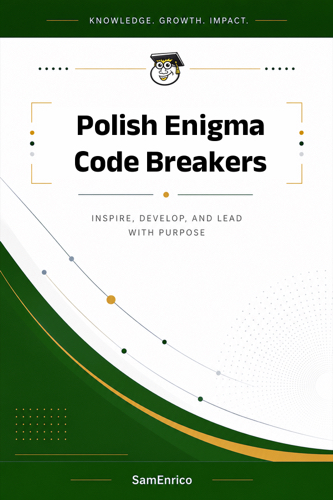
Polish Enigma Code Breakers eBook
Crack the German cipher machine before the war, th
Crack the German cipher machine before the war, then continue resistance from exile.
Formats
Free sample
Chapter 1: A Nation of Ghosts...--The man who would crack the unbreakable code was not a soldier, a spy, or a diplomat. He was a twenty-seven-year-old mathematician with wire-rimmed spectacles, a quiet wife, and a mind trained to see order where others saw only chaos. In the winter of 1932, Marian Rejewski sat in a cramped office in Warsaw's Saxon Palace, surrounded by stacks of intercepted German radio messages that looked like nonsense. The letters marched across the pages in seemingly random sequences—QXP BZM KRL...—and every other cryptanalyst in Europe had declared them impossible to decipher. The Germans themselves had staked their military communications on that impossibility.
They believed, with the unshakable confidence of engineers who had done the math, that their Enigma machine had created a cipher that would never be broken.They were wrong. They just did not know it yet.Rejewski leaned back in his chair, the wooden legs squeaking against the worn floorboards. He did not have a blueprint of the German machine. He had never seen one. What he had was something more powerful: the conviction that mathematics could uncover what engineering had hidden.
Somewhere in those strings of gibberish, he suspected, there was a pattern—not a visible pattern, but a structural one, buried in the relationships between letters, waiting to be extracted by the tools of permutation theory. He had learned those tools at the University of Poznań and later at Göttingen, one of the world's great centers of mathematical thought. Now he was about to apply them to the most urgent problem of his young nation's short and precarious existence.Poland, in 1932, had been back on the map for only fourteen years. After 123 years of partition—during which the country had been erased entirely, its name removed from European atlases, its people ruled from Berlin, Vienna, and St. Petersburg—the Second Polish Republic was a nation of ghosts.
Its borders were contested. Its economy was fragile. Its intelligence services were underfunded and overstretched. And it was surrounded by enemies. To the east, the Soviet Union had already tried to conquer Warsaw once, in 1920, and was still hungry for more.
To the west, Germany was beginning to stir under a new chancellor named Adolf Hitler, who had made no secret of his desire to reclaim the lands Poland had taken. Between these two giants, Poland existed on borrowed time.The Poles understood something that Britain and France did not. The great Western powers still thought of codebreaking as an art practiced by linguists and classicists—men who could guess at words based on context and intuition. Poland had no such luxury. It had no colonial empire to provide listening posts, no centuries-old tradition of foreign intelligence, no bottomless budget for espionage.
What it had was desperation. And desperation, as it turned out, was an excellent teacher.The Birth of the Cipher Bureau In 1919, just one year after regaining independence, the Polish General Staff established a small, secret unit called the Biuro Szyfrów—the Cipher Bureau. It began in a single room with a handful of officers who knew almost nothing about cryptography. Their first attempts to break Soviet codes were, by all accounts, embarrassing failures. They tried everything: linguistic analysis, guesswork, even the occasional bribe to Russian telegraph operators.
Nothing worked reliably. The Soviets changed their codes too often, and the Poles lacked the mathematical sophistication to keep up.But something interesting happened in those early years of frustration. The Polish military, searching for any advantage, made a decision that would shape the next two decades: they turned to the universities. France recruited its codebreakers from the ranks of classicists who could read Latin and Greek; Britain recruited from linguists who could parse German and Italian. Poland recruited from mathematics departments.
Specifically, they recruited from the University of Poznań, which had become a hotbed of a new kind of abstract mathematics—the kind that dealt not with numbers but with structures, permutations, and groups.In 1929, the Cipher Bureau began offering a secret course in cryptanalysis for select mathematics students. The students were told nothing about the course in advance; they simply received a notice to report to a certain room at a certain time. There, they were introduced to the principles of codebreaking as a mathematical discipline. Among those students were three young men who would become legends—though no one knew it yet.Marian Rejewski was the most naturally gifted of the three, a mathematician of rare intuition. Jerzy Różycki was the youngest, quick with calculations and possessed of a restless, searching intelligence.
Henryk Zygalski was the quietest, methodical and patient, the kind of man who would spend weeks designing a solution and then execute it with flawless precision. Together, they formed an unlikely trio: Rejewski the theorist, Różycki the speed demon, Zygalski the engineer. They were not soldiers. They were not spies. They were puzzle-solvers who happened to be working on the most important puzzle in the world.The Enemy's Machine To understand what these three men achieved, one must first understand the machine they were up against.
The German Enigma was not a single device but a family of cipher machines, the most advanced of which looked like a typewriter inside a wooden box. When an operator pressed a key, an electrical current traveled through a series of rotating wheels called rotors, each wired to scramble the letters in a specific way. The current then hit a reflector, which sent it back through the rotors along a different path, finally illuminating a lamp on the display board. The result: a letter that bore no obvious relationship to the one typed.The genius of the Enigma—from the German perspective—was its sheer combinatorial complexity. A standard military Enigma in the early 1930s had three rotors chosen from a set of five.
Each rotor had twenty-six starting positions. And then there was the plugboard, which allowed the operator to swap ten pairs of letters before and after the rotor encryption, adding another layer of scrambling. Multiply all these possibilities together, and the number of possible starting configurations was approximately 158 quintillion. That is 158 followed by eighteen zeros—more than the number of grains of sand on every beach on Earth.The Germans believed that this number made the Enigma unbreakable. They were not foolish to think so.
In 1930, no existing technology could test 158 quintillion possibilities in any reasonable amount of time. Even if a cryptanalyst could test one configuration per second, it would take five quadrillion years to try them all. The universe, by comparison, was only 13.8 billion years old. The math seemed airtight.But mathematics is a double-edged sword. The same abstract reasoning that convinced the Germans of their security could also be turned against them.
The Enigma had a flaw—not a design flaw in the sense of a broken part, but a mathematical consequence of the way it was built. The reflector, which sent the current back through the rotors, had a peculiar property: it made the cipher reciprocal. That is, if pressing A produced B, then pressing B would produce A. This might seem like a harmless symmetry, but it was a leak. Information…
This is the end of the free sample. Get the eBook to keep going. Buy now
About this book
Details
- Author
- Greenfield Jon
- Publisher
- SamEnrico
- Language
- English
- Genre
- Non-Fiction, History, Code Breaking
- Released
- 2026-06-08
- Pages (approx.)
- 134
- Available as
- eBook, Audiobook

Read better in the ZLOADR app
Your eBooks on your phone or tablet. Sign in with your SamEnrico account and start reading.
More by Greenfield Jon
 Distraction Proof Meeting CultureGreenfield Jon$11.99
 Studio Setup for HypnosisGreenfield Jon$11.99
 Gig Platform Healthcare GuideGreenfield Jon$11.99
 Growth Hormone and Hair GrowthGreenfield Jon$11.99
 Mindfulness for Job LossGreenfield Jon$11.99
 Writing Child's ObituaryGreenfield Jon$11.99
 Burnout Recovery Sleep HygieneGreenfield Jon$11.99
 The Silent Codebreakers: How WWII's Female Spies Cracked the EnigmaGreenfield Jon$11.99
 The Bullet That Changed Brazil: The 1964 Military Coup and Forensic ScienceGreenfield Jon$11.99
 How to Produce Winter SportsGreenfield Jon$11.99
 A Collector's Handbook to the Nsu Prinz IGreenfield Jon$11.99
 Offer Letter Legal Traps WorkbookGreenfield Jon$12.99