
Non-FictionHealth & WellnessGlobal Health
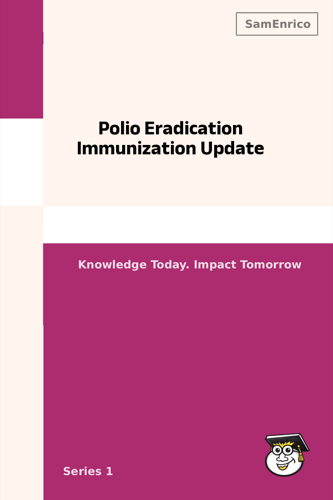
Polio Eradication Immunization Update eBook
IPV and OPV schedules and global status.
by Sells Keisha
IPV and OPV schedules and global status.
Formats
Free sample
Chapter 1: The Sewer Warning--The email arrived at the Rockland County Department of Health on a Tuesday in late June, buried beneath a dozen other routine alerts. The subject line was innocuous: "Environmental Sample Results – Week 25." The sender was the New York State Wastewater Surveillance Network, a system that had been expanded dramatically during the COVID-19 pandemic to track viral pathogens flowing through the region's sewage treatment plants. In 2020 and 2021, that system had detected the rise and fall of SARS-Co V-2 variants with remarkable precision, turning wastewater epidemiology from a niche academic curiosity into a mainstream public health tool. By 2022, the network was testing for over a dozen pathogens—influenza, RSV, monkeypox, and polio among them. Polio was included mostly as a formality.
The United States had been polio-free since 1979. No one expected the test to turn positive.But it did.The sample came from the Rockland County Wastewater Treatment Plant, which processes sewage from approximately 85,000 residents across several towns and villages north of New York City. The laboratory analysis detected genetic material from poliovirus. Further testing identified the specific strain as type 2 vaccine-derived poliovirus—c VDPV2. The genetic sequencing showed that the virus had been circulating for some time, accumulating mutations that indicated sustained person-to-person transmission.
This was not a one-off shedding event from a recently vaccinated traveler. This was an outbreak.Dr. Patricia Schnabel Ruppert, the Rockland County health commissioner, received the confirmation from the state lab on July 8. She had spent thirty years in public health, had responded to West Nile virus outbreaks, H1N1 influenza, the opioid epidemic, and COVID-19. But polio was supposed to be a settled matter.
The disease that had paralyzed her grandmother's generation—the disease that closed swimming pools and movie theaters in the 1950s, that sent terrified parents to keep their children indoors during summer months, that filled hospital wards with children in iron lungs—was not supposed to reappear in her county in 2022. And yet here it was, circulating silently in the sewage beneath her feet, invisible to the surveillance system that had been designed to detect it.The Rockland County health department declared a state of emergency on July 21. Mobile vaccination clinics were deployed to shopping center parking lots, community centers, and church basements. Public health officials appeared at every local news station, urging parents to check their children's vaccination records and to bring any unvaccinated or under-vaccinated child to a clinic immediately. The messaging was urgent but measured: the risk to the general population was low because most people were already vaccinated, but the virus was spreading, and every unvaccinated child was at risk.Meanwhile, across the Atlantic Ocean, another email had arrived at the UK Health Security Agency.
On June 22, routine wastewater sampling at the London Beckton Sewage Treatment Works—one of Europe's largest treatment facilities, serving approximately four million residents—had detected vaccine-derived poliovirus. The virus detected was c VDPV2, genetically distinct from the Rockland County strain but similarly concerning. Over the following weeks, additional positive samples emerged from other London treatment plants, indicating widespread circulation across the city. The UK Health Security Agency declared a national incident on August 10. Polio, a disease that the United Kingdom had eliminated in 2003, was back.Montreal followed in 2023.
Then Jerusalem. Then Jakarta. The pattern was consistent across continents: wastewater surveillance systems, originally designed for COVID-19, were detecting polio in communities where no paralysis cases had been reported. The virus was traveling on airplanes, crossing borders without detection, establishing silent chains of transmission in under-immunized communities. And no one had known until they looked in the sewers.The Polio Surveillance Paradox To understand why polio could circulate undetected in Rockland County, London, and Montreal for months or even years before wastewater sampling revealed its presence, one must understand the fundamental limitation of traditional polio surveillance.
Since the 1950s, the gold standard for polio detection has been Acute Flaccid Paralysis (AFP) surveillance. Every case of sudden limb weakness in a child under fifteen years—and in any person of any age if polio is suspected—must be reported to public health authorities. Stool samples are collected within fourteen days of paralysis onset and sent to WHO-accredited laboratories for testing. The system is sensitive, specific, and has been the backbone of polio eradication monitoring for decades.But AFP surveillance has an Achilles' heel: it only detects polio when polio causes paralysis. For every paralytic case, epidemiologists estimate that there are between one hundred and one thousand silent infections.
Most people infected with poliovirus—approximately 95 percent—experience no symptoms at all. Another 4 to 5 percent experience mild, flu-like symptoms that are never attributed to polio. Only about 0.5 percent of infections result in paralysis. This ratio, the asymptomatic-to-paralytic ratio, has been known since the 1950s and has shaped eradication strategy for generations. When wild poliovirus was circulating widely, the sheer volume of cases meant that AFP surveillance detected outbreaks reliably.
One paralytic case signaled hundreds or thousands of silent infections, but the signal was clear.In the IPV era, however, the relationship between infection and paralysis has been fundamentally altered. Inactivated polio vaccine—the Salk vaccine, the standard in high-income countries—protects against paralysis with remarkable efficacy. After a full course of IPV, a vaccinated individual has near-complete protection against developing paralytic polio. But IPV does not, as explained in the previous chapter, prevent infection or shedding. The virus can still replicate in the vaccinated individual's gut.
The individual can still shed infectious virus in their stool. And crucially, because IPV protects against paralysis, that individual will never appear in AFP surveillance data even if they are actively shedding virus to their community.This creates a surveillance paradox. In a population with high IPV coverage, poliovirus can circulate silently, infecting hundreds of individuals, causing zero paralysis cases, and producing zero AFP alerts. The traditional surveillance system goes blind precisely when it is most needed—during the final stages of eradication, when the goal is not just to stop paralysis but to interrupt all transmission. Wastewater surveillance, which bypasses the paralysis requirement entirely by detecting virus directly in the environment, has become the essential countermeasure to this blindness.The Biology of the Sabin Revertant The virus detected in Rockland County, London, and Montreal was not wild poliovirus.
It was vaccine-derived. To understand what that means and why it matters, one must understand the biology of the Sabin vaccine.Albert Sabin's oral polio vaccine, licensed in 1962, contains live but attenuated poliovirus. "Attenuated" means weakened—the virus has been modified through serial passage in non-human cells to reduce its ability to cause disease in humans. Sabin selected strains that replicated well in the human gut (producing strong mucosal immunity) but did not efficiently infect the central nervous system (the site of paralytic disease). The Sabin strains were never completely harmless—they could, in rare cases, cause Vaccine-Associated Paralytic Polio (VAPP) in approximately 1 in 2.7 million recipients—but they were orders of magnitude safer than wild poliovirus.However, the Sabin strains are not genetically stable.
When they replicate in the human gut, they accumulate mutations. Most of these mutations are neutral—they do not affect the virus's behavior. But some mutations occur in critical regions of the viral genome, particularly the 5'…
This is the end of the free sample. Get the eBook to keep going. Buy now
About this book
Details
- Author
- Sells Keisha
- Publisher
- SamEnrico
- Language
- English
- Genre
- Non-Fiction, Health & Wellness, Global Health
- Released
- 2026-06-06
- Pages (approx.)
- 147
- Available as
- eBook, Audiobook

Read better in the ZLOADR app
Your eBooks on your phone or tablet. Sign in with your SamEnrico account and start reading.
More by Sells Keisha
 The DBT Regulation ChallengeSells Keisha$11.99
 Gail Hoffman Ransom CallsSells Keisha$11.99
 Self Hypnosis for Fear of InsectsSells Keisha$11.99
 Daughter's ForgivenessSells Keisha$11.99
 Transcendental Meditation for BFRBsSells Keisha$11.99
 Body Acceptance Emotional EatingSells Keisha$11.99
 Whispers in the Wheatfields: The Ballad of the Vanishing HarvestSells Keisha$11.99
 The Green Revolutionaries: How Victorian Architects Built the FutureSells Keisha$11.99
 How to Produce a Sepro Mineral SystemSells Keisha$11.99
 How to Produce Flying Toy AccessoriesSells Keisha$11.99
 Climate Risk Insurance Regulatory GuideSells Keisha$12.99
 Generational Money Trauma WorkbookSells Keisha$12.99
You may also like
 Hong Kong Handover 1997Dunn Johnnie$11.99
 Zumba For Postnatal Recovery CourseNeal Christian$11.99
 Zumba for BeginnersLadner Nikia$11.99
 YouTube Comment Mining GuideHumes Pandora$12.99
 Worry Box MeditationCarlin Rudy$11.99
 Workplace Stress MeditationNguyen Lynn$11.99
 Workplace Stress and Sleep RepairHawley Ivory$11.99
 Workplace Perfectionism CureDelaney Jeffry$11.99
 Workplace Injustice Anger GuideWallen Isabelle$11.99
 Work Addiction and Burnout LinkGreenwood Ester$11.99
 Women in Yoga and WellnessBeattie Galina$11.99
 Women in Stand Up ComedyChun Evangeline$11.99