
Non-FictionInformativeEducational
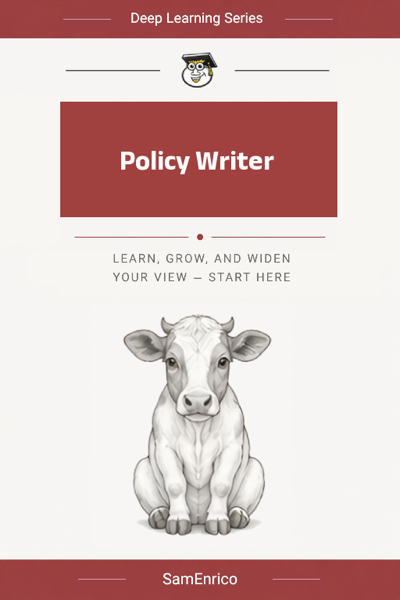
Policy Writer eBook
A Coursebook on Policy Writer
by Marlowe Sid
A Coursebook on Policy Writer
Formats
Free sample
Chapter 1: The 30-Second Scan--You have twenty-seven seconds.That is not a metaphor. That is not an exaggeration to make a point. That is the average amount of time a chief of staff, agency head, or legislative director spends on a first read of a policy document before deciding whether to finish it, file it, or delete it. Twenty-seven seconds. Less time than it takes to brew a single cup of coffee.
Less time than it takes to tie a pair of dress shoes. Less time than it takes to scroll through the first three posts on your social media feed.In twenty-seven seconds, a decision-maker will decide the fate of your analysis, your recommendation, and—if you are a junior analyst—potentially your career.This is not fair. You spent twenty-seven hours on that memo. You ran the numbers three times. You consulted with subject matter experts.
You wrote and rewrote the executive summary until 2 AM. You did everything your graduate school professors taught you. And then your memo landed in an inbox alongside forty-seven other messages, and someone with no patience and less sleep scanned it for less than half a minute and moved on.The problem is not your intelligence. The problem is not your work ethic. The problem is not even your writing ability, in the narrow sense of grammar and syntax.
The problem is that you are writing for an audience that does not exist.You are writing for a reader who has unlimited time, who reads every word in order, who wants to understand every nuance and caveat, and who will follow your argument from first sentence to last. That reader does not exist. That reader has never existed. And that reader certainly does not work in government, where the average workday includes four hours of meetings, two hours of email, one hour of unexpected crises, and approximately zero hours of quiet, contemplative reading.This book exists to close the gap between how you write and how your reader actually reads. This chapter, in particular, exists to introduce you to the single most important concept in policy writing: the 30-Second Scan, and its corollary, the distinction between Decision-Makers and Advisors.
Master these two concepts, and you will never again send a document that dies unread. Ignore them, and nothing else in this book will save you.The Reality of the Busy Reader Before we discuss how to write, we need to talk about who is reading. Not in the abstract. Not in the way your composition teacher meant when she said "know your audience." We need to talk about the specific, measurable, almost depressing reality of the policymaker's workday.Let us describe a typical morning for someone we will call Sarah. Sarah is a deputy chief of staff in a mid-sized mayoral office.
She arrives at her desk at 7:45 AM. By 7:46, she has opened her email. There are forty-three new messages from overnight. Among them: a draft executive order from legal counsel, three briefing requests from the city council, a press inquiry about a homeless encampment, eleven calendar invitations, two requests for signatures, a note from the mayor asking for a "quick thought" on a zoning variance, and seven messages that are either spam or newsletters she never unsubscribed from.At 8:00 AM, Sarah has her first meeting. At 8:30, she has her second.
At 9:00, the mayor calls with a question about a budget amendment. At 9:15, a reporter calls about a data breach in the IT department that Sarah did not even know existed. At 9:30, she finally returns to her inbox. There are now fifty-one messages.At no point in this morning did Sarah have a block of uninterrupted time longer than twelve minutes. At no point did she say to herself, "I will now sit down and read a policy memo from cover to cover with the attention it deserves." At no point did she pour a cup of coffee, close her door, and think deeply about the trade-offs between Option A and Option B.This is not because Sarah is a bad person.
This is not because Sarah does not care about policy. This is because Sarah's job is not to read. Her job is to make decisions, manage crises, and keep the mayor from saying something regrettable on live television. Reading is a means to those ends, not an end in itself. And reading is therefore compressed, rushed, and often delegated to a junior staffer who will summarize it for her in ninety seconds.This is the reader you are writing for.
Not a scholar. Not a student. Not a judge who will read every word of your brief. A person with fifty-one unread emails and a reporter on line two.The 30-Second Scan: What It Is and Why It Matters The 30-Second Scan is not a rule that someone invented for this book. It is an empirical finding from multiple studies of workplace reading behavior, adapted specifically for policy environments.
Researchers who have tracked eye movements and reading time in government offices have consistently found that the first read of a document—the read that determines whether the document will receive any further attention—lasts between twenty and thirty seconds.In those twenty-seven seconds, the reader answers four questions, usually without conscious awareness:First, what is this document about? Not the nuanced answer. The one-sentence answer. The subject line answer. The "can I explain this to my boss in six words" answer.Second, does this document require action from me?
The reader is looking for a clear signal: yes, I need to do something, or no, this is for my information only. If the answer is unclear, the document gets deferred. Deferred means dead.Third, how long is this document? This is not laziness. This is triage.
A document that appears long will be set aside for "later." Later never comes. The reader is not trying to be rude. The reader is trying to survive until 6 PM.Fourth, do I trust this document? This judgment happens almost instantly, based on formatting, tone, and the presence or absence of obvious errors. A typo in the first paragraph signals carelessness.
A missing date signals sloppiness. A document that looks unprofessional will be treated as unprofessional, regardless of the quality of its analysis.If your document answers these four questions poorly, it will never be read again. It will sit in an inbox, or a folder, or a stack of papers, until someone finally deletes it or files it in a place no one will ever look. Your analysis will have been correct. Your recommendation may have been brilliant.
And none of it will matter, because no one saw it.This is not hyperbole. This is the daily reality of policy writing. The best memo in the world is worthless if no one reads it.The Two Audiences: Decision-Maker vs. Advisor The 30-Second Scan explains why readers behave the way they do. But it does not yet tell you what to do about it.
For that, we need to introduce a distinction that will run through every chapter of this book: the difference between a Decision-Maker and an Advisor.A Decision-Maker is someone who has the authority…
This is the end of the free sample. Get the eBook to keep going. Buy now
About this book
Details
- Author
- Marlowe Sid
- Publisher
- SamEnrico
- Language
- English
- Genre
- Non-Fiction, Informative, Educational
- Released
- 2026-06-02
- Pages (approx.)
- 150
- Available as
- eBook, Audiobook

Read better in the ZLOADR app
Your eBooks on your phone or tablet. Sign in with your SamEnrico account and start reading.
More by Marlowe Sid
 Affirmation Friend Letter MethodMarlowe Sid$11.99
 Laci Peterson Burglary TheoryMarlowe Sid$11.99
 Netlify Hosting Outage ProtocolMarlowe Sid$11.99
 Spin Hill Repeats Training ManualMarlowe Sid$11.99
 The Workplace Emotion GuideMarlowe Sid$11.99
 Blood and Silk: The Siege of Antioch and the Birth of a Crusader StateMarlowe Sid$11.99
 Startup Visa Comparison GuideMarlowe Sid$12.99
 Understanding Vitamin B12 DeficiencyMarlowe Sid$17.99
 How to Start a Desalination Plant for Water Treatment Business (Beginners Guide)Marlowe Sid$11.99
You may also like
 Hong Kong Handover 1997Dunn Johnnie$11.99
 Zumba For Postnatal Recovery CourseNeal Christian$11.99
 Zumba for BeginnersLadner Nikia$11.99
 YouTube Comment Mining GuideHumes Pandora$12.99
 Worry Box MeditationCarlin Rudy$11.99
 Workplace Stress MeditationNguyen Lynn$11.99
 Workplace Stress and Sleep RepairHawley Ivory$11.99
 Workplace Perfectionism CureDelaney Jeffry$11.99
 Workplace Injustice Anger GuideWallen Isabelle$11.99
 Work Addiction and Burnout LinkGreenwood Ester$11.99
 Women in Yoga and WellnessBeattie Galina$11.99
 Women in Stand Up ComedyChun Evangeline$11.99