
Non-FictionSelf-HelpLaw EnforcementInterrogation
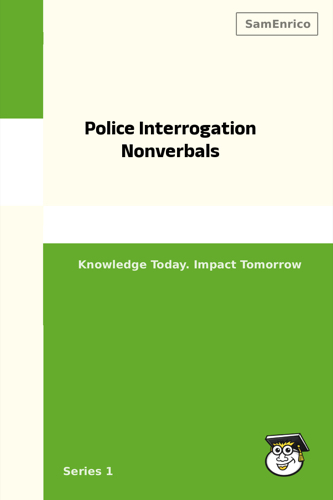
Police Interrogation Nonverbals
Detect deception and build rapport using body lang
by Lentz Dann
Detect deception and build rapport using body language reading.
Formats
About this book
Free sample
Chapter 1: The Honest Witness--–- The fluorescent lights hummed overhead, casting a sterile glow on the beige walls of the interrogation room. Across the table sat a man suspected of a crime he vehemently denied. His words were confident, his denials rehearsed, his eyes locked on mine with a practiced sincerity. To the untrained observer, he appeared truthful. But I wasn’t watching his eyes.
I was watching his feet. They were pointed directly at the door, the toes gripping the floor as if ready to spring. His hands, resting calmly on the table, said one thing. His lower body, hidden beneath the table, said another. In that moment, I learned a fundamental truth that would define my entire career: the body has a language of its own, and it almost never lies.This is the paradox at the heart of police interrogation.
We are trained to listen to words, to parse statements, to catch suspects in verbal contradictions. Yet the most truthful witness in the room is often the one who never speaks a word. The body, unlike the mouth, does not rehearse. It does not strategize. It does not calculate the consequences of its movements.
It simply responds—immediately, reflexively, and honestly—to the world as the brain perceives it. For the investigator who learns to read this silent language, every interrogation becomes a conversation with two witnesses: the suspect who speaks and the body that cannot lie.This chapter establishes the biological and neurological foundation for all subsequent nonverbal analysis. It introduces the Triune Brain model—reptilian, limbic, and neocortex—a concept popularized by former FBI agent Joe Navarro and validated by decades of neuroscience research. The core argument is simple but profound: the limbic system, the brain’s emotional and survival center, reacts to perceived threats and stress far more rapidly than the rational neocortex. In an interrogation setting, this means a deceptive suspect’s body will often “leak” truth through reflexive behaviors before the conscious mind can censor them.
Understanding this biological reality transforms interrogation from an art of persuasion into a science of observation.The Myth of the Human…
This is the end of the free sample. Get the eBook to keep going. Buy now
Contents
- Chapter 1
- Chapter 2
- Chapter 3
- Chapter 4
- Chapter 5
- Chapter 6
- Chapter 7
- Chapter 8
- Chapter 9
- Chapter 10
- Chapter 11
- Chapter 12
Details
- Author
- Lentz Dann
- Publisher
- SamEnrico
- Language
- English
- Genre
- Non-Fiction, Self-Help, Law Enforcement, Interrogation
- Released
- 2026-06-10
- Pages (approx.)
- 160
- Available as
- eBook, Audiobook

Read better in the ZLOADR app
Your eBooks on your phone or tablet. Sign in with your SamEnrico account and start reading.
More by Lentz Dann
 Market Stall Product DemosLentz Dann$11.99
 Canva Brand Font Pairing GuideLentz Dann$11.99
 Vaping Cessation for TeensLentz Dann$11.99
 The Leshy's Shadow WarLentz Dann$11.99
 AI Medical Transcription WorkflowsLentz Dann$12.99
 Learn to Play the SchwyzerörgeliLentz Dann$11.99
 How to Start a Cloth (wholesale) Business (Beginners Guide)Lentz Dann$11.99
 Electro TechnicianLentz Dann$11.99
You may also like
 Hong Kong Handover 1997Dunn Johnnie$11.99
 Zumba For Postnatal Recovery CourseNeal Christian$11.99
 Zumba for BeginnersLadner Nikia$11.99
 YouTube Comment Mining GuideHumes Pandora$12.99
 Worry Box MeditationCarlin Rudy$11.99
 Workplace Stress MeditationNguyen Lynn$11.99
 Workplace Stress and Sleep RepairHawley Ivory$11.99
 Workplace Perfectionism CureDelaney Jeffry$11.99
 Workplace Injustice Anger GuideWallen Isabelle$11.99
 Work Addiction and Burnout LinkGreenwood Ester$11.99
 Women in Yoga and WellnessBeattie Galina$11.99
 Women in Stand Up ComedyChun Evangeline$11.99