
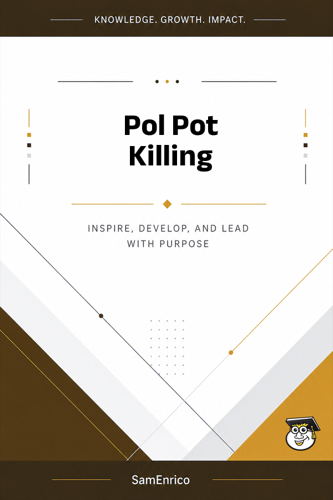
Pol Pot Killing eBook
Chronicles the Khmer Rouge leader's genocide.
Chronicles the Khmer Rouge leader's genocide.
Formats
Free sample
Chapter 1: The Mediocre Student...--–- He was the kind of boy teachers forgot. In the dusty classrooms of rural Kampong Thom province, in the red-soiled village of Prek Sbauv, a child named Saloth Sar sat near the back, head down, avoiding eye contact. He was not the smartest. He was not the strongest. He was not the most curious or the most charming.
He was, by every surviving account, profoundly average—a boy who completed his assignments without distinction, spoke rarely, and left no impression on anyone who met him. No prophecy foretold his future. No village elder whispered that this child would one day be responsible for the deaths of nearly two million people. If anything, those who remembered young Saloth Sar recalled a boy so unremarkable that they later struggled to recall his face at all.This is the first and most unsettling fact about Pol Pot: he was not born a monster. He became one through a specific, avoidable alchemy of colonial humiliation, ideological indoctrination, personal mediocrity disguised as revolutionary purity, and the slow corrosion of a conscience that was never particularly robust to begin with.
The story of how a quiet, failed scholarship student became Brother Number One—the dictator who emptied Cambodia's cities, abolished its families, and turned its fertile fields into killing grounds—is not a story about madness. It is a story about ordinary men who convinced themselves that extraordinary violence was a form of virtue. And it begins, as so many horrors do, with a young man who wanted desperately to belong to something larger than himself.The Boy Who Disappeared in Plain Sight Saloth Sar was born around May 19, 1925—the exact date is uncertain, because no one thought to write it down—into a moderately prosperous farming family in Kompong Thom province, about ninety miles north of Phnom Penh. His father, Saloth Pen, was a respected rice farmer who owned substantial land and several oxen. His mother, Sok Nem, came from a family with minor connections to the Cambodian royal court.
By the standards of rural Cambodia under French colonial rule, the Saloth family was comfortable, even privileged. They were not the desperately poor peasants who would later form the backbone of the Khmer Rouge's revolutionary army. They were, in a sense, the rural middle class—people with something to lose.Saloth Sar was the eighth of nine children, a position that often breeds either desperate attention-seeking or comfortable anonymity. In his case, it bred anonymity. His older siblings were more outgoing, more successful in school, more remembered.
One brother, Saloth Chhay, would later become a court official under Prince Norodom Sihanouk. Another, Loth Suong, worked as a clerk in the French colonial administration. The family sent its brightest children to Phnom Penh for education. But Saloth Sar? He stayed home longer than his siblings.
When he finally attended the local pagoda school, his teachers described him as "passable"—not failing, not excelling, simply present.This mediocrity followed him to Phnom Penh when he was finally sent there in the late 1930s. He enrolled at the École Miche, a Catholic primary school run by French priests. By all accounts, he struggled. His French was poor. His mathematics were worse.
He was, in the cruel calculus of colonial education, a disappointment to a family that had invested hope in him. After several years, he failed to gain admission to the prestigious Lycée Sisowath, the elite secondary school that produced Cambodia's future administrators and intellectuals. Instead, he was sent to a technical school in Kompong Cham province to learn carpentry—a trade, not a profession.This failure marked him. In a family of overachievers, Saloth Sar was the one who couldn't keep up. He was the brother who didn't get the court appointment, who didn't speak elegant French, who didn't impress the colonial masters.
Later, revolutionary propaganda would transform this into a virtue—the pure peasant rejecting the corrupt city, the simple carpenter choosing honest labor over bourgeois comfort. But the truth is less flattering. Saloth Sar did not reject the colonial education system; the colonial education system rejected him. And he never forgot it.The Journey to Paris: A Mediocre Student Abroad In 1949, Saloth Sar received an unexpected second chance. Cambodia was in the midst of a complicated transition—still a French colony but moving toward a form of internal autonomy.
As part of France's efforts to train a compliant local elite, technical scholarships were offered to promising Cambodian students. Saloth Sar, now twenty-four years old and with a carpentry certificate that impressed no one, applied. He was accepted. He boarded a steamer in Saigon and traveled for weeks—through Singapore, through the Suez Canal, through the Mediterranean—to Marseille, and from there to Paris.He was supposed to study radio electronics at the École Française de Radioélectricité. This was a practical skill, not an intellectual pursuit.
France needed technicians who could maintain colonial infrastructure, not philosophers who could question colonial authority. Saloth Sar arrived with minimal French language skills, a thin educational foundation, and no clear ambition beyond survival.In Paris, he discovered two things that would change his life: communism and humiliation.The first discovery was gradual. Paris in the late 1940s and early 1950s was a city of intense political ferment. The trauma of Nazi occupation was fresh. The French Communist Party was one of the largest political movements in the country.
Intellectuals debated Marxism in cramped cafes, and students from the colonies found in communist theory a language that explained—or seemed to explain—their subjugation. Saloth Sar fell in with a small circle of Cambodian students who gathered to read revolutionary texts, argue about dialectics, and imagine a future without French masters.The circle included men who would become the Khmer Rouge's inner leadership: Ieng Sary, a charismatic and politically sophisticated student from the southern province of Takeo; Khieu Samphan, a brilliant economist who would later write his doctorate on the question of Cambodian industrial development under colonialism; Son Sen, a quiet, intense young man who would become the regime's defense minister. These were not mediocre students. Ieng Sary was sharp-tongued and well-connected. Khieu Samphan was genuinely brilliant, his doctoral thesis winning a prestigious prize.
Son Sen was disciplined and methodical.And then there was Saloth Sar—the oldest of the group, but the least impressive. His grades were poor. His French remained halting. His contributions to discussions were, according to fellow students who survived to give testimony, rarely original and often confused. He was, in the words of one contemporary, "a follower, not a leader."This leads to the second discovery: humiliation.
The French left, for all its anti-colonial rhetoric, was not immune to colonial prejudice. The Cambodian students were tolerated, even welcomed into communist circles, but they were not treated as equals. They were exotic curiosities—natives who could quote Marx, which was charming but not threatening. French communist intellectuals would pat them on the head, praise their enthusiasm, and then turn to more important conversations among themselves.For the brilliant ones—Ieng Sary, Khieu Samphan—this treatment bred a cold, calculating rage. They would remember the slights and repay them later in blood.…
This is the end of the free sample. Get the eBook to keep going. Buy now
About this book
Details
- Author
- Almond Hannelore
- Publisher
- SamEnrico
- Language
- English
- Genre
- Non-Fiction, Biography, Dictator
- Released
- 2026-06-09
- Pages (approx.)
- 150
- Available as
- eBook, Audiobook

Read better in the ZLOADR app
Your eBooks on your phone or tablet. Sign in with your SamEnrico account and start reading.
More by Almond Hannelore
 Indian BPO Data Security GuideAlmond Hannelore$12.99
 Opioid Recovery and Anger ManagementAlmond Hannelore$11.99
 Pattern Recognition for DesignersAlmond Hannelore$11.99
 The Dream Journal WorkbookAlmond Hannelore$11.99
 Parallel Parking Frustration GuideAlmond Hannelore$11.99
 Imposter Syndrome for EntrepreneursAlmond Hannelore$11.99
 Sleep Hygiene for MemoryAlmond Hannelore$11.99
 Gridiron Warrior Mindset TrainingAlmond Hannelore$11.99
 Dopamine Agonist AugmentationAlmond Hannelore$11.99
 Whispers of the Jade Serpent: China's Forgotten Dragon CultAlmond Hannelore$11.99
 The Vanishing Hiker of the Appalachian TrailAlmond Hannelore$11.99
 Growing Pyrola (Wintergreen)Almond Hannelore$11.99
You may also like
 Hong Kong Handover 1997Dunn Johnnie$11.99
 Zumba For Postnatal Recovery CourseNeal Christian$11.99
 Zumba for BeginnersLadner Nikia$11.99
 YouTube Comment Mining GuideHumes Pandora$12.99
 Worry Box MeditationCarlin Rudy$11.99
 Workplace Stress MeditationNguyen Lynn$11.99
 Workplace Stress and Sleep RepairHawley Ivory$11.99
 Workplace Perfectionism CureDelaney Jeffry$11.99
 Workplace Injustice Anger GuideWallen Isabelle$11.99
 Work Addiction and Burnout LinkGreenwood Ester$11.99
 Women in Yoga and WellnessBeattie Galina$11.99
 Women in Stand Up ComedyChun Evangeline$11.99