
Non-FictionHealth & WellnessAdvanced
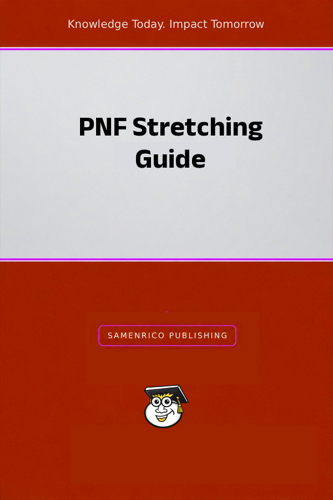
PNF Stretching Guide eBook
Teaches proprioceptive neuromuscular facilitation
Teaches proprioceptive neuromuscular facilitation for advanced flexibility.
Formats
Free sample
Chapter 1: The Negotiation Room--–- You are not tight. Your nervous system is just afraid.Let that sink in for a moment. For years, you have been told that your hamstrings feel like steel cables because they are "short." You have been told that your hips are locked up because your psoas is "tight." You have been told that your inability to touch your toes is a simple matter of tissue length – as if your muscles are ropes that need to be physically stretched longer, millimeter by painful millimeter.That explanation is wrong. And believing it has cost you years of wasted effort.The truth is more interesting, more hopeful, and entirely within your control. Your muscles are not ropes.
They are not rubber bands. They are organs controlled by a hyper-vigilant, risk-averse, and endlessly adaptable nervous system. When you feel "tight," you are not experiencing a shortage of tissue length. You are experiencing a neurological decision – a decision made by your brain to apply the brakes before you get hurt.This chapter is about entering what I call the Negotiation Room. It is the space between what your body can physically do and what your nervous system will allow you to do.
In this room, you are not the enemy of your tight muscles. You are a diplomat negotiating with a frightened security guard. And the tool you will use to win that negotiation is called Proprioceptive Neuromuscular Facilitation – PNF for short.By the end of this chapter, you will understand why static stretching fails, how your brain's fear sensors work, and why a six-second contraction can unlock range of motion that thirty minutes of passive pulling never could.The Myth of the Short Muscle Let us start with a simple experiment you can perform right now while reading this book.Sit on the floor with your legs extended straight in front of you. Do not strain. Simply sit upright and notice where your hamstrings feel.
Now, without moving your torso, bend one knee slightly – just a few degrees. What happens to the sensation of tightness?For the vast majority of people, the tightness dramatically decreases or disappears entirely. But here is the problem: bending your knee did not lengthen your hamstring. In fact, bending the knee shortens the hamstring muscle. The distance from your sit bone to the back of your knee actually decreased.
By every measure of tissue length, your hamstring became shorter, not longer. Yet the feeling of tightness vanished.This single observation dismantles the entire "short muscle" theory of inflexibility.What you just experienced is your nervous system changing its mind. When you straightened your knee, the hamstring was placed under tension, and your muscle spindles – the fear sensors we will discuss shortly – sent an urgent message to your brain: "Warning! Tension detected! Possible tissue damage imminent!" Your brain responded by applying the brakes, creating the sensation of tightness.
When you bent your knee, you removed that tension, and the brakes released.Your muscle length did not change. Your nervous system's permission changed.This is the single most important concept in this entire book. Flexibility is not a battle of tissue length. It is a negotiation with your nervous system. And once you understand the rules of that negotiation, you can win every time.The Two Guards at the Gate Your nervous system has two specialized sensory receptors that control the stretch reflex.
Think of them as two guards standing at the gate of every muscle, each with a different job description.Guard Number One: The Muscle Spindle (The Fear Sensor)Muscle spindles are tiny, cigar-shaped sensory receptors embedded within your muscle fibers. Their sole purpose is to detect changes in muscle length – specifically, how fast and how far a muscle is being stretched.Imagine a smoke alarm. A smoke alarm does not care about a gentle wisp of steam from a hot shower. But the moment it detects a sudden burst of smoke, it screams. Muscle spindles work the same way.
A slow, controlled stretch barely registers. But a rapid, forceful stretch – or a stretch that approaches what your brain perceives as the "danger zone" – triggers an immediate, involuntary muscle contraction. This is the stretch reflex, the same reflex a doctor triggers when they tap your patellar tendon and your leg kicks out.The muscle spindle is a fear sensor. Its job is to protect you from tearing your own muscles by pulling too hard or too fast. And it is very good at its job.Guard Number Two: The Golgi Tendon Organ (The Safety Valve)The Golgi tendon organ, or GTO, lives in a different neighborhood.
It is located where your muscle meets your tendon – the transition zone between contractile tissue and connective tissue. The GTO does not measure muscle length. It measures muscle tension. Specifically, it measures how much force is being generated by a muscle contraction.Here is where it gets interesting. When a muscle contracts with sufficient force – typically around 30-50% of its maximum capacity – the GTO sends a signal that overrides the muscle spindle.
It essentially says: "This muscle is generating so much tension that continuing to resist might cause injury. I am going to force the muscle to relax."This is called autogenic inhibition. The muscle's own tension triggers its own relaxation. It is a built-in safety valve designed to prevent you from tearing your tendon off the bone during a maximal contraction.Let me say that again because it is the entire foundation of this book: When a muscle contracts with moderate to high force, its own tension triggers a neurological reflex that forces it to relax.You have experienced this reflex without knowing it. Have you ever been lifting something heavy – a couch, a suitcase, a barbell – and suddenly felt your grip give out or your legs buckle?
That was not muscle failure in the sense of exhaustion. That was your GTO deciding that the tension had reached a dangerous threshold and shutting down the muscle to protect your connective tissue.The PNF "hack" is simple and elegant: you intentionally trigger the GTO reflex by performing a controlled, submaximal contraction of a stretched muscle. The GTO forces the muscle to relax. And in that window of neurological inhibition – which lasts about ten to fifteen seconds – you can stretch the muscle further than your muscle spindles would normally allow.Why Static Stretching Hits a Wall Now you understand why traditional static stretching – the kind where you passively hold a position for thirty seconds while counting your breaths – has such limited effectiveness.Static stretching does not trigger the GTO. When you passively relax into a stretch, you are not contracting the muscle.
You are simply waiting for the muscle spindles to habituate – to get bored and stop sending fear signals. This process takes time, and it is easily reversed. The moment you stand up and move around, the spindles reset, and your "gains" evaporate.Static stretching also fails to address reciprocal inhibition, the second neurological mechanism we will explore in Chapter 2. But for now, understand this: static stretching asks your nervous system to stop being afraid. PNF, by contrast, gives your nervous system a reason to relax.
Instead of fighting the stretch reflex, you use it as a tool.A 2022 meta-analysis published in the Journal of Sports…
This is the end of the free sample. Get the eBook to keep going. Buy now
About this book
Details
- Author
- Sommers Meryl
- Publisher
- SamEnrico
- Language
- English
- Genre
- Non-Fiction, Health & Wellness, Advanced
- Released
- 2026-06-10
- Pages (approx.)
- 158
- Available as
- eBook, Audiobook

Read better in the ZLOADR app
Your eBooks on your phone or tablet. Sign in with your SamEnrico account and start reading.
More by Sommers Meryl
 Uber Acceptance Rate GuideSommers Meryl$11.99
 Pandemic Call Center ProtocolSommers Meryl$11.99
 REIT Dividend Investing PrimerSommers Meryl$11.99
 Foster Care Summer CampSommers Meryl$11.99
 Subway Station Memory RouteSommers Meryl$11.99
 Opioid Sleep Apnea GuideSommers Meryl$11.99
 Recovery After Exhaustion PhaseSommers Meryl$11.99
 The Skyward Pioneers: Black Genius in the Nobel SciencesSommers Meryl$11.99
 The Iron Queen of Meroë: A Love Forged in FireSommers Meryl$11.99
 How to Produce Matte FinishSommers Meryl$11.99
 Growing AbromaSommers Meryl$11.99
 How to Produce Window Treatment AccessoriesSommers Meryl$11.99
You may also like
 Hong Kong Handover 1997Dunn Johnnie$11.99
 Zumba For Postnatal Recovery CourseNeal Christian$11.99
 Zumba for BeginnersLadner Nikia$11.99
 YouTube Comment Mining GuideHumes Pandora$12.99
 Worry Box MeditationCarlin Rudy$11.99
 Workplace Stress MeditationNguyen Lynn$11.99
 Workplace Stress and Sleep RepairHawley Ivory$11.99
 Workplace Perfectionism CureDelaney Jeffry$11.99
 Workplace Injustice Anger GuideWallen Isabelle$11.99
 Work Addiction and Burnout LinkGreenwood Ester$11.99
 Women in Yoga and WellnessBeattie Galina$11.99
 Women in Stand Up ComedyChun Evangeline$11.99