
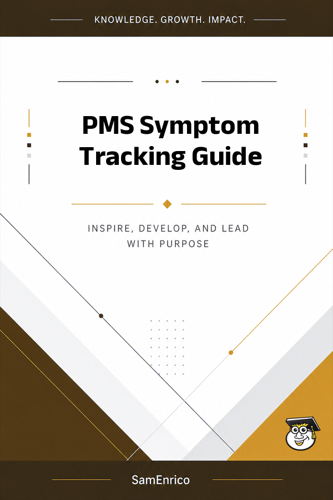
Non-FictionHealth & WellnessSymptom Tracking
PMS Symptom Tracking Guide eBook
Log mood, bloating, and cramps across cycles to id
by Held Marlin
Log mood, bloating, and cramps across cycles to identify patterns and triggers.
Formats
Free sample
Chapter 1: Your Inner Weather Map--–- You wake up one morning and the world looks gray. Not literally—the sun might be shining, the birds singing, your coffee tastes exactly the way you like it. But something is off. The person in the mirror seems like a stranger wearing your face. You feel heavy, irritable, or inexplicably sad.
Perhaps your abdomen feels like a tightly wound balloon. Perhaps your patience for your partner, your children, or your own thoughts has evaporated overnight. You scroll back through your mental calendar trying to find what went wrong. Did you eat something? Did someone say something?
Did you sleep poorly? The answer, more often than not, is simpler and stranger than any of those: your hormones changed, and your brain and body followed.This chapter is not about tracking yet. It is about something more fundamental: permission to stop blaming yourself for a biological process you never chose. For decades, the cultural script around premenstrual symptoms has been a toxic mixture of dismissal ("it's just PMS"), self-help platitudes ("just relax more"), and outright gaslighting ("all women feel this way, stop complaining"). That ends here.
This book operates from a single, unshakeable premise: your premenstrual symptoms are real, they are measurable, and they are not a personality flaw. You are not "too sensitive," "crazy," or "dramatic." You are experiencing a predictable biological event that, for millions of people, produces profound changes in mood, pain perception, digestion, energy, and cognition. The goal of this chapter is to give you the language and framework to understand what is actually happening inside your body during the ten to fourteen days before your period—and to help you distinguish between the kind of symptoms that are annoying but manageable and the kind that require medical attention.This chapter introduces the concept of your "menstrual fingerprint"—the unique pattern of symptoms that your body produces cycle after cycle. No two people have identical fingerprints, and no two people have identical premenstrual experiences. Some people feel primarily physical symptoms: bloating, breast tenderness, cramps, headaches.
Others feel primarily emotional symptoms: irritability, anxiety, rage, sudden sadness. Many feel a mix of both. Some have symptoms that begin exactly three days before bleeding and vanish the moment blood appears. Others have symptoms that start two full weeks before bleeding and linger for days after. None of these patterns are "wrong." The only wrong approach is the one that tells you to ignore your symptoms, push through them, or accept them as an unchangeable punishment for having a uterus.By the end of this chapter, you will understand the basic architecture of your menstrual cycle with a specific focus on the phase that causes most of the trouble.
You will be able to identify whether your symptoms fall into the category of functional PMS, clinical PMDD, or premenstrual exacerbation of an underlying condition. And you will complete a simple but powerful self-assessment that will serve as your baseline before you log a single symptom. This is not a chapter that requires any special tools or daily commitment. It requires only that you bring your lived experience and a willingness to see it through a new lens.The Architecture of a Cycle: Why the Luteal Phase Changes Everything To understand premenstrual symptoms, you have to understand the hormonal script that your body follows each month. The menstrual cycle is not a flat line with one dramatic event (bleeding) surrounded by nothingness.
It is a dynamic, four-act play with distinct hormonal characters entering and exiting the stage. Here are the four phases simplified:The menstrual phase (bleeding) is Day 1 through approximately Day 5 to 7. During this time, estrogen and progesterone are both low. Many people feel a sense of physical relief during this phase because the symptoms that plagued them in the premenstrual week suddenly vanish. This is not random.
It is chemical.The follicular phase follows bleeding and lasts until ovulation. This phase can be as short as seven days or as long as twenty-one days, depending on your cycle length. Estrogen rises steadily during this phase, and for most people, this brings increasing energy, optimism, social confidence, and physical strength. This is the phase where you feel most like your "best self." Many people mistakenly believe this is their "normal" and that the luteal phase is an aberration. In truth, both are normal—they are just different hormonal states.Ovulation itself is a brief event, usually lasting less than twenty-four hours, when a mature egg is released.
Estrogen peaks right before ovulation, and for some people, this is the peak of their physical and emotional energy for the entire cycle.Then comes the phase that is the subject of this entire book: the luteal phase. The luteal phase begins immediately after ovulation and lasts until the first day of bleeding. Its length is the most stable feature of the menstrual cycle, typically lasting ten to fourteen days and varying by no more than a day or two from cycle to cycle in the same person. During the luteal phase, the empty follicle that released the egg transforms into a structure called the corpus luteum, which produces large amounts of progesterone. Progesterone is not a "bad" hormone.
It is essential for preparing the uterine lining for a potential pregnancy. But for many people, the rise in progesterone—and particularly the way their brain processes progesterone metabolites—produces a cascade of side effects that range from mildly annoying to completely disabling.The most important progesterone metabolite for our purposes is allopregnanolone. This compound acts on GABA receptors in the brain, the same receptors targeted by anti-anxiety medications like benzodiazepines. For most people, allopregnanolone produces a calming, sedating effect. But for a significant minority—estimates range from five to eight percent of menstruating people—allopregnanolone produces the opposite effect.
Instead of calming the brain, it triggers anxiety, irritability, rage, and emotional lability. This is not a psychological weakness. It is a genetic and neurobiological variation in how GABA receptors respond to allopregnanolone. You cannot meditate or "think positive" your way out of a receptor-level biochemical reaction. This is one of the most important sentences in this entire book: your premenstrual mood changes are not caused by a failure of willpower, character, or mental hygiene.
They are caused by a predictable, measurable, biological reaction that happens in your brain every single month.In addition to the neurological effects of progesterone, the luteal phase also brings changes in fluid balance (driven by aldosterone, which causes water retention), pain perception (progesterone lowers the threshold for pain in some people), digestion (progesterone slows gut motility, leading to constipation and gas), and energy regulation (progesterone has a sedating effect that compounds with poor sleep quality).Beyond the 28-Day Myth: Why Your Cycle Length Matters Before we go any further, a crucial clarification. You will notice that this chapter refers to a "typical 28-day cycle" as a reference point. This is the average used in medical textbooks, but very few real people have a perfectly regular 28-day cycle. Your cycle might be 24 days, 32 days, 35 days, or something entirely different. What matters is not the total length but the stability of your luteal phase.
In a healthy cycle, the luteal phase should be relatively consistent from month to month—usually varying by less than two…
This is the end of the free sample. Get the eBook to keep going. Buy now
About this book
Details
- Author
- Held Marlin
- Publisher
- SamEnrico
- Language
- English
- Genre
- Non-Fiction, Health & Wellness, Symptom Tracking
- Released
- 2026-06-06
- Pages (approx.)
- 146
- Available as
- eBook, Audiobook

Read better in the ZLOADR app
Your eBooks on your phone or tablet. Sign in with your SamEnrico account and start reading.
More by Held Marlin
 Personal Ing For Success StoryHeld Marlin$11.99
 Breath Counting for Test AnxietyHeld Marlin$11.99
 Reddit Personal Finance BragHeld Marlin$11.99
 Loneliness And Travel GuideHeld Marlin$11.99
 The Ballot and the Bomb: How One Election Night Changed Nuclear HistoryHeld Marlin$11.99
 Blood, Sweat, and Lies: The Untold Story of the 1988 Seoul Olympics Doping Cover-UpHeld Marlin$11.99
 Continuous Wave Laser TechnicianHeld Marlin$11.99
 Real Estate Stock GuideHeld Marlin$12.99
 Decision Making FrameworkHeld Marlin$12.99
 Understanding DysmorphophobiaHeld Marlin$17.99
 How to Become a Sawmill WorkerHeld Marlin$11.99
You may also like
 Hong Kong Handover 1997Dunn Johnnie$11.99
 Zumba For Postnatal Recovery CourseNeal Christian$11.99
 Zumba for BeginnersLadner Nikia$11.99
 YouTube Comment Mining GuideHumes Pandora$12.99
 Worry Box MeditationCarlin Rudy$11.99
 Workplace Stress MeditationNguyen Lynn$11.99
 Workplace Stress and Sleep RepairHawley Ivory$11.99
 Workplace Perfectionism CureDelaney Jeffry$11.99
 Workplace Injustice Anger GuideWallen Isabelle$11.99
 Work Addiction and Burnout LinkGreenwood Ester$11.99
 Women in Yoga and WellnessBeattie Galina$11.99
 Women in Stand Up ComedyChun Evangeline$11.99