
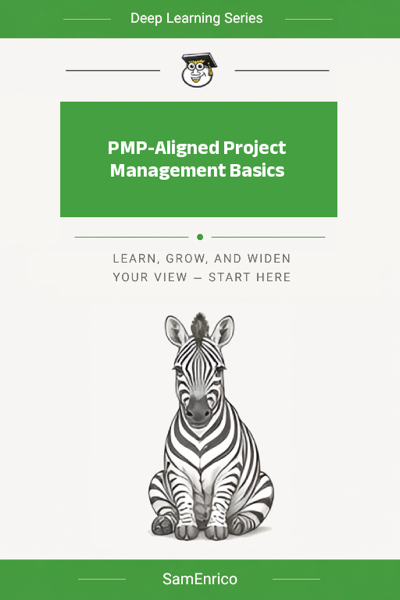
Non-FictionInformativeEducational
PMP-Aligned Project Management Basics eBook
A Coursebook on PMP-Aligned Project Management Bas
A Coursebook on PMP-Aligned Project Management Basics
Formats
Free sample
Chapter 1: The Value Lie...--Most project managers believe they are in the business of delivering on time and on budget. They are wrong.If you have ever managed a project that finished exactly on schedule and exactly within budget—only to have the stakeholder shrug and say, “That’s nice, but we expected more”—then you have already lived the central contradiction of modern project management. The tools, techniques, and certifications you have been taught prioritize predictability over value. And predictability, as it turns out, is not what your customers pay for.This chapter dismantles the most dangerous assumption in project management: that success equals compliance with a plan. You will learn why projects exist, what “value” actually means, and why the project manager’s role has shifted from controller to integrator to—in some contexts—servant leader.
By the end of this chapter, you will see every project you touch through a new lens. The lens of value delivery.Let us begin with a story.The Dashboard That Took Six Months Too Long A mid-sized technology firm—let us call it Greenfield Technologies—faced a crisis. Customer churn had risen to 18 percent annually, and exit interviews consistently cited the same complaint: “We cannot see our data in real time.” The company’s legacy analytics platform updated once every 24 hours. Competitors offered dashboards that refreshed in seconds.The executive team approved a project to build the Greenfield Smart Dashboard: an Io T‑based analytics platform that would ingest streaming data from customer devices and display visualizations with sub‑second latency. The business case projected a 20 percent reduction in churn within twelve months of launch.
The project budget was $2.4 million. The schedule was nine months.A certified Project Management Professional (PMP) was assigned. She built a detailed work breakdown structure, a critical path schedule, a risk register, and a change control board. She executed the project exactly as the PMBOK® Guide’s predictive (waterfall) methodology prescribed. She tracked earned value weekly.
She never missed a status report.The project launched in nine months and one week—a negligible delay. It came in $37,000 under budget.Six months after launch, churn had dropped by only 3 percent. Users hated the dashboard. It had every feature the requirements document specified, but those requirements had been frozen eighteen months before launch. In the intervening time, competitors had added artificial intelligence recommendations, natural language queries, and predictive alerts.
Greenfield’s Smart Dashboard was technically flawless and commercially irrelevant.The project was a success by every traditional metric. And it was a failure where it mattered most.The Fundamental Distinction: Projects vs. Operations Before we can talk about project success, we must distinguish projects from the thing they are not: operations. This distinction is not academic. Confusing the two is a primary cause of project failure.Operations are ongoing, repetitive, and process‑driven.
An automobile assembly line is an operation. Processing payroll every two weeks is an operation. Operating a data center is an operation. Operations execute the same activities repeatedly, optimize for efficiency, and continue indefinitely. The goal of operations is consistency and predictability.Projects are temporary, unique, and driven by uncertainty.
Designing a new automobile model is a project. Implementing a new payroll system is a project. Migrating a data center to the cloud is a project. Projects have defined start and end dates, produce unique deliverables, and dissolve upon completion. The goal of a project is not efficiency—it is effectiveness.
Projects exist to create something that does not yet exist.This difference explains why project management requires different tools than operations management. An operations manager can use statistical process control to reduce variance; a project manager cannot, because the work is non‑repeating. An operations manager can rely on historical data to predict throughput; a project manager often cannot, because the work has never been done before.The Smart Dashboard project was temporary (nine months) and unique (no prior Io T analytics platform at Greenfield). It was a project, not an operation. But it was managed as if it were an operation: freeze requirements, optimize the plan, execute against baseline, minimize variance.
This mismatch—applying operational thinking to a project—produced a technically perfect, commercially useless dashboard.The Value Delivery System: Why Projects Exist Projects do not exist to produce outputs. They exist to produce outcomes that deliver value. This distinction is subtle but critical.An output is a deliverable. The Smart Dashboard’s output was a software platform with real‑time data ingestion and sub‑second visualizations.An outcome is a change in behavior or capability enabled by the output. The desired outcome was a 20 percent reduction in customer churn.Value is the net benefit of that outcome, measured in financial, strategic, reputational, or social terms.
The value of the Smart Dashboard was not the software; it was the retained customer revenue minus the cost of building and operating the software.The Value Delivery System is the mechanism by which projects connect to organizational strategy. It has three levels, and understanding all three is essential for any project manager who wants to be taken seriously by executives.Level 1: Portfolio Management. The organization maintains a portfolio of potential projects, each with an estimated cost, duration, risk, and expected value. Leadership selects the combination of projects that maximizes total value within resource constraints. A project that delivers perfect outputs but low value should never have been selected.Level 2: Program Management.
Related projects are grouped into programs that share a common strategic objective. The program manager coordinates dependencies, resolves resource conflicts, and ensures that the sum of the projects delivers more value than the parts individually. The Smart Dashboard might have been one project within a broader “Customer Experience Transformation” program that also included a new mobile app and a customer support chatbot.Level 3: Project Management. The individual project delivers its specific outputs in alignment with portfolio and program priorities. Crucially, the project manager must understand not just what to build but why it matters.
When a stakeholder requests a change, the project manager should evaluate it not only against schedule and budget but against value. “Will this change increase the value of the final product enough to justify its cost and delay?”The Smart Dashboard project failed at Level 3 because the project manager never questioned the frozen requirements. When competitors added AI features, the original business case became obsolete. But the project continued executing against a plan that no longer delivered value. A value‑aware project manager would have escalated: “Our original assumptions are no longer valid.
We need to re‑evaluate the business case or descope low‑value features to accelerate launch.”The Project Manager’s Dual Role: Integrator and (Context‑Dependent) Servant Leader The project manager wears two hats. One hat is universal. The other hat depends on the project approach.The Integrator (Universal): Every project manager, regardless of methodology, must integrate. Integration means coordinating people, resources, and information across functional silos. The marketing department does not talk to engineering.
Engineering does not talk to finance. Finance does not talk to sales. The project manager is the only person whose job crosses all these boundaries. You connect the disconnected. You translate between specialists…
This is the end of the free sample. Get the eBook to keep going. Buy now
About this book
Details
- Author
- Holmes Billie
- Publisher
- SamEnrico
- Language
- English
- Genre
- Non-Fiction, Informative, Educational
- Released
- 2026-05-11
- Pages (approx.)
- 154
- Available as
- eBook, Audiobook

Read better in the ZLOADR app
Your eBooks on your phone or tablet. Sign in with your SamEnrico account and start reading.
More by Holmes Billie
 Einstein Nobel Photo Electric EffectHolmes Billie$11.99
 Drug Dependency and HomelessnessHolmes Billie$11.99
 The Nobel Prize in Physics 2020Holmes Billie$11.99
 Affirmations for EntrepreneursHolmes Billie$11.99
 Shoulder Asymmetry GuideHolmes Billie$11.99
 Yosemite Missing PersonsHolmes Billie$11.99
 Bill Gross BondHolmes Billie$11.99
 Trinidadian Family ReunionHolmes Billie$11.99
 The Marid’s Lament: A Djinn’s Forbidden LoveHolmes Billie$11.99
 The Lost Codex of Florence: Secrets of the Medici's Forgotten ScholarHolmes Billie$11.99
 How to Start a Hobby in German board gamesHolmes Billie$11.99
 Growing Conoclinium (Mistflower)Holmes Billie$11.99
You may also like
 Hong Kong Handover 1997Dunn Johnnie$11.99
 Zumba For Postnatal Recovery CourseNeal Christian$11.99
 Zumba for BeginnersLadner Nikia$11.99
 YouTube Comment Mining GuideHumes Pandora$12.99
 Worry Box MeditationCarlin Rudy$11.99
 Workplace Stress MeditationNguyen Lynn$11.99
 Workplace Stress and Sleep RepairHawley Ivory$11.99
 Workplace Perfectionism CureDelaney Jeffry$11.99
 Workplace Injustice Anger GuideWallen Isabelle$11.99
 Work Addiction and Burnout LinkGreenwood Ester$11.99
 Women in Yoga and WellnessBeattie Galina$11.99
 Women in Stand Up ComedyChun Evangeline$11.99