
Non-FictionSelf-HelpPrototyping
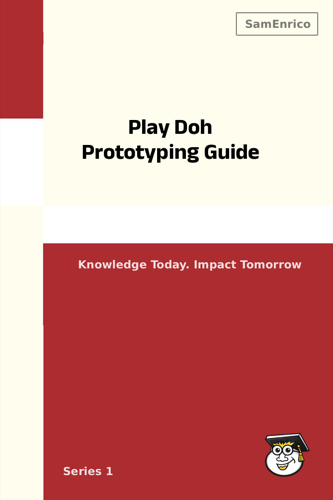
Play Doh Prototyping Guide eBook
Sculpt ideas physically for tactile creativity.
Sculpt ideas physically for tactile creativity.
Formats
Free sample
Chapter 1: The Smash Permission--–- Most people open a book like this expecting to learn how to make things. They want techniques. They want tool lists. They want step-by-step instructions for sculpting a perfect eye or a realistic hand. They want permission to become good at something.This is not that book.This book will not teach you how to make a perfect anything.
In fact, the first and most important lesson of the Play Doh Prototyping Guide is that perfection is the enemy of creativity—and the fastest way to kill a great idea is to try to make it beautiful before you have even figured out what it is.So here is your first and most important instruction: Smash the first three things you make.Not because they will be bad—though they will be—but because smashing them will teach you something that no amount of careful sculpting ever could. Smashing teaches you that the material costs nothing, that failure is instant and reversible, and that the only metric that matters is how many times you are willing to start over.This chapter is about why that matters. It is about the science of touch, the psychology of low-fidelity prototyping, and the radical permission to be bad. By the time you finish these pages, you will have unlearned everything school and society taught you about creativity. You will be ready to smash.
And that is when the real learning begins.The Cognitive Science of Tactile Creativity Let us start with a question that most creativity books never ask: Why do your hands matter?For the past thirty years, the dominant tools of creative work have been screens. Keyboards. Mice. Touchscreens. We design products by clicking, write novels by typing, and compose music by dragging MIDI notes across a grid.
All of these tools share a common feature: they separate the hand from the object being created. You do not touch the letter you are typing. You do not feel the weight of the melody you are arranging. The feedback is visual and auditory, but it is not haptic.Haptic feedback—from the Greek haptesthai, meaning "to touch"—is the information your nervous system receives when your hands interact with physical matter. When you press your thumb into a ball of clay, three things happen simultaneously.
First, your skin's mechanoreceptors detect pressure, texture, and temperature. Second, your muscles and joints send proprioceptive signals to your brain about the position and movement of your fingers. Third, your brain integrates all of this data into a real-time model of the object you are shaping.Here is what makes this important for creativity: The haptic loop is faster than the visual loop.When you look at a screen, you are processing information through a single channel—vision. You see a shape, you decide it needs to change, you move your mouse or stylus, and you look again to see if the change worked. That cycle takes time.
But when you touch clay, your hands are feeding information back to your brain continuously, at speeds approaching one hundred milliseconds per adjustment. You do not have to decide to change the shape; your fingers simply feel their way toward a solution.Neuroscience research backs this up. Studies using functional magnetic resonance imaging (f MRI) have shown that haptic exploration activates the somatosensory cortex, the motor cortex, and the prefrontal cortex simultaneously. This is a different neural pathway than the one used for visual thinking. It is more associative, less linear, and—critically—less burdened by the inner critic.
When your hands are busy solving a spatial problem, the language centers of your brain tend to quiet down. You stop narrating your failures and start doing.Consider the case of a product designer we will call Elena. Elena had spent two weeks modeling a new ergonomic handle in CAD software. She had adjusted curves, run simulations, and rendered photorealistic images. But when she received the first 3D-printed prototype, it felt wrong in her hand—too narrow, with a sharp edge that dug into her palm.
She had spent fourteen days solving a problem she could have discovered in fourteen seconds with a lump of clay.This is not an indictment of digital tools. CAD and 3D printing are magnificent for refinement. But they are terrible for discovery. Discovery requires speed, risk-taking, and the ability to fail without penalty. Discovery requires the haptic loop.The Low-Fidelity Advantage: Why Imperfection Is a Feature, Not a Bug The term "low-fidelity prototyping" comes from the world of product design.
A low-fidelity prototype is one that deliberately omits detail, color, finish, and precision. It is rough, ugly, and obviously unfinished. Its purpose is not to impress stakeholders or test usability—its purpose is to generate information as quickly as possible.Play Doh is the ultimate low-fidelity prototyping medium. Here is why.Zero material cost. A standard four-ounce can of Play Doh costs less than two dollars.
That can be smashed and rebuilt hundreds of times before it finally dries out. Compare this to ceramic clay, which must be fired in a kiln and cannot be reused once hardened. Compare it to epoxy putty, which permanently cures in twenty minutes. Compare it to Plasticine, which is oil-based and requires warm-up but still costs five times as much per ounce. Play Doh is cheap enough that you never have to worry about "wasting" it.
And when a material is that cheap, you are free to experiment wildly.Zero time cost. Most sculpting materials have a clock running. Ceramic clay dries out and must be kept moist. Epoxy putty hardens whether you are ready or not. Even Plasticine stiffens when cold and requires kneading.
Play Doh has a different relationship with time. If left exposed to air, it will begin to dry after about twenty-four hours. But here is the clarification that most books get wrong: Play Doh remains fully workable for two to three days if left exposed, and for several weeks if stored in an airtight container with a damp paper towel. That is an enormous window. You can start a prototype, set it aside for a week, and come back to find it exactly as you left it.
Or you can smash it immediately and start over. The choice is yours.Zero emotional cost. This is the most important factor. When you sit down with expensive materials—kiln-fired clay, marble, fine art supplies—you bring a certain psychological weight to the table. You are afraid to make mistakes because mistakes cost money.
You are afraid to cut because you cannot uncut. You hesitate. You plan. You think instead of do. Play Doh removes that fear entirely.
Because you can always ball it up and start again, there is no such thing as a mistake. There are only iterations.This is what we call the Smash It and Start Over rule. Here is how it works:Set a timer for five minutes.Sculpt something—anything—without stopping.When the timer ends, look at what you made. Do not judge it. Do not critique it.
Just look.Then smash it into a ball.Reset the timer. Start over.Repeat this five times. By the end, you will have…
This is the end of the free sample. Get the eBook to keep going. Buy now
About this book
Details
- Author
- Pringle Shantelle
- Publisher
- SamEnrico
- Language
- English
- Genre
- Non-Fiction, Self-Help, Prototyping
- Released
- 2026-06-10
- Pages (approx.)
- 141
- Available as
- eBook, Audiobook

Read better in the ZLOADR app
Your eBooks on your phone or tablet. Sign in with your SamEnrico account and start reading.
More by Pringle Shantelle
 Self Hypnosis for Herniated Disc PainPringle Shantelle$11.99
 Financial Survival After Job LossPringle Shantelle$11.99
 Pacing Back and ForthPringle Shantelle$11.99
 Conversation Starters for Fish MarketsPringle Shantelle$11.99
 Self Esteem for Software DevelopersPringle Shantelle$11.99
 Repair After Parental OutburstPringle Shantelle$11.99
 Design Thinking for Service DesignPringle Shantelle$11.99
 Silk & Steel: The Underground Fashion Wars of 19th Century ParisPringle Shantelle$11.99
 Rana Sanga: The Lion of Chittor - The Last Stand of Rajput PridePringle Shantelle$11.99
 How to Produce OrangesPringle Shantelle$11.99
 How to Produce Coffee MakersPringle Shantelle$11.99
 A Collector's Handbook to the Steyr 35Pringle Shantelle$11.99
You may also like
 Hong Kong Handover 1997Dunn Johnnie$11.99
 Zumba For Postnatal Recovery CourseNeal Christian$11.99
 Zumba for BeginnersLadner Nikia$11.99
 YouTube Comment Mining GuideHumes Pandora$12.99
 Worry Box MeditationCarlin Rudy$11.99
 Workplace Stress MeditationNguyen Lynn$11.99
 Workplace Stress and Sleep RepairHawley Ivory$11.99
 Workplace Perfectionism CureDelaney Jeffry$11.99
 Workplace Injustice Anger GuideWallen Isabelle$11.99
 Work Addiction and Burnout LinkGreenwood Ester$11.99
 Women in Yoga and WellnessBeattie Galina$11.99
 Women in Stand Up ComedyChun Evangeline$11.99