
Non-FictionInformativeEducational
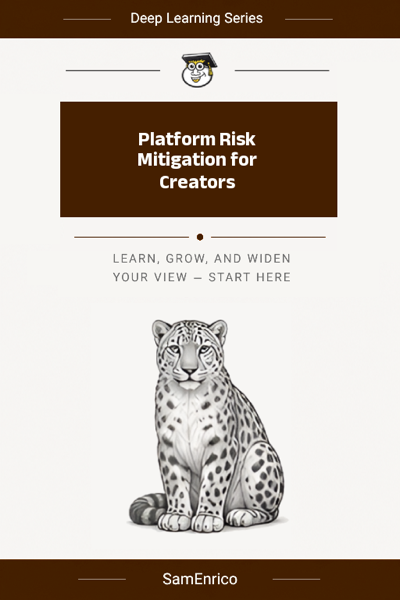
Platform Risk Mitigation for Creators eBook
A Coursebook on Platform Risk Mitigation for Creat
by Mount Alba
A Coursebook on Platform Risk Mitigation for Creators
Formats
Free sample
Chapter 1: The Ownership Mirage...–- Most creators discover they don’t own their business on a Tuesday. Not a Monday, when you’re fresh and ready to fight. Not a Friday, when you can drown the news in weekend plans. A Tuesday. The algorithm changed overnight.
The appeal was denied in fourteen minutes, probably by a bot. The email from the platform arrived at 2:47 AM, timestamped somewhere in a time zone you don’t live in, and by the time you woke up, 94% of your projected revenue for the month had already evaporated. No warning. No human to call. No office to visit.
Just a dashboard that now shows numbers that look like a typo but aren’t.This chapter opens with a hard truth that most creators learn only after disaster strikes, and it is the single most important idea in this entire book: you do not own your audience, your content distribution, or your revenue streams. You rent them. And the landlord can evict you at any time, for any reason, or for no reason at all.If you are a creator on any major platform—You Tube, Tik Tok, Instagram, Substack, Twitch, Amazon KDP, Spotify, Patreon, Apple Podcasts—you are not a customer. You are not a partner. You are not even, in the strict legal sense, a user.
You are an uncompensated input provider whose labor generates value for the platform, and the platform, in turn, grants you conditional access to an audience it controls. That access can be modified, reduced, or eliminated based on criteria that are often invisible, always unilaterally determined, and never negotiated with you.This is not paranoia. This is the structural reality of the creator economy.The Tuesday That Changed Everything Let me tell you about a creator we’ll call Maya. Maya is a composite—drawn from dozens of real interviews, Reddit threads, Twitter meltdowns, and support forum pleas—but her story is not fictional. She represents a pattern so common that it has its own name in creator circles: “the rug pull.”Maya spent three years building a cooking channel on You Tube.
Five hundred thousand subscribers. Consistent monthly revenue averaging 8,000fromadshares,another8,000 from ad shares, another 8,000fromadshares,another4,000 from sponsored integrations, and a growing Patreon bringing in $2,000 from superfans who wanted her weekly meal-prep PDFs. She had quit her teaching job nine months earlier. Her husband’s salary covered the mortgage; her creator income covered everything else. It was working.
She was living the dream that every “quit your job and follow your passion” Linked In post promises.Then came the Tuesday.You Tube rolled out a “sensitivity update” to its algorithm. No notice. No preview. No opt-out. Maya’s videos—which featured sharp knives, raw meat, and the occasional accidental splatter of tomato sauce that looked vaguely red—were suddenly classified as “disturbing content.” Her new uploads were not demonetized in the traditional sense.
They were simply not shown. Impressions dropped 87% in 48 hours. Revenue followed. By Thursday, her estimated monthly earnings had collapsed from 14,000tounder14,000 to under 14,000tounder1,000.She appealed. The form asked her to select from a dropdown menu why she disagreed.
She typed a careful 500-word explanation. She received an automated response fourteen minutes later: “After review, our decision stands.” She appealed again. Same result. She searched for a human email address. She found a support forum where other creators described identical experiences.
One had been waiting six months for a reply. Another had submitted seventeen appeals. None had spoken to a person.Maya did not violate a single policy. She did not post anything that was not already on her channel for years. She was not warned.
She was not given a path to compliance. She was simply deprioritized—exiled to the digital equivalent of a city dump, where her content would sit, technically alive, but invisible to the audience she had spent three years building.This is platform risk. And it is the defining economic reality of the creator profession today.Defining the Chokepoint Drawing from the foundational work of Cory Doctorow and Rebecca Giblin in Chokepoint Capitalism, we need a precise term for what happened to Maya. That term is chokepoint: a point of control where a platform can unilaterally change terms, extract more value, or cut off access entirely, with no meaningful recourse for the creators who depend on it.A chokepoint has three defining characteristics:First, it is unilateral. The platform makes decisions alone.
You do not vote on algorithm updates. You do not negotiate To S changes. You are notified—if you are lucky, with advance notice; if you are typical, after the change has already rolled out.Second, it is opaque. The platform does not need to explain its reasoning. You Tube does not have to tell you why your video was limited.
Tik Tok does not have to disclose how its “health” score is calculated. Substack does not have to share the internal metrics that determine whether your newsletter is boosted or buried. The platform’s decision-making is a black box, and you are not allowed to look inside.Third, it is non-negotiable. Your only choices are to accept the new terms or leave. But leaving means abandoning your audience, your archive, and your income stream.
That is not a real choice. It is a hostage situation dressed up as a user agreement.Chokepoints are not bugs. They are features. They are the structural architecture of the platform economy. Every major creator platform is built on the same fundamental economic logic: aggregate creators, extract value from their labor, control the relationship between creator and audience, and optimize for platform metrics (engagement, time on site, ad inventory) over creator outcomes (income stability, creative freedom, audience ownership).This is not a conspiracy.
It is not malice. It is rational self-interest operating within misaligned incentives. Platforms are businesses. They answer to shareholders, advertisers, and regulators. They do not answer to you.
And as long as your business depends on their infrastructure, your business is not truly yours.The Five Faces of Platform Risk What happened to Maya is just one expression of platform risk. In reality, platform risk wears many faces, and understanding each one is the first step toward mitigating it. Drawing from the risk categories we will map in detail in Chapter 2, here are the five primary manifestations of platform risk that every creator faces.1. Demonetization Demonetization is the removal of advertising revenue from your content without removing the content itself. It is the most common form of platform risk, and it is often applied for reasons that are vague, inconsistent, or demonstrably false.In You Tube’s system, for example, a video can be demonetized for “unsuitable content” that violates no specific policy.
The definition of “unsuitable” changes over time and varies by region, advertiser demand, and even the time of year. A video about breastfeeding might be demonetized in one month and monetized the next. A video about war history might be flagged for “violent imagery” even if it shows no actual violence.The economic impact is immediate and severe. Most creators earn between 1and1 and 1and10 per thousand ad views (RPM). A channel with 100,000 monthly…
This is the end of the free sample. Get the eBook to keep going. Buy now
About this book
Details
- Author
- Mount Alba
- Publisher
- SamEnrico
- Language
- English
- Genre
- Non-Fiction, Informative, Educational
- Released
- 2026-05-11
- Pages (approx.)
- 149
- Available as
- eBook, Audiobook

Read better in the ZLOADR app
Your eBooks on your phone or tablet. Sign in with your SamEnrico account and start reading.
More by Mount Alba
 The Delhi Prize Money DisputeMount Alba$11.99
 Kabukicho Tokyo UnderworldMount Alba$11.99
 Gold Dream SymbolismMount Alba$11.99
 Walking Meditation Audio CollectionMount Alba$11.99
 Spouse Loss Sleep GuideMount Alba$11.99
 Mindful Eating PracticeMount Alba$11.99
 Customizing Anki IntervalsMount Alba$11.99
 The Quality Engineer InnovationMount Alba$11.99
 Complex Regional Pain ProtocolMount Alba$11.99
 The Last Light of Byzantium: Justinian and the Golden AgeMount Alba$11.99
 Dragonbone and the Ninefold CrownMount Alba$11.99
 The Day the Music Died... Almost: The 1971 Attica Prison UprisingMount Alba$11.99
You may also like
 Hong Kong Handover 1997Dunn Johnnie$11.99
 Zumba For Postnatal Recovery CourseNeal Christian$11.99
 Zumba for BeginnersLadner Nikia$11.99
 YouTube Comment Mining GuideHumes Pandora$12.99
 Worry Box MeditationCarlin Rudy$11.99
 Workplace Stress MeditationNguyen Lynn$11.99
 Workplace Stress and Sleep RepairHawley Ivory$11.99
 Workplace Perfectionism CureDelaney Jeffry$11.99
 Workplace Injustice Anger GuideWallen Isabelle$11.99
 Work Addiction and Burnout LinkGreenwood Ester$11.99
 Women in Yoga and WellnessBeattie Galina$11.99
 Women in Stand Up ComedyChun Evangeline$11.99