
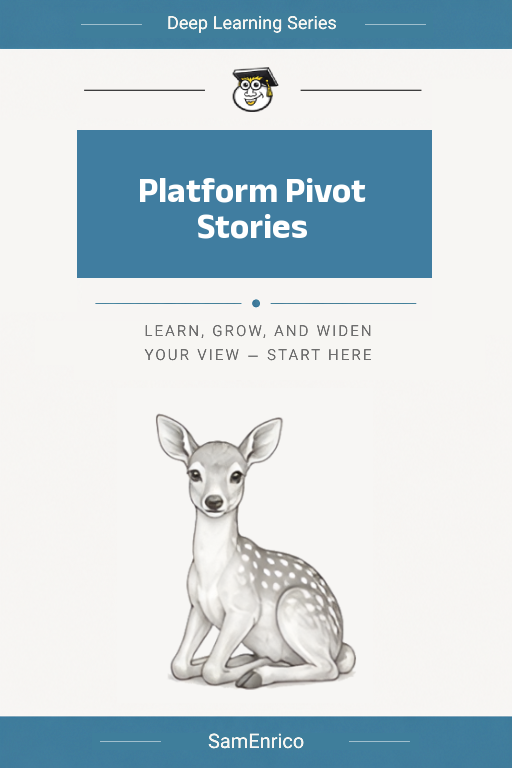
Non-FictionStartup GuideCase Studies
Platform Pivot Stories eBook
Startups that pivoted from product to platform. En
by Ochoa Santa
Startups that pivoted from product to platform. Enabling others to build on their technology.
Formats
Free sample
Chapter 1: The Feature Trap...--–- The founders of Inkitt thought they were building a writing tool. They were wrong. They were building a bottleneck disguised as a business.On a Tuesday night in Berlin, Ali Albazaz did something most startup founders avoid at all costs. He opened his analytics dashboard at 2:00 AM, poured himself a glass of whiskey, and faced the numbers he had been ignoring for six months.The numbers were not bad. That was the problem.Inkitt, his two-year-old startup, had 50,000 monthly active users.
Revenue was growing at 8% month over month—respectable, if unspectacular. Customer satisfaction scores were in the high 80s. By any reasonable measure, Inkitt was a healthy, growing software product.But Albazaz was not relieved. He was terrified.Because he had done the math. At 8% monthly growth, Inkitt would reach 1 million users in thirty-four months.
That was fine. But here was the terrifying part: to serve 1 million users with their current model, he would need to hire 200 editors. Two hundred. At Berlin salaries. The company would bleed cash long before it reached profitability.Inkitt was a writing tool for amateur authors.
Users uploaded their stories—novels, short fiction, fan fiction—and Inkitt's team of human editors read through the submissions, picked the best ones, and published them under the company's fledgling imprint, Galatea. The value proposition was simple: "Upload your story. If it's good enough, we'll publish it."The problem was the "if it's good enough" part. Every new user created work for the editors. Every new story required human judgment.
Inkitt was not a software company with linear scaling. It was a publishing house disguised as an app.That Tuesday night, Albazaz wrote in his notebook: "We don't have a product problem. We have a leverage problem."He didn't know it yet, but he had just identified the single most common failure mode in modern startups. And he was about to discover the only cure.The 74% Reality Before we go any further, let me show you a number that should terrify every founder reading this book.According to a 2023 CB Insights study of 1,200 failed Saa S startups, 74% died as "features"—useful tools that a larger platform eventually cloned, acquired for pennies on the dollar, or simply rendered irrelevant by bundling similar functionality into an existing ecosystem.Think about that. Almost three out of every four software startups end their lives not with a bang, but with a whimper—acquired for their technology stack at a fire sale price, or slowly starved of users as a larger competitor adds their core feature as a free bolt-on to an existing platform.Why does this happen?
Because most founders misunderstand the fundamental difference between a product and a platform.A product is a destination. Users arrive, consume value, and leave. Think of a calculator app, a weather widget, or a writing tool. The relationship is transactional and linear. The company's growth is tied directly to the number of users it can acquire and retain.
When the product stops improving, users drift away.A platform is an ecosystem. Participants build, transact, and stay because the value comes from each other, not just from the platform owner. Think of Shopify's app store, where developers build features that merchants buy. Or Tik Tok's feed, where creators and viewers create value for each other. The relationship is multiplicative and exponential.
Growth comes from network effects, not just acquisition.Here is the brutal truth that most founders learn too late: Every product eventually becomes a feature of a larger platform. The only question is whether you are the one building the platform or the one being absorbed by it.Inkitt in 2014 was a classic product on the verge of becoming a feature. If Albazaz had continued down the path of hiring more editors and manually curating stories, one of two things would have happened. Either a larger publishing platform (Amazon, perhaps, or a European competitor) would have added a "writing tool" feature to their existing ecosystem, making Inkitt irrelevant. Or Inkitt would have grown just enough to become an attractive acquisition target—bought for its user base, then gutted for its technology.The only way out was to stop being a product and start becoming a platform.
But how? Albazaz didn't have an API. He didn't have third-party developers. He didn't have a marketplace. He had a writing tool and a team of exhausted editors.The answer came from an unexpected place: a Reddit thread.The Epiphany That Changed Everything On that same Tuesday, several hours before Albazaz opened his analytics dashboard, an Inkitt user named Sarah uploaded the fourth chapter of her fantasy serial, "The Crystal Labyrinth." Sarah was a 28-year-old administrative assistant from Manchester.
She had been writing since she was twelve. She had submitted her work to twelve traditional publishers and received twelve rejection letters.She had no reason to believe this upload would be different.But Sarah had done something the other 49,999 users had not. She had posted a link to her Inkitt story on Reddit's r/fantasywriters community, a forum with 1.2 million members. She had written a simple post: "Hi everyone, I'm writing a serial fantasy novel. Chapter 4 just went live.
Would love feedback."The post received seventy-three upvotes. Then two hundred. Then five hundred.By midnight, "The Crystal Labyrinth" had been read 50,000 times. Not because an Inkitt editor had picked it. Not because Albazaz had promoted it.
But because readers had shared it with other readers. The link propagated through Discord servers, Twitter threads, and private messaging groups. By the time Albazaz looked at his dashboard at 2:00 AM, Sarah's story was the most popular piece of content on Inkitt by a factor of ten.And here is the critical detail: Inkitt had done nothing to make this happen. The platform had no algorithm. No "trending" page.
No social sharing features beyond a basic "copy link" button. The spread was entirely organic, driven by readers who simply wanted other people to read something they enjoyed.Albazaz sat in his dark apartment and stared at the numbers. Then he wrote a second line in his notebook: "We aren't a software company. We're a hit-finding engine. And we're not the ones finding the hits.
Our readers are."That was the moment Inkitt died as a product. And the moment it was reborn as something else.The Bottleneck Taxonomy Before we go further into Inkitt's pivot, let me introduce a framework that will appear throughout this book. I call it the Bottleneck Taxonomy.Every product that should become a platform is blocked by one or more bottlenecks. These bottlenecks are the reason the product cannot scale. They are the source of the founder's 2:00 AM dread.
And they are the clue that a pivot is necessary.Through my research for this book, I have identified four distinct types of bottlenecks that appear repeatedly in successful platform pivots.Type 1: The Operational Bottleneck This is what Inkitt faced. The company's growth was limited not by demand, but by the manual labor required to fulfill that demand. Every new user required human intervention. Every new piece of content required a human decision. The bottleneck was not technology; it was bodies.Operational bottlenecks are the most…
This is the end of the free sample. Get the eBook to keep going. Buy now
About this book
Details
- Author
- Ochoa Santa
- Publisher
- SamEnrico
- Language
- English
- Genre
- Non-Fiction, Startup Guide, Case Studies
- Released
- 2026-05-30
- Pages (approx.)
- 127
- Available as
- eBook, Audiobook

Read better in the ZLOADR app
Your eBooks on your phone or tablet. Sign in with your SamEnrico account and start reading.
More by Ochoa Santa
 Dental Forensic PhotographyOchoa Santa$11.99
 Customer Service Real Time AdherenceOchoa Santa$11.99
 Francis Youth and ConversionOchoa Santa$11.99
 Saint Francis Simplicity VirtueOchoa Santa$11.99
 The Stroke and High BP GuideOchoa Santa$11.99
 The Hippocratic Paradox: A World Without AntibioticsOchoa Santa$11.99
 AWS Certification MOOC PathOchoa Santa$12.99
 How to Start a Fire Insurance Business (Beginners Guide)Ochoa Santa$11.99
 Learn to Play the SurdoOchoa Santa$11.99
 Afghanite MiningOchoa Santa$11.99
You may also like
 Hong Kong Handover 1997Dunn Johnnie$11.99
 Zumba For Postnatal Recovery CourseNeal Christian$11.99
 Zumba for BeginnersLadner Nikia$11.99
 YouTube Comment Mining GuideHumes Pandora$12.99
 Worry Box MeditationCarlin Rudy$11.99
 Workplace Stress MeditationNguyen Lynn$11.99
 Workplace Stress and Sleep RepairHawley Ivory$11.99
 Workplace Perfectionism CureDelaney Jeffry$11.99
 Workplace Injustice Anger GuideWallen Isabelle$11.99
 Work Addiction and Burnout LinkGreenwood Ester$11.99
 Women in Yoga and WellnessBeattie Galina$11.99
 Women in Stand Up ComedyChun Evangeline$11.99