
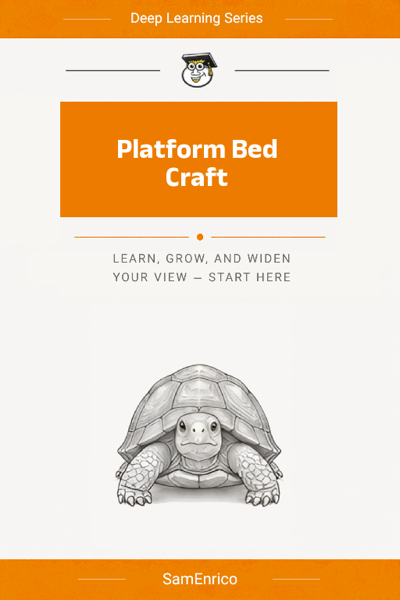
Non-FictionInformativeEducational
Platform Bed Craft eBook
A Coursebook on Platform Bed Craft
A Coursebook on Platform Bed Craft
Formats
Free sample
Chapter 1: The $47 Billion Lie...--The bed you are sleeping on right now is probably engineered to fail. Not because it was cheap, not because you bought it from a discount store, and not because you assembled it wrong. It is failing because the entire traditional bedding industry has built a system that prioritizes repeat sales over structural integrity. Box springs were invented in 1899 for a different kind of mattress—one made of cotton batting and horsehair that actually needed the give. Today, your memory foam or latex mattress sits on top of a box spring that flexes in all the wrong ways, creating a suspension system that guarantees sagging within three to five years.
That is not a coincidence. That is planned obsolescence disguised as tradition.This book exists because a platform bed is not merely a different aesthetic choice. It is a fundamentally superior engineering solution that extends the life of your mattress by distributing weight evenly, eliminates the need for a box spring entirely, and transforms the way you interact with your bedroom. But before you build anything, before you select a single board or cut a single joint, you need to understand why the platform bed represents a complete rethink of what a bed should do. This chapter dismantles the mythology of the traditional Western bed, gives you the scientific framework for mattress support, and introduces the visual language that will guide every decision you make in the chapters ahead.The Anatomy of Deception: Why Box Springs Are a Scam Let us start with a simple experiment that requires no tools.
Walk over to your current bed and press your hand firmly into the center of the mattress. Now press your hand into the edge near the frame. If the center feels noticeably softer or gives more than the edges, your box spring is already failing. What you are feeling is the gradual collapse of a system never designed for the mattresses we now buy.The box spring was patented in 1899 by a man named John S. Scott.
His original design used a grid of steel coils covered in fabric, intended to sit beneath a mattress stuffed with natural fibers like cotton, wool, or horsehair. Those old mattresses were heavy, dense, and lacked any internal support structure of their own. They needed the box spring's give to provide comfort. When the innerspring mattress emerged in the 1930s, mattress manufacturers simply kept the box spring because it was already integrated into the sales model. By the 1950s, the two-piece system (mattress plus box spring) was so deeply embedded in American consumer culture that no one thought to question it.Then came the foam revolution.
Memory foam entered the consumer market in the 1990s, followed by latex and hybrid designs. These new mattresses are fundamentally different from their ancestors. A memory foam mattress contains its own internal support structure—usually a high-density foam base layer topped with progressively softer comfort layers. It does not need a box spring's give. In fact, the give works against it.
When you place a foam mattress on a box spring, the box spring flexes under the mattress's weight, creating a concave sleeping surface that misaligns your spine and concentrates wear in the center. Every night you sleep on that setup, you are accelerating the destruction of both the mattress and your back.The mattress industry knows this. Every major mattress manufacturer includes a warranty void clause specifying that foam and latex mattresses must be placed on a solid or slatted foundation with no more than 2–3 inches of gap between slats. But they still sell box springs alongside these mattresses because the profit margin on a $250 box spring is nearly 70 percent. You are buying a product that your warranty explicitly says you should not use.A platform bed eliminates this entire nonsense.
By providing a rigid or semi-rigid deck directly beneath the mattress, it allows the mattress to perform as designed. The foam base layer does its job without interference. The sleeper's weight is distributed across the entire surface rather than concentrated at the center. The mattress lasts longer, sleeps cooler, and supports better spinal alignment. And you never buy another box spring again.The Three Support Systems: Solid, Slatted, and Everything in Between Not all platform beds are the same.
The choice between a solid deck, a slatted deck, or a hybrid system has direct consequences for mattress compatibility, breathability, and structural engineering. Understanding these three systems is the foundation of every build in this book.Solid Decks: Maximum Rigidity, Minimum Airflow A solid deck is exactly what it sounds like: a continuous sheet of plywood, MDF, or joined boards that covers the entire sleeping surface. This is the most rigid support system available. It provides perfect uniform support for foam mattresses, eliminates any possibility of sagging between slats, and creates a stable platform that will not shift or settle over time.The tradeoff is breathability. Mattresses generate heat and moisture through body heat and perspiration.
A solid deck traps that moisture against the bottom of the mattress, creating an environment where mold, mildew, and dust mites thrive. Most mattress warranties require ventilation holes in solid decks—typically one-inch diameter holes drilled every 12 inches in a grid pattern. This is not optional. Skip the ventilation, and you void your warranty while creating a health hazard.Solid decks are best suited for memory foam and high-density latex mattresses that already sleep warm and require rigid support. They are also the simplest to build, requiring no slat cutting or spacing calculations.
Chapters 5 and 6 in this book use solid deck designs for cantilevered and lift-up storage beds.Slatted Decks: The Goldilocks Solution Slatted decks use parallel wooden slats running across the width of the bed frame, supported by a central rail or perimeter cleats. This is the most common platform bed design because it balances support, breathability, and material efficiency. Air circulates freely between the slats, keeping the mattress dry. The slight give of properly spaced slats adds a small amount of cushioned suspension that many sleepers find more comfortable than a rigid deck.The critical variable is slat spacing. Too wide, and the mattress sags between slats, creating pressure points and voiding warranties.
Too narrow, and you are essentially building a solid deck with extra steps—wasting material and reducing airflow without gaining meaningful support. After analyzing warranty requirements from fifteen major mattress manufacturers and consulting with sleep science researchers, the following standards are definitive:Mattress Type Maximum Slat Gap Minimum Slat Thickness Warranty Void Threshold Memory foam2 inches3/4 inch Greater than 2.5 inches Latex3 inches1/2 inch Greater than 3.5 inches Hybrid (foam + coils)3 inches1/2 inch Greater than 4 inches Innerspring4 inches3/8 inch Greater than 5 inches These numbers are not suggestions. They are the engineering limits beyond which your mattress will deform, your warranty will be voided, and your sleep will suffer. A memory foam mattress on slats spaced 3 inches apart will sag between the slats within six months. The foam flows into the gaps under body weight, creating a washboard effect that you can feel with your hand and your spine will definitely notice.Slat thickness matters almost as much as spacing.
A 3/8-inch slat spanning 36 inches will flex significantly under a 200-pound sleeper, transferring that flex to the mattress above.…
This is the end of the free sample. Get the eBook to keep going. Buy now
About this book
Details
- Author
- Andersen Curt
- Publisher
- SamEnrico
- Language
- English
- Genre
- Non-Fiction, Informative, Educational
- Released
- 2026-05-06
- Pages (approx.)
- 140
- Available as
- eBook, Audiobook

Read better in the ZLOADR app
Your eBooks on your phone or tablet. Sign in with your SamEnrico account and start reading.
More by Andersen Curt
 Memory Reconstruction TheoryAndersen Curt$11.99
 PCOS Pregnancy Loss Support GuideAndersen Curt$11.99
 The Refugee Metta GuideAndersen Curt$11.99
 Consumer Electronics ESG GuideAndersen Curt$11.99
 The Virtual Meeting NonverbalsAndersen Curt$11.99
 The Lion of Pasargadae: Artaxerxes I and the Achaemenid Empire's Golden AgeAndersen Curt$11.99
 Understanding Schereshevskij TurnerAndersen Curt$17.99
 Informational Interview Request GuideAndersen Curt$12.99
 AliExpress Dropshipping GuideAndersen Curt$12.99
 How to Become a Dry-starch OperatorAndersen Curt$11.99
You may also like
 Hong Kong Handover 1997Dunn Johnnie$11.99
 Zumba For Postnatal Recovery CourseNeal Christian$11.99
 Zumba for BeginnersLadner Nikia$11.99
 YouTube Comment Mining GuideHumes Pandora$12.99
 Worry Box MeditationCarlin Rudy$11.99
 Workplace Stress MeditationNguyen Lynn$11.99
 Workplace Stress and Sleep RepairHawley Ivory$11.99
 Workplace Perfectionism CureDelaney Jeffry$11.99
 Workplace Injustice Anger GuideWallen Isabelle$11.99
 Work Addiction and Burnout LinkGreenwood Ester$11.99
 Women in Yoga and WellnessBeattie Galina$11.99
 Women in Stand Up ComedyChun Evangeline$11.99