
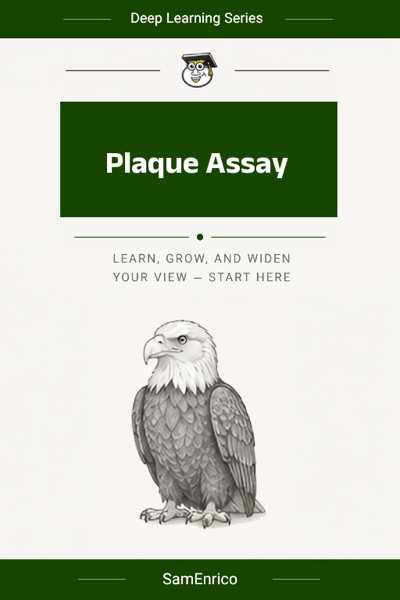
Non-FictionInformativeEducational
Plaque Assay eBook
A Coursebook on Plaque Assay
by Noe Caridad
A Coursebook on Plaque Assay
Formats
Free sample
Chapter 1: The Purple Truth--–- A single drop of purple dye, applied with the care of a calligrapher, can reveal what electron microscopes and gene sequencers cannot. That simple, almost primitive act—flooding a petri dish with crystal violet, waiting a moment, then pouring it away—transforms an invisible biological event into something unmistakable. Where living cells once formed a uniform carpet, there now appear circular holes, like windows punched through a violet curtain. Each hole, each plaque, is a tombstone. It marks the place where one infectious virus particle, no larger than a hundred nanometers, landed on a cell, forced its way inside, hijacked the cell's machinery to produce thousands of copies of itself, and then exploded outward to kill the neighbors.
The purple dye stains the living but flows through the dead, and in that stark contrast, a number emerges. You can count the holes. You can calculate how many viruses were in your original sample. You can hold in your hand a quantitative answer to one of the most important questions in all of virology: how much infectious virus is there?This is the plaque assay. It is not new.
It is not flashy. It does not involve lasers, nanoparticles, or artificial intelligence. It requires little more than a cell culture incubator, some sterile plasticware, and the patience to wait for days while viruses do what viruses do. And yet, seventy years after its invention, the plaque assay remains the gold standard for measuring viral infectivity. It has outlasted countless technological revolutions because it answers a question that no machine can answer directly: is this virus alive?Before we descend into the practical details—the cell lines, the dilutions, the overlays, the staining—we must first understand why this technique exists at all.
Why is it so hard to count viruses? Why can't we simply put a sample under a microscope and tally the particles? And why, despite the astonishing power of molecular biology, does the plaque assay stubbornly refuse to become obsolete? This chapter will answer those questions by taking you from the fundamental challenge of viral quantification through the historical breakthrough that solved it, culminating in a clear understanding of what the plaque assay measures, what it does not measure, and why that distinction can mean the difference between life and death.The Invisible Arithmetic of Infection Imagine you are handed a test tube containing a clear liquid. You are told that this liquid contains a virus—let us say influenza, or HIV, or the virus that causes COVID-19.
How many virus particles are in that tube? A thousand? A million? A billion? The liquid looks exactly like water.
It has no color, no odor, no viscosity. You cannot see the viruses, even with the most powerful light microscope, because they are twenty to three hundred nanometers in diameter—far smaller than the wavelength of visible light. An electron microscope could resolve them, but electron microscopes are expensive, require extensive sample preparation, and see only a vanishingly small fraction of the liquid at a time. Counting viruses by electron microscopy would be like trying to count the grains of sand on a beach by examining a single square millimeter under a magnifying glass.This invisibility is the first challenge. The second is more fundamental.
Even if you could see every virus particle, you would still not know which ones are infectious. Viruses are fragile things. Their genetic material can be damaged by ultraviolet light, by heat, by freeze-thaw cycles, by the shear forces of pipetting. Their protein envelopes can be punctured or denatured. They can assemble incorrectly during replication, producing particles that look perfect under an electron microscope but lack the necessary components to start an infection.
A viral preparation might contain ten billion physical particles but only one hundred million infectious ones—or only ten thousand. The ratio, known as specific infectivity, can vary by orders of magnitude depending on the virus, the host cell, the growth conditions, and the method of purification.This distinction between physical particles and infectious particles is not an academic curiosity. It has life-or-death implications. When a vaccine manufacturer produces a batch of live-attenuated influenza vaccine, they must know not how many viral particles are present, but how many infectious particles—how many viruses that can actually replicate in the human respiratory tract. Too few, and the vaccine will not stimulate protective immunity.
Too many, and the vaccine might cause adverse reactions. The same logic applies to gene therapy vectors, to oncolytic viruses used to treat cancer, to any situation where a living virus is deliberately administered to a human being. Physical methods cannot provide this information. Only biological methods can.The Pre-Plaque Dark Ages Before Dulbecco and Vogt, virologists had only crude tools for measuring infectivity. The most common method was endpoint dilution, also known as the 50% tissue culture infectious dose or TCID₅₀.
The procedure was straightforward in concept but maddeningly imprecise in practice. You would prepare a series of tenfold dilutions of your virus sample, typically across a 96-well plate, and add each dilution to multiple wells containing susceptible cells. Then you would wait. After several days, you would examine each well under a microscope, looking for cytopathic effect—the visible changes in cell morphology that indicate viral infection. You would record which wells were positive (showing CPE) and which were negative.
Then you would calculate the dilution at which 50% of the wells were infected, using a statistical formula developed by Reed and Muench in 1938.The TCID₅₀ had several advantages. It required no specialized equipment beyond a tissue culture hood and an inverted microscope. It could be performed in standard 96-well plates, making it relatively high-throughput. And it did not require the cells to be completely confluent or the plaques to be perfectly separated. But its disadvantages were equally significant.
The TCID₅₀ was a quantal assay—it measured only whether infection occurred or not, not how much infection occurred. This binary readout made it statistically inefficient. To achieve the same precision as a plaque assay, a TCID₅₀ required many more replicates. Moreover, the TCID₅₀ did not directly measure infectious particles; it measured a probabilistic endpoint. Converting TCID₅₀ values to PFU equivalents required assumptions about the underlying distribution of infectious particles, typically that one TCID₅₀ corresponded to approximately 0.7 PFU.
This conversion was rough at best.More fundamentally, the TCID₅₀ could not distinguish between a single infectious particle and a thousand. A well was scored as positive if it contained any infectious virus at all. This binary readout threw away quantitative information that the plaque assay would later capture. It was, in the language of statistics, an inefficient estimator of viral titer.Other methods existed, but they were even more limited. The pock assay, used for some poxviruses, involved inoculating virus onto the chorioallantoic membrane of a developing chick embryo and counting the resulting lesions.
This method was cumbersome, expensive, and applicable only to a narrow range of viruses. Direct particle counting by electron microscopy, as noted, could not distinguish infectious from non-infectious particles. Hemagglutination assays, which measure the ability of certain viruses to bind and cross-link red blood cells, were useful for estimating total particle concentration for influenza…
This is the end of the free sample. Get the eBook to keep going. Buy now
About this book
Details
- Author
- Noe Caridad
- Publisher
- SamEnrico
- Language
- English
- Genre
- Non-Fiction, Informative, Educational
- Released
- 2026-06-02
- Pages (approx.)
- 154
- Available as
- eBook, Audiobook

Read better in the ZLOADR app
Your eBooks on your phone or tablet. Sign in with your SamEnrico account and start reading.
More by Noe Caridad
 HIIT For CrossFit AthletesNoe Caridad$11.99
 Financial Stress Young Adult GuideNoe Caridad$11.99
 Clubhouse Drop In Status AnxietyNoe Caridad$11.99
 Food Addiction in MenNoe Caridad$11.99
 The Forgotten Murders: The Amnesia Killer of New OrleansNoe Caridad$11.99
 Executive Calendar Audit GuideNoe Caridad$12.99
 Learn to Play the Clapsticks/calve SticksNoe Caridad$11.99
 How to Start a Bottled Gas (commission Agent) Business (Beginners Guide)Noe Caridad$11.99
You may also like
 Hong Kong Handover 1997Dunn Johnnie$11.99
 Zumba For Postnatal Recovery CourseNeal Christian$11.99
 Zumba for BeginnersLadner Nikia$11.99
 YouTube Comment Mining GuideHumes Pandora$12.99
 Worry Box MeditationCarlin Rudy$11.99
 Workplace Stress MeditationNguyen Lynn$11.99
 Workplace Stress and Sleep RepairHawley Ivory$11.99
 Workplace Perfectionism CureDelaney Jeffry$11.99
 Workplace Injustice Anger GuideWallen Isabelle$11.99
 Work Addiction and Burnout LinkGreenwood Ester$11.99
 Women in Yoga and WellnessBeattie Galina$11.99
 Women in Stand Up ComedyChun Evangeline$11.99