
Non-FictionHealth & WellnessTransition
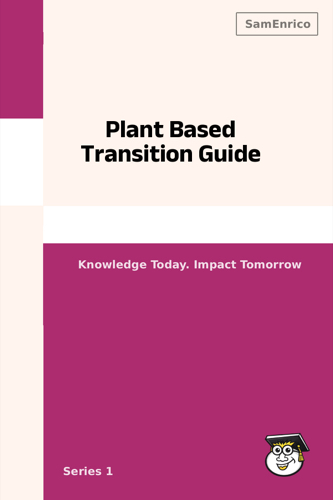
Plant Based Transition Guide eBook
Shift gradually from omnivore to vegan without nut
Shift gradually from omnivore to vegan without nutrient gaps.
Formats
Free sample
Chapter 1: The Addition Revolution--The moment you stop saying "no" to yourself is the moment real change begins.If you are reading this book, you have likely tried to change your diet before. Perhaps you woke up on a Monday morning, fueled by a documentary or a doctor's warning, and declared that from this day forward, you would eat only plants. You cleaned out the refrigerator. You threw away the cheese. You made a solemn promise to never touch chicken again.
And then, somewhere between Day 3 and Day 14, you found yourself standing in front of an open refrigerator at 10:00 PM, eating shredded cheese directly from the bag, or pulling into a drive-through because you were hungry, tired, and there was "nothing to eat."This is not a failure of willpower. This is a failure of strategy.The diet industry has spent decades convincing us that change requires deprivation. Weight Watchers, keto, paleo, intermittent fasting, juice cleanses—almost every popular eating protocol is built on a foundation of subtraction. Remove the sugar. Remove the carbs.
Remove the fat. Remove the meat. Remove the cheese. Remove, remove, remove. The underlying message is always the same: you cannot be trusted with food, so someone must create rules to restrain you.But here is the truth that the diet industry does not want you to hear: subtraction-based change almost always fails because it triggers a predictable psychological response called reactance.Reactance is the uncomfortable feeling you get when someone takes away a freedom.
It is why teenagers rebel against curfews. It is why employees resent micromanagers. And it is why, when you tell yourself "no more cheese," your brain suddenly wants cheese more intensely than it has in years. You are not weak. You are not broken.
You are experiencing a normal, hardwired human response to perceived loss.The solution is not to try harder. The solution is to stop playing the subtraction game entirely.The Dietary Gateway: How Addition Changes Everything This book introduces a concept called the Dietary Gateway. The idea is simple: instead of removing animal products from your diet, you aggressively add high-quality, satisfying plant foods to your existing meals. You do not throw away anything. You do not announce that you are "going vegan." You do not make any rules about what you cannot eat.
You simply begin adding.Here is why this works.When you add a new food to a meal, three things happen simultaneously. First, you increase the total volume of food on your plate, which means you feel fuller and are naturally less interested in eating more of the animal-based components. Second, you expose your taste buds to new flavors and textures, which begins the process of palate adaptation. Third—and most importantly—you never trigger reactance because you are not taking anything away. Your brain does not feel threatened.
There is no rebellion. There is just curiosity.Over the course of four to six weeks, research from the journal Chemical Senses (2018) shows that dietary fat and salt preferences begin to shift when novel foods are introduced consistently. Your taste buds are not static. They are living tissue that regenerates approximately every two weeks. When you feed them new flavors repeatedly, they physically change.
The foods that once seemed bland or strange begin to taste normal. The foods that once felt essential begin to taste heavy, greasy, or unappealing.This is not a metaphor. This is biology.A 2016 study from the Monell Chemical Senses Center found that participants who consumed a low-sodium diet for eight weeks experienced a measurable shift in their salt taste threshold. By the end of the study, foods that previously tasted "normally salted" now tasted too salty. The same phenomenon occurs with fat, sugar, and umami.
Your palate is plastic. It changes with exposure.The Dietary Gateway leverages this plasticity by introducing plant foods gradually, without pressure, and without removal. By the time you have spent four to six weeks adding mushrooms, beans, tofu, and umami-rich sauces to your meals, something remarkable happens: you start to prefer the plant versions. Not because you forced yourself. Not because you exercised superhuman willpower.
But because your taste buds have literally changed.The 84 Percent Problem: Why Overnight Vegans Usually Quit Let us be honest about the numbers. A 2014 study published in Appetite followed individuals who adopted a vegetarian or vegan diet and found that approximately 84 percent returned to eating meat within one year. Other studies have shown similar or even higher relapse rates. The most common reasons cited were social pressure, cravings, and feeling deprived.These are not failures of ethics or commitment. They are failures of transition strategy.The human brain does not handle abrupt, categorical shifts well.
When you tell yourself "I am a vegan now," you create an all-or-nothing identity. Every meal becomes a test. Every slip becomes a catastrophe. This psychological pressure is unsustainable for most people. The few who succeed on an overnight transition are statistical outliers, not a replicable model.Consider how other successful behavior changes happen.
Smokers who quit permanently typically make multiple attempts over several years. People who lose weight and keep it off usually do so through gradual habit changes, not crash diets. Exercise routines stick when they are built incrementally, not when someone goes from zero to marathon training overnight.Dietary change is no different. The science of habit formation, popularized by researchers like BJ Fogg at Stanford University, shows that small, consistent changes anchored to existing routines are far more effective than grand, sweeping declarations. Fogg's research suggests that when you tie a new behavior to an existing habit (a "recipe" he calls an Anchor), the adoption rate increases by approximately 300 percent.The Dietary Gateway uses this principle.
You are not creating a new identity. You are not learning an entirely new way of eating. You are simply adding one new plant food to meals you already make. The anchor is your existing dinner routine. The new behavior is adding mushrooms to your ground meat or swapping half your chicken for tofu.
The change is so small that your brain barely notices—until, four weeks later, you realize you have cut your meat consumption in half without any suffering.The Biology of Palate Adaptation: Why Four to Six Weeks Matters Let us go deeper into the science of taste, because understanding this will save you from blaming yourself when cravings appear.Your taste buds are clusters of 50 to 100 sensory cells located on the papillae of your tongue. These cells have a lifespan of approximately 10 to 14 days. Old cells die and are replaced by new cells that are influenced by your recent dietary exposure. This means that every two weeks, you have the opportunity to "reset" part of your taste perception.When you consistently eat high-sugar foods, your taste buds become less sensitive to sweetness. You need more sugar to achieve the same sensation.
The opposite is also true: when you reduce sugar intake, your sensitivity to sweetness increases. Within two to four weeks, foods that previously tasted "barely sweet" will taste intensely sweet.The same mechanism applies to fat and salt. A 2015 study in the American Journal of Clinical Nutrition found that participants who…
This is the end of the free sample. Get the eBook to keep going. Buy now
About this book
Details
- Author
- Sherrill Marci
- Publisher
- SamEnrico
- Language
- English
- Genre
- Non-Fiction, Health & Wellness, Transition
- Released
- 2026-06-09
- Pages (approx.)
- 133
- Available as
- eBook, Audiobook

Read better in the ZLOADR app
Your eBooks on your phone or tablet. Sign in with your SamEnrico account and start reading.
More by Sherrill Marci
 SAD Relapse PreventionSherrill Marci$11.99
 4 7 8 Breath PracticeSherrill Marci$11.99
 Anger De escalation with ADHDSherrill Marci$11.99
 Workplace Energy ManagementSherrill Marci$11.99
 The Test Drive GenerationSherrill Marci$11.99
 Networking for ConstructionSherrill Marci$11.99
 Grounding Chair TechniqueSherrill Marci$12.99
 Collaborative PrioritizationSherrill Marci$11.99
 The Conquerors of the Clouds: The Golden Age of Alpinism (1950-1980)Sherrill Marci$11.99
 The Alpine Culinary Crown: How Swiss Innovation Transformed Global DiningSherrill Marci$11.99
 Service Providers Guide to GardenersSherrill Marci$11.99
 How to Produce Waffle Iron AccessoriesSherrill Marci$11.99
You may also like
 Hong Kong Handover 1997Dunn Johnnie$11.99
 Zumba For Postnatal Recovery CourseNeal Christian$11.99
 Zumba for BeginnersLadner Nikia$11.99
 YouTube Comment Mining GuideHumes Pandora$12.99
 Worry Box MeditationCarlin Rudy$11.99
 Workplace Stress MeditationNguyen Lynn$11.99
 Workplace Stress and Sleep RepairHawley Ivory$11.99
 Workplace Perfectionism CureDelaney Jeffry$11.99
 Workplace Injustice Anger GuideWallen Isabelle$11.99
 Work Addiction and Burnout LinkGreenwood Ester$11.99
 Women in Yoga and WellnessBeattie Galina$11.99
 Women in Stand Up ComedyChun Evangeline$11.99