
Non-FictionHealth & WellnessEndurance Sports
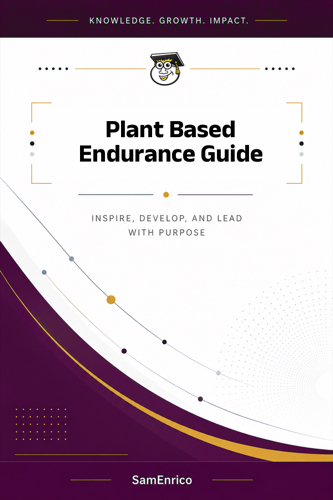
Plant Based Endurance Guide eBook
Optimize performance for runners and cyclists usin
by Khan Cyril
Optimize performance for runners and cyclists using this vegan sports nutrition handbook.
Formats
Free sample
Chapter 1: The Oxygen Advantage--–- The first time I truly understood the connection between food and performance, I was lying on a cold pavement, staring at the underside of my bicycle.It was August. The asphalt was soft enough to leave an imprint. My left quad had seized into a knot the size of a fist, and somewhere in the distance, the rest of the peloton was disappearing over a rise. I had bonked. Not the gentle fade of running out of steam, but the catastrophic, full-system shutdown that leaves you curled on the side of the road, watching your season evaporate.I had trained for this race.
I had done the intervals, the long rides, the strength work. I had a power meter and a coach and a spreadsheet that tracked my every watt. What I did not have was any understanding of what I was putting in my mouth.That night, sitting on my kitchen floor with a bag of frozen peas pressed to my cramping quad, I did something I had never done before. I opened a peer-reviewed study. Not a blog post.
Not a podcast summary. An actual, dry, numbers-filled study from the Journal of Applied Physiology.And I found something that changed everything.The Blood Thickness Problem No One Talks About Here is a sentence I wish someone had told me ten years earlier: Your blood is too thick.Not in a pathological sense. Not "see a doctor" thick. But thick enough that your heart has to work harder than it should. Thick enough that your capillaries—those tiny vessels that deliver oxygen to your muscle fibers—are not getting as much blood as they could.Blood thickness is measured by something called viscosity.
Think of honey versus water. Honey has high viscosity. Water has low viscosity. Your blood is somewhere in between, but where it falls on that spectrum depends heavily on what you eat.Animal products, particularly red meat and full-fat dairy, increase blood viscosity. Why?
Two reasons. First, they are high in saturated fat, which makes red blood cells less flexible. Stiff red blood cells cannot squeeze through capillaries as easily. Second, they increase your hematocrit (the percentage of your blood occupied by red blood cells) beyond the optimal range. Too many red blood cells, and your blood turns to sludge.A 2014 study in Clinical Hemorheology and Microcirculation compared blood viscosity in vegetarians versus omnivores.
The vegetarians had significantly lower blood viscosity—about 15% lower on average. That means their hearts could pump the same volume of blood with 15% less effort. Or, to put it in endurance terms: at the same heart rate, a plant-based athlete delivers more oxygen to working muscles.The Science of Slippery Blood Let me get specific about what is happening inside your vessels.Your blood contains red blood cells, white blood cells, platelets, and plasma. Red blood cells are the oxygen carriers. They are shaped like donuts—technically, biconcave discs—which gives them a high surface area for oxygen exchange.
But that shape also makes them vulnerable. When you eat saturated fat, it gets incorporated into the cell membranes of your red blood cells. Saturated fat makes membranes stiffer, less fluid. Stiff red blood cells cannot deform as easily to squeeze through capillaries.Capillaries are tiny. Most are narrower than a red blood cell.
To get through, a red blood cell must stretch and bend, like a person crawling through a tight tunnel. Stiff cells get stuck. When they get stuck, they block the capillary, and the muscle fibers downstream get no oxygen.That is what happened to me on that August pavement. I had eaten a cheeseburger the night before—"protein loading," I told myself—and my red blood cells were stiff. They could not navigate my working muscles' capillaries.
My quads ran out of oxygen. They cramped. I stopped.Plants do the opposite. Plant-based diets are high in unsaturated fats (from nuts, seeds, avocados) and low in saturated fats. Unsaturated fats keep cell membranes fluid and flexible.
Your red blood cells can bend, twist, and squeeze through the tiniest capillaries. Every muscle fiber gets the oxygen it needs.The Second Lie: Protein Is Protein We are taught that protein is protein. A gram from beef is the same as a gram from beans. This is false.Animal protein comes packaged with saturated fat, heme iron, and often sodium. Plant protein comes packaged with fiber, antioxidants, and potassium.
The protein molecule itself might be similar, but the package determines what happens in your body.Consider leucine. Leucine is the amino acid that triggers muscle protein synthesis. It is the "on switch" for building muscle. Animal protein tends to be higher in leucine gram-for-gram than most plant proteins. This is true.
I will not pretend otherwise.But here is what the supplement industry does not tell you: your body does not need a constant flood of leucine. It needs pulses. A leucine spike of 2.5-3 grams triggers muscle protein synthesis for about 2-3 hours. Then the system resets. Another spike triggers another round.You can get that spike from plants.
Soybeans, lentils, chickpeas, and seitan all provide leucine. The trick is timing—which we will cover in Chapter 10. But the point for now is this: animal protein is not better at building muscle. It is just different. And the differences come with costs: inflammation, blood thickness, and the metabolic burden of processing heme iron and saturated fat.The Inflammation That Never Turns Off Inflammation is not evil.
Inflammation is your body's repair crew. When you run a marathon, you create microscopic tears in your muscle fibers. That is good—that is how you get stronger. The tears trigger an inflammatory response. Immune cells rush to the site, clean up the damage, and release signaling molecules that tell your muscle cells to rebuild bigger and stronger.The problem is when inflammation never turns off.Chronic, low-grade inflammation is like having your repair crew on overtime, every day, even when there is no damage.
It wears down your joints. It impairs recovery. It blunts the adaptive response to training. And it is directly linked to the foods you eat.Animal products contain arachidonic acid, a fatty acid that your body converts into pro-inflammatory signaling molecules. Plants contain anti-inflammatory compounds—polyphenols, flavonoids, carotenoids—that help resolve inflammation once it has served its purpose.A 2018 study in Medicine & Science in Sports & Exercise followed two groups of runners through a marathon training block.
One group ate their normal omnivorous diet. One group switched to a plant-based diet. Both groups did the same training. The plant-based group had significantly lower levels of C-reactive protein (a marker of systemic inflammation) at rest and after exercise. They also reported less muscle soreness and took fewer rest days due to injury.Less soreness.
Fewer rest days. More quality training. That is the plant-based advantage.The Vasodilation Breakthrough Vasodilation is the widening of blood vessels. It happens naturally during exercise—your body's way of delivering more oxygen and glucose to working muscles. The primary molecule responsible for vasodilation is nitric oxide.Nitric oxide is produced from the amino acid L-arginine.
Both plants and animals contain L-arginine. But here is the critical difference: animal products also contain asymmetric dimethylarginine (ADMA), a…
This is the end of the free sample. Get the eBook to keep going. Buy now
About this book
Details
- Author
- Khan Cyril
- Publisher
- SamEnrico
- Language
- English
- Genre
- Non-Fiction, Health & Wellness, Endurance Sports
- Released
- 2026-06-10
- Pages (approx.)
- 123
- Available as
- eBook, Audiobook

Read better in the ZLOADR app
Your eBooks on your phone or tablet. Sign in with your SamEnrico account and start reading.
More by Khan Cyril
 Student Athlete Stress Management CourseKhan Cyril$11.99
 The Pain And Emotions MeditationKhan Cyril$11.99
 The Dashboard Camera PerspectiveKhan Cyril$11.99
 Retirement Account State TaxesKhan Cyril$11.99
 The Iceberg Gambit: How a Rogue Ship Defied the Law of the SeaKhan Cyril$11.99
 How to Become a Concrete-paving-machine OperatorKhan Cyril$11.99
 Undergraduate Scholarship MapKhan Cyril$12.99
 Victoria's Secret SWOTKhan Cyril$12.99
 Understanding Neuroendocrine TumorKhan Cyril$17.99
 Market Development ManagerKhan Cyril$11.99
You may also like
 Hong Kong Handover 1997Dunn Johnnie$11.99
 Zumba For Postnatal Recovery CourseNeal Christian$11.99
 Zumba for BeginnersLadner Nikia$11.99
 YouTube Comment Mining GuideHumes Pandora$12.99
 Worry Box MeditationCarlin Rudy$11.99
 Workplace Stress MeditationNguyen Lynn$11.99
 Workplace Stress and Sleep RepairHawley Ivory$11.99
 Workplace Perfectionism CureDelaney Jeffry$11.99
 Workplace Injustice Anger GuideWallen Isabelle$11.99
 Work Addiction and Burnout LinkGreenwood Ester$11.99
 Women in Yoga and WellnessBeattie Galina$11.99
 Women in Stand Up ComedyChun Evangeline$11.99