
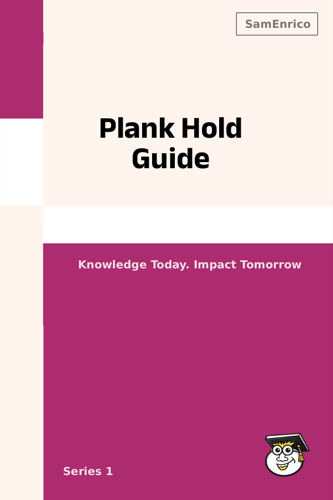
Non-FictionHealth & WellnessCore
Plank Hold Guide eBook
Teaches core stability through front, side, and re
by Booth Lenita
Teaches core stability through front, side, and reverse planks.
Formats
Free sample
Chapter 1: The Six-Pack Lie--–- Most people who believe they have a strong core are actually walking around with a deeply unstable spine, and the multi-billion-dollar fitness industry has spent decades making sure you never find out the truth. The truth is this: the visible abdominal muscles that everyone chases—the coveted six-pack—are almost entirely irrelevant to real core stability. They are the decorative curtains hanging in front of a crumbling foundation. And if you have been doing crunches, sit-ups, and ab-wheel rollouts in pursuit of a pain-free back or a stronger midsection, you have likely been wasting your time while slowly grinding your lumbar spine into an early grave.This is not hyperbole. This is biomechanics.Every year, millions of people walk into gyms, roll out yoga mats, or click on fitness videos with one goal in mind: a stronger core.
They are told to do hundreds of repetitions of spinal flexion exercises. They buy ab gadgets from late-night infomercials. They suffer through “30-day ab challenges” that leave them with neck pain, hip flexor tightness, and a lower back that aches when they sit too long. And then they wonder why nothing changed.The answer is simple but rarely taught: you have been training the wrong muscles in the wrong way.This book exists because the plank—specifically the front plank, side plank, and reverse plank—is the single most effective, scientifically validated, and time-efficient method for building true core stability. But here is the catch: most people do planks incorrectly.
They hold positions that harm their shoulders, compress their lower backs, and reinforce the very movement patterns they are trying to fix. Even worse, they only do front planks, ignoring the lateral and posterior core work that creates a truly balanced, resilient midsection.By the time you finish this chapter, you will understand exactly what the core actually is, why the fitness industry has lied to you about how to train it, and how the “3-Plank Trinity” of front, side, and reverse planks will rebuild your body from the inside out. You will also discover something that most core training books hide until the final chapters: planks alone are not a complete core program. They are the foundation—the non-negotiable starting point—but true core mastery requires integrating rotation and spinal flexion as well. That admission is not a weakness of the plank.
It is a strength of honest teaching.Let us begin by dismantling everything you thought you knew.The Anatomy of a Lie: Why “Six-Pack Abs” Are Not Your Core Walk into any gym and point to your midsection. Ask ten people what their core is, and nine of them will grab the front of their stomach—the rectus abdominis. That thin sheet of muscle that creates the cosmetic “six-pack” appearance when body fat is low enough. They will tell you that a strong core means visible abs. They are dangerously wrong.The rectus abdominis has one primary mechanical function: spinal flexion, which is the act of curling your ribcage toward your pelvis.
That is it. It is a mover, not a stabilizer. In fact, when the rectus abdominis contracts forcefully during heavy loading, it actually increases shear stress on the lumbar spine. This is why powerlifters and strongmen rarely do crunches. They understand that visible abs are a product of low body fat and genetic insertion points, not a marker of spinal stability.The real core—the stability core—is buried deeper.
It is a hydraulic system of four interconnected structures that work together to create intra-abdominal pressure, which is the single most important mechanism for protecting your spine under load.The Transverse Abdominis is the deepest abdominal muscle, wrapping around your torso like a natural weight belt. When it contracts, it does not create movement. It creates tension. It compresses the abdominal contents and stiffens the entire lumbar-pelvic region. EMG studies have shown that the transverse abdominis fires milliseconds before any limb movement in healthy individuals.
In people with chronic low back pain, that anticipatory contraction is delayed or absent entirely. Your body’s natural stabilization system has fallen asleep.The Multifidus is a series of small muscles running along the back of your spine, attaching between individual vertebrae. Think of them as tiny guy wires on a tent pole. They do not produce powerful movements. Instead, they provide segmental stability—preventing one vertebra from sliding past another.
When the multifidus atrophies, which happens rapidly with inactivity or injury, the spine becomes unstable at the micro level. Disc herniations and facet joint pain often trace back to multifidus dysfunction.The Diaphragm is not just a breathing muscle. It is the roof of the core canister. When it contracts and descends during inhalation, it increases intra-abdominal pressure. This is why breath holding can artificially increase stability—but it also spikes blood pressure and creates a false sense of security.
True core stability requires the diaphragm to work in concert with the pelvic floor, not against it.The Pelvic Floor is the base of the core canister. It forms the bottom of the hydraulic system. If the pelvic floor is weak or uncoordinated, intra-abdominal pressure leaks downward. The result? The lower back takes load it was never designed to handle.
Pelvic floor dysfunction is not just a women’s health issue. Men who suffer from chronic low back pain often have undiagnosed pelvic floor tension or weakness.These four structures—transverse abdominis, multifidus, diaphragm, and pelvic floor—create what exercise scientists call the “core canister.” When they contract together in a coordinated fashion, they generate intra-abdominal pressure. That pressure pushes outward against the abdominal wall, the spine, and the ribcage, creating a rigid, stable cylinder. This is true core stability. Not a six-pack.
Not a crunch. A cylinder of pressurized tension that protects your spine while your limbs move freely.Here is the critical insight that changes everything: the three plank variations train this core canister in fundamentally different ways, and you need all three.The 3-Plank Trinity: Three Movements, Three Planes, One Stable Spine The human body moves in three planes of motion: sagittal (forward and backward), frontal (side to side), and transverse (rotational). Most core training ignores at least one of these planes entirely. Crunches work only in the sagittal plane. Russian twists work in the transverse plane but often at the expense of lumbar shear.
Side bends work in the frontal plane but rarely teach true anti-lateral flexion.The plank family, when properly understood and executed, covers all three stability demands. But here is where almost everyone gets lost: they treat planks as endurance challenges rather than tension exercises. Holding a front plank for three minutes with sagging hips and a piked butt is not strength. It is suffering with poor form. The goal is not to see how long you can suffer.
The goal is to generate maximum tension in the core canister for shorter periods, building true stiffness that transfers to real-world activities.The Front Plank trains anti-extension. This is the ability to resist your spine arching backward under load. Every time you pick up a heavy box, push open a stuck door, or brace for impact in a sport, your…
This is the end of the free sample. Get the eBook to keep going. Buy now
About this book
Details
- Author
- Booth Lenita
- Publisher
- SamEnrico
- Language
- English
- Genre
- Non-Fiction, Health & Wellness, Core
- Released
- 2026-06-06
- Pages (approx.)
- 156
- Available as
- eBook, Audiobook

Read better in the ZLOADR app
Your eBooks on your phone or tablet. Sign in with your SamEnrico account and start reading.
More by Booth Lenita
 QMS Implementation Gantt ChartBooth Lenita$11.99
 Isaac Asimov BioBooth Lenita$11.99
 Teen Boundary ConversationBooth Lenita$11.99
 Intergroup Service in Twelve StepsBooth Lenita$11.99
 Gig Platform City ComparisonBooth Lenita$11.99
 Nonprofit Operations From Corporate GuideBooth Lenita$11.99
 Yahoo Security Question DatabaseBooth Lenita$11.99
 The Poet and the Pedal: Thomas Green's Forbidden Symphony of the 1866 OlympicsBooth Lenita$11.99
 The Silk Road Scrolls: The Secret Photographs of the Han DynastyBooth Lenita$11.99
 How to Start a Analytical Chemist Business (Beginners Guide)Booth Lenita$11.99
 Growing AlyogyneBooth Lenita$11.99
 A Collector's Handbook to the Panhard Dyna JuniorBooth Lenita$11.99
You may also like
 Hong Kong Handover 1997Dunn Johnnie$11.99
 Zumba For Postnatal Recovery CourseNeal Christian$11.99
 Zumba for BeginnersLadner Nikia$11.99
 YouTube Comment Mining GuideHumes Pandora$12.99
 Worry Box MeditationCarlin Rudy$11.99
 Workplace Stress MeditationNguyen Lynn$11.99
 Workplace Stress and Sleep RepairHawley Ivory$11.99
 Workplace Perfectionism CureDelaney Jeffry$11.99
 Workplace Injustice Anger GuideWallen Isabelle$11.99
 Work Addiction and Burnout LinkGreenwood Ester$11.99
 Women in Yoga and WellnessBeattie Galina$11.99
 Women in Stand Up ComedyChun Evangeline$11.99