
Non-FictionInformativeEducational
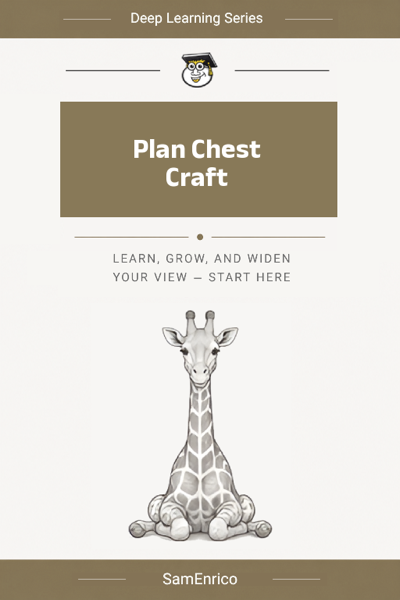
Plan Chest Craft eBook
A Coursebook on Plan Chest Craft
A Coursebook on Plan Chest Craft
Formats
Free sample
Chapter 1: The Flat Truth--–- You have a problem. You might not have named it yet, but it has been stealing time from your creative work for years. Every time you roll a blueprint instead of laying it flat, you introduce a curl that will never fully disappear. Every time you stack a quilt on top of another quilt, the weight of the top one presses creases into the one below. Every time you shove a large-format drawing into a vertical hanging file, gravity pulls against the paper fibers, slowly but inevitably bending them toward the floor.
Your storage is damaging your work, and you have been taught to accept this as normal.The furniture industry has convinced us that vertical filing is the only civilized way to store documents. We buy tall, narrow filing cabinets with hanging folders and assume that this is how organized people live. But there is a quiet secret that architects, printmakers, and museum curators have known for centuries: horizontal flat storage is superior in every measurable way. The only reason vertical filing became dominant is that it takes up less floor space in commercial offices. That is an economic decision, not a preservation decision.
For your studio, your art, your fabrics, and your sanity, flat storage is the correct answer.This book exists because the furniture industry has largely abandoned the plan chest. True flat-file cabinets—the kind with wide, shallow drawers designed to hold paper flat—are still manufactured, but they are shockingly expensive. A new 5-drawer flat file from a professional supplier can cost 1,500to1,500 to 1,500to3,000. Used ones appear on Craigslist and Facebook Marketplace, but they are heavy, often damaged, and require a truck and two strong friends to move. The result is that most makers, artists, and quilters simply give up.
They stuff their large-format materials into corners, roll them into tubes, or lean them against walls where they slowly warp. This book is the alternative.By the time you finish this chapter, you will understand not just the what of flat storage but the why. You will learn the surprising history of the plan chest, the physics of paper preservation, and the four specific projects that the rest of this book will teach you to build. More importantly, you will stop feeling guilty about your messy studio. The problem was never your organizational skills.
The problem was that you were using the wrong furniture.The Anthropology of the Chest: From Blanket Boxes to Blueprints The story of flat storage begins not in architectural firms but in colonial bedrooms. The 18th-century blanket chest—a simple wooden box with a hinged lid and one deep interior compartment—was the original plan chest. Families stored their valuable linens, wool blankets, and occasionally legal documents in these chests, laying everything flat in layers separated by lavender sachets or cedar blocks. The design worked perfectly for several centuries because the principle was sound: horizontal storage distributes weight evenly, prevents gravitational sag, and allows the owner to see everything at once by simply lifting the lid.The first major innovation came in the 19th century with the arrival of the printing press boom. Newspapers, broadsides, and large-format engravings became common household items, and people quickly discovered that rolling or folding these papers caused permanent damage.
The "portfolio chest"—a shallow drawer version of the blanket chest—emerged in England and France around 1820. These were furniture-grade pieces, often made of mahogany or walnut, with two or three shallow drawers just two inches tall. Each drawer was lined with felt or paper, and the contents were stored flat, undisturbed, for decades.The 20th century brought the steel flat file. Architectural firms, engineering departments, and government map rooms needed to store thousands of large drawings efficiently. The steel flat file—sometimes called a "plan file" or "map file"—was the solution.
These cabinets had five to ten shallow drawers, each capable of holding a hundred blueprints. They were stacked vertically, taking up minimal floor space while providing massive flat storage. The military adopted them as the "GI Standard," a 29-inch-tall cabinet with drawers sized to hold standard military maps. For fifty years, these were the gold standard.Then something strange happened. In the 1980s, the office furniture industry shifted almost entirely to vertical filing.
The reason was purely economic: vertical filing cabinets occupy less square footage per document than flat files. Commercial office rents were rising, and landlords wanted to maximize the number of workers per floor. Vertical files allowed a 10-foot wall to hold three times as many documents as a flat file stack. The flat file was pushed into niche markets—architectural firms, art studios, and museums—where preservation mattered more than square footage.Today, the flat file has become a specialty item. Most people under the age of forty have never seen one.
They struggle with rolled blueprints, curled posters, and crushed fabrics because they have been taught that vertical filing is normal. But normal is not the same as correct. The physics has not changed. Paper still wants to lie flat. Fabric still wants to be stacked without pressure.
Your work still deserves better than a hanging folder.Digital vs. Physical: Why This Still Matters in 2026 and Beyond You might be thinking: I store everything digitally now. I photograph my artwork. I scan my blueprints. I have the cloud.
Why do I need physical storage at all?This is a fair question, and it deserves an honest answer. Digital storage is wonderful for distribution, sharing, and backup. But digital is not physical preservation. A JPEG of a watercolor painting is not the painting. A scanned blueprint does not have the original architect's pencil marks in the margin.
A photograph of a quilt does not capture the texture of the fabric or the weight of the stitching. Physical originals have value that cannot be digitized away.Moreover, digital storage introduces its own risks: hard drives fail, cloud services change their terms, file formats become obsolete, and passwords are forgotten. The only truly permanent archive is a physical one stored under stable conditions. Museums, libraries, and archives have not abandoned flat storage. They have doubled down on it.
The Library of Congress stores its rarest maps in flat files. The Metropolitan Museum of Art stores its textile collection in shallow, horizontal drawers. The National Archives stores the Declaration of Independence flat, in a carefully controlled environment. These institutions have unlimited budgets and access to the best technology in the world. They choose flat files.But let us move beyond the museum argument.
Let us talk about your everyday workflow. Consider the experience of pulling a rolled blueprint out of a tube. You have to unroll it, weight the corners, and wait for it to relax—if it ever does. Paper has memory. Once it has been rolled for weeks or months, it will always want to curl back toward that shape.
You can flatten it temporarily with weights, but the curl will return the moment the weights are removed. The only way to remove a curl permanently is to store the paper flat for an extended period—usually six months to a year. Every day that your…
This is the end of the free sample. Get the eBook to keep going. Buy now
About this book
Details
- Author
- Perreault Joe
- Publisher
- SamEnrico
- Language
- English
- Genre
- Non-Fiction, Informative, Educational
- Released
- 2026-06-02
- Pages (approx.)
- 143
- Available as
- eBook, Audiobook

Read better in the ZLOADR app
Your eBooks on your phone or tablet. Sign in with your SamEnrico account and start reading.
More by Perreault Joe
 Meeting Reduction for Deep WorkPerreault Joe$11.99
 Study Motivation and Focus GuidePerreault Joe$11.99
 Remote Retreats for Engineering TeamsPerreault Joe$11.99
 Probate and Heirs Property BriefPerreault Joe$11.99
 French Resistance Maquis GuidePerreault Joe$11.99
 The Ballot That Broke the InternetPerreault Joe$11.99
 The Ancestral Code: Unlocking Australia’s Deep Genetic PastPerreault Joe$11.99
 JEE Calculus Mastery GuidePerreault Joe$12.99
 Budget Approval Workflow GuidePerreault Joe$12.99
 How to Become a Mobile-lounge DriverPerreault Joe$11.99
 Understanding Choroid Plexus NeoplasmsPerreault Joe$17.99
You may also like
 Hong Kong Handover 1997Dunn Johnnie$11.99
 Zumba For Postnatal Recovery CourseNeal Christian$11.99
 Zumba for BeginnersLadner Nikia$11.99
 YouTube Comment Mining GuideHumes Pandora$12.99
 Worry Box MeditationCarlin Rudy$11.99
 Workplace Stress MeditationNguyen Lynn$11.99
 Workplace Stress and Sleep RepairHawley Ivory$11.99
 Workplace Perfectionism CureDelaney Jeffry$11.99
 Workplace Injustice Anger GuideWallen Isabelle$11.99
 Work Addiction and Burnout LinkGreenwood Ester$11.99
 Women in Yoga and WellnessBeattie Galina$11.99
 Women in Stand Up ComedyChun Evangeline$11.99