
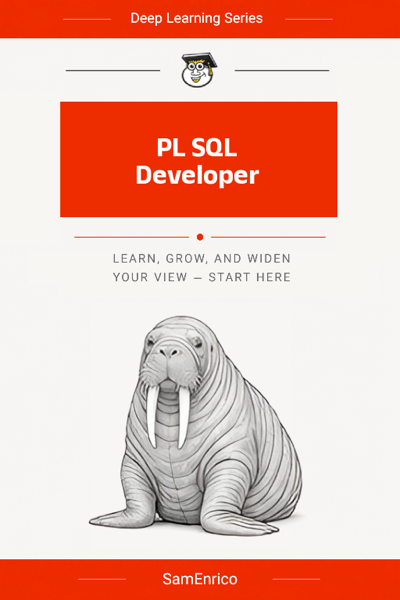
Non-FictionInformativeEducational
PL SQL Developer
A Coursebook on PL SQL Developer
by Mccrary Gale
A Coursebook on PL SQL Developer
Formats
About this book
Free sample
Chapter 1: The Engine Beneath--–- The screen blinked with a familiar prompt: SQL>. For most database users, this was the end of the road. They wrote queries, fetched rows, and logged off. But for you—the PL/SQL developer—this is where the journey begins. Beneath that simple prompt lies a dual-engine architecture that most textbooks explain poorly and most developers ignore entirely. That ignorance costs companies millions in inefficient code, and it costs developers countless hours of frustration.This chapter is not about syntax. You can find syntax in any reference manual. Instead, this chapter is about territory. Before you write your first loop or declare your first variable, you need to understand the landscape you are about to command. You need to understand the PL/SQL engine: where it lives, how it thinks, and why it sometimes fights against you.Let me tell you a story. A junior developer once wrote a loop that processed 50,000 insurance claims. It ran correctly. It updated every single row. It took eleven hours. The next day, a senior developer rewrote the same logic using a different approach. It ran in fourteen seconds. The difference was not intelligence. The difference was understanding the engine. By the end of this chapter, you will understand what that senior developer knew.The Two Engines: A Marriage of Convenience Most people believe Oracle Database runs SQL. That is partially true. What actually happens is more nuanced. The Oracle database architecture contains two distinct execution engines that work together but operate independently.The SQL engine handles set-based operations. When you write SELECT * FROM employees WHERE salary > 50000, the SQL engine parses, optimizes, and executes that statement. It thinks in sets. It processes millions of rows at once. It is brutally efficient at what it does.The PL/SQL engine handles procedural logic. When you write IF salary > 50000 THEN raise_bonus; END IF;, the PL/SQL engine evaluates the condition and decides which path to take. It thinks in steps. It processes one instruction at a time. It is flexible but comparatively slow.Here is the critical insight that separates experts from novices: These two engines are…
This is the end of the free sample. Get the eBook to keep going. Buy now
Contents
- Chapter 1
- Chapter 2
- Chapter 3
- Chapter 4
- Chapter 5
- Chapter 6
- Chapter 7
- Chapter 8
- Chapter 9
- Chapter 10
- Chapter 11
- Chapter 12
Details
- Author
- Mccrary Gale
- Publisher
- SamEnrico
- Language
- English
- Genre
- Non-Fiction, Informative, Educational
- Released
- 2026-06-02
- Pages (approx.)
- 146
- Available as
- eBook, Audiobook

Read better in the ZLOADR app
Your eBooks on your phone or tablet. Sign in with your SamEnrico account and start reading.
More by Mccrary Gale
 Balloon Ride RelaxationMccrary Gale$11.99
 The Last Radio DramaMccrary Gale$11.99
 Project Buffer ManagementMccrary Gale$11.99
 Vegan for Weight Loss GuideMccrary Gale$11.99
 Laundry and Folding Time Hack GuideMccrary Gale$11.99
 The Silent Revolution: How a Single Tweet Toppled a DictatorMccrary Gale$11.99
 How to Start a Cakes Business (Beginners Guide)Mccrary Gale$11.99
 Supplemental Essays Mastery GuideMccrary Gale$12.99
 Small Business AI Financial Statement AnalysisMccrary Gale$12.99
 Understanding Nevoid Basal Cell Carcinoma SyndromeMccrary Gale$17.99
You may also like
 Hong Kong Handover 1997Dunn Johnnie$11.99
 Zumba For Postnatal Recovery CourseNeal Christian$11.99
 Zumba for BeginnersLadner Nikia$11.99
 YouTube Comment Mining GuideHumes Pandora$12.99
 Worry Box MeditationCarlin Rudy$11.99
 Workplace Stress MeditationNguyen Lynn$11.99
 Workplace Stress and Sleep RepairHawley Ivory$11.99
 Workplace Perfectionism CureDelaney Jeffry$11.99
 Workplace Injustice Anger GuideWallen Isabelle$11.99
 Work Addiction and Burnout LinkGreenwood Ester$11.99
 Women in Yoga and WellnessBeattie Galina$11.99
 Women in Stand Up ComedyChun Evangeline$11.99