
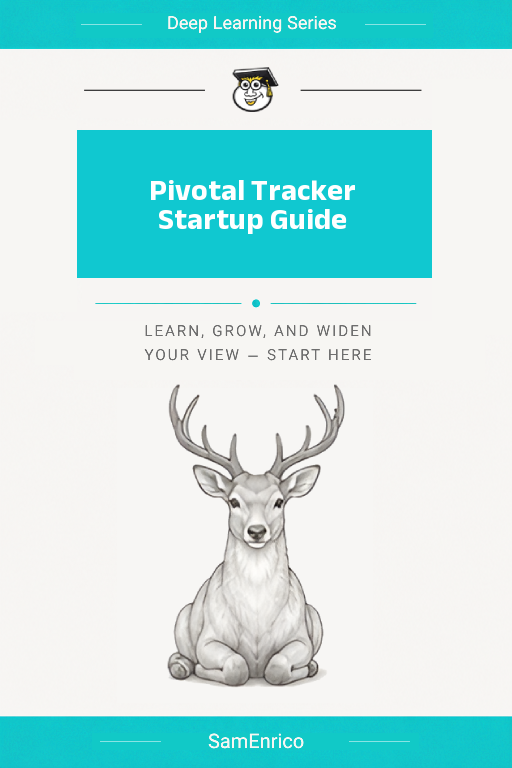
Non-FictionStartup GuideStory Points
Pivotal Tracker Startup Guide eBook
Use Pivotal's story point system and ICE prioritiz
by Tilley Signe
Use Pivotal's story point system and ICE prioritization for early stage startup scrum.
Formats
Free sample
Chapter 1: The Agile Heresy--–- Most startup founders discover project management the same way they discover their first cash flow crisis: too late, with too little information, and while someone is yelling at them. You have likely already tried something else. Perhaps you started with a shared Google Sheet that became a graveyard of strikethrough text and conflicting color codes. Maybe you moved to Trello, where cards multiplied like rabbits and your "Done" column became a museum of unfinished arguments. Or worse, someone on your team installed Jira, and you now spend more time configuring workflows than writing code.
None of these tools failed because they are bad software. They failed because they were designed for a different reality: one where requirements are stable, teams are large, and failure is expensive. Your startup lives in the opposite reality. Your requirements change every time a competitor launches or a user sends a angry email. Your team is so small that losing one person for a day means losing 20% of your capacity.
And failure is not expensive—it is expected. The only real failure is failing to learn quickly. This chapter introduces a heresy: the standard rules of Scrum were not written for you. You are going to break most of them. You are going to skip retrospectives, merge sprint reviews into Slack messages, and define "Done" in a way that would make a certified Scrum Master choke on their certification.
And you are going to ship faster because of it.The Lie of Enterprise Scrum The Scrum Guide, written by Ken Schwaber and Jeff Sutherland, is a masterpiece of software development—for teams of fifty people building systems that cannot fail. It assumes you have a dedicated Product Owner who does nothing but manage the backlog. It assumes a Scrum Master whose full-time job is removing impediments. It assumes two-week sprints with a planning meeting, a daily standup, a review, and a retrospective. These assumptions kill startups.
Not because they are wrong in theory, but because they are wrong in resource allocation. Your startup cannot afford a full-time Product Owner because your founder is already doing sales, support, and coffee runs. You cannot afford a Scrum Master because your "Scrum Master" is also the lead developer and the on-call ops person. And you certainly cannot afford to spend four hours every two weeks in meetings about how to improve your meetings. The lie of enterprise Scrum is that it scales down.
It does not. It collapses under its own ceremony. A study of 127 early-stage startups conducted by the Software Engineering Institute found that teams using full Scrum ceremonies spent 31% of their time in meetings and administrative overhead. Teams using a minimalist, startup-adapted version spent 11%. The difference was not quality or velocity—the minimalist teams shipped 40% more points per month because they had more time to actually write code.
This chapter adapts Scrum for your reality. We keep what works: iterative delivery, transparency, and continuous improvement. We discard what does not: mandatory ceremonies, fixed roles, and the illusion that you can plan two weeks of work without interruption.Your New Definition of "Done"In enterprise Scrum, "Done" means the story has been coded, tested, integrated, documented, and deployed to production. It means zero known bugs. It means the feature is ready for millions of users.
This definition will kill your startup because it will take you six months to ship anything. Your new definition of "Done" is: the story validates or invalidates a hypothesis, and it does not actively destroy user data. That is it. A story is "Done" when you have learned something useful and the system still works well enough for the next person to build on top of it. Let me give you an example.
A story titled "As a user, I want to log in with Google" might be considered "Done" in enterprise Scrum only after the OAuth flow works for every edge case, the error messages are translated into six languages, and the security audit passes. In your startup, that story is "Done" when a single user can log in with Google, the session does not crash, and you have confirmed that this feature increases retention. If there is a typo in the error message, you do not care. If the login fails for users in Germany, you do not care—unless Germany is your primary market. If the button is slightly misaligned on mobile, you do not care.
You care about learning. Does Google login increase signup conversion by 15%? That is the hypothesis. The moment you have data to answer that question, the story is Done, even if the CSS is ugly. This is not an excuse for sloppy work.
It is a recognition that perfection is the enemy of learning. In a startup, you are not building a cathedral. You are building a raft to cross a river. The raft only needs to float long enough to reach the other side. Once you are there, you can build a better raft—or a bridge, or a ferry.
But you cannot build the bridge before you know where the river is. The startup mantra "move fast and break things" is often misunderstood. It does not mean break user data. It means break your assumptions. A story that ships with a cosmetic bug but teaches you that users hate the feature is more valuable than a story that ships perfectly but teaches you nothing.Velocity vs.
Your Gut Feeling One of the most dangerous beliefs in early-stage startups is that you know how productive you are. You do not. Your gut feeling is systematically wrong because of cognitive biases that evolution wired into your brain. Let me name three that plague founders. The optimism bias makes you believe you can accomplish more in a week than any team in history.
The planning fallacy makes you underestimate how long a task will take even when you have done similar tasks before. And the recency bias makes you remember your best weeks and forget your worst ones. This is why you need a metric that is immune to your feelings. That metric is Velocity. Velocity is the average number of story points your team completes per iteration.
It is not a measure of quality. It is not a measure of impact. It is a measure of throughput—how much stuff you ship, in rough units of effort. And it is ruthlessly honest. If your team completes 15 points one week and 5 points the next, your velocity is not 10.
It is whatever the average of the last three iterations says it is. You cannot argue with the number. You cannot feel like you did more. The number is the number. The distinction between Velocity and your gut feeling is the difference between a compass and a wish.
A compass tells you where north is, even if you wish it were east. Your gut feeling tells you where you want to be, not where you are. In Chapter 9, we will explore how to use Velocity to forecast your runway and make hard decisions about cutting scope. For now, simply understand that you must trust the number, not your emotion.The Ceremonies You…
This is the end of the free sample. Get the eBook to keep going. Buy now
About this book
Details
- Author
- Tilley Signe
- Publisher
- SamEnrico
- Language
- English
- Genre
- Non-Fiction, Startup Guide, Story Points
- Released
- 2026-05-30
- Pages (approx.)
- 124
- Available as
- eBook, Audiobook

Read better in the ZLOADR app
Your eBooks on your phone or tablet. Sign in with your SamEnrico account and start reading.
More by Tilley Signe
 Loneliness Recovery for Homeless YouthTilley Signe$11.99
 Tornado GR4 PilotTilley Signe$11.99
 Snack Prep GuideTilley Signe$11.99
 The Immigrant Beauty BrandTilley Signe$11.99
 Design Thinking for BusinessTilley Signe$11.99
 The Collaborative Genius HandbookTilley Signe$11.99
 SAD And Sleep HygieneTilley Signe$11.99
 Grit for NonprofitsTilley Signe$11.99
 The Witch of the Iron Wood: A Love Forbidden by the LeshyTilley Signe$11.99
 The Vanishing of Mary Ann: Canada's First High-Profile Parental Abduction (1877)Tilley Signe$11.99
 How to Produce Law Enforcement EquipmentTilley Signe$11.99
 Schedule G FundraisingTilley Signe$12.99
You may also like
 Hong Kong Handover 1997Dunn Johnnie$11.99
 Zumba For Postnatal Recovery CourseNeal Christian$11.99
 Zumba for BeginnersLadner Nikia$11.99
 YouTube Comment Mining GuideHumes Pandora$12.99
 Worry Box MeditationCarlin Rudy$11.99
 Workplace Stress MeditationNguyen Lynn$11.99
 Workplace Stress and Sleep RepairHawley Ivory$11.99
 Workplace Perfectionism CureDelaney Jeffry$11.99
 Workplace Injustice Anger GuideWallen Isabelle$11.99
 Work Addiction and Burnout LinkGreenwood Ester$11.99
 Women in Yoga and WellnessBeattie Galina$11.99
 Women in Stand Up ComedyChun Evangeline$11.99