
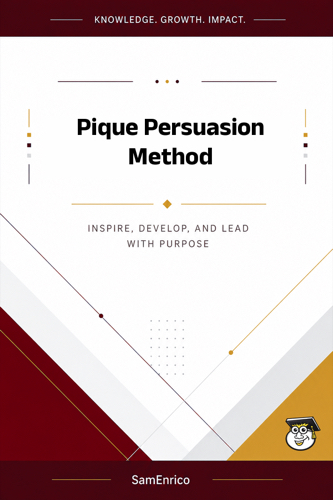
Non-FictionSelf-HelpCuriosity Marketing
Pique Persuasion Method eBook
Use unexpected questions to bypass resistance and
Use unexpected questions to bypass resistance and engage attention.
Formats
Free sample
Chapter 1: The Invisible Wall--–- The email arrives at 9:47 AM on a Tuesday. You have been pitching this client for eleven months. Three proposals. Four follow-up calls. One in-person coffee that you paid for and they barely touched.
And now, finally, a response. You open it with the specific kind of hope that only the chronically ignored can manufacture. The email is three sentences. The second sentence contains the phrase "not at this time." The third sentence wishes you well. You close the laptop and feel something you cannot name—not quite anger, not quite defeat, but something heavier than both.
You were polite. You were professional. You followed every rule in every sales book you have ever read. And still, they said no before you even asked.This is not a failure of your product, your price, or your personality. This is a failure of predictability.Every day, you walk into a wall you cannot see.
It is made of invisible scripts, neural shortcuts, and the accumulated exhaustion of a human brain that has learned, through thousands of repetitions, that most requests are not worth considering. The wall is not personal. It does not hate you. It does not even know you exist. It is simply there, standing between you and every person you need to say yes.This book is about how to walk through that wall.Not by pushing harder.
Not by being more charming. Not by offering discounts or working longer hours or learning thirty-seven closing techniques that all sound exactly the same. The wall does not respond to force. It responds to surprise. The wall is built from patterns, and patterns have one weakness: they only recognize what they have seen before.
Show the wall something it has never seen, and for one brief moment—less than a second, but long enough—the wall disappears.That moment is called pique.And this chapter is about understanding why the wall exists in the first place.The Million-Dollar Question That No One Asks There is a question that haunts every salesperson, every manager, every entrepreneur, every parent trying to get a teenager to do homework, and every human being who has ever needed something from another human being. The question is simple, devastating, and almost never asked out loud:Why do they say no before I finish asking?Not after considering. Not after weighing pros and cons. Before. The word is already forming on their lips while you are still speaking.
You can see it in the micro-movements of their face—the slight turning away, the small exhale, the eyes drifting to a point just over your shoulder. They have rejected you before you have made your case. They have judged your request without hearing it. They have decided, and the decision arrived faster than thought.For decades, this phenomenon was dismissed as rudeness. The person was simply being impolite, or busy, or defensive.
But in the 1970s, a pair of cognitive psychologists named Amos Tversky and Daniel Kahneman began asking a different question. They wanted to know not whether people were rude, but how people thought. Their answer would upend economics, transform marketing, and lay the groundwork for everything in this book.They discovered that the human brain does not think the way we think it thinks.The Two Residents Inside Your Head Imagine, for a moment, that your brain is a small office with two employees.The first employee is young, energetic, and works at incredible speed. His desk is piled high with files labeled "past experience," "patterns," "gut feelings," and "what usually happens." He does not deliberate. He does not analyze.
He does not stop to ask whether this particular situation is different from all the other similar situations he has seen. He simply matches the present to the past and produces an answer in milliseconds. His name is System 1, and he is the reason you can catch a falling glass before you consciously realize it is falling.The second employee is older, slower, and far more deliberate. He sits in a quiet corner with a calculator and a stack of reference books. He does not make snap judgments.
He gathers data, weighs options, considers alternatives, and arrives at conclusions that are usually correct but always slow. His name is System 2, and he is the reason you can solve a calculus problem or plan a retirement portfolio. He is also incredibly lazy. He only wakes up when System 1 encounters something he cannot handle.Here is the problem: System 1 is in charge of most of your daily life. He decides whether to say yes or no to most requests.
And he has one overriding rule: when in doubt, say no.Why? Because saying no costs nothing. Saying yes costs time, money, energy, attention, and the risk of future obligation. Evolution has programmed System 1 to be a gatekeeper, not a philanthropist. Every "yes" is a potential threat; every "no" is a preserved resource.
System 1 does not know whether your request is valuable. He does not care. His job is to protect the status quo, and the status quo is always preserved by saying no.This is the invisible wall. System 1, working at the speed of habit, rejecting you before you have made your case.The Moment the Script Takes Over The psychologists who study persuasion have a name for the patterns that System 1 recognizes. They call them scripts.
A script is a sequence of behaviors that the brain has encoded through repetition. You have scripts for ordering coffee, for ending a phone call, for greeting a neighbor, for responding to a sales pitch. You do not think about these scripts. You simply execute them.The "no" script is the most powerful script of all. It activates whenever the brain detects certain trigger patterns:A stranger approaching with a smile and an open mouth.A sentence that begins with "Could I just..."A request that includes the words "minute of your time."A question that starts with "Would you be interested in..."Any phrase that sounds like the beginning of a pitch.Once the script activates, the outcome is predetermined.
The person will say no—not because they have evaluated your offer, but because the script has run its course. The words "no, thank you" are not a decision. They are a reflex, like pulling your hand from a hot stove.Consider the door-to-door salesperson. Researchers have filmed hundreds of these interactions, and the pattern is remarkably consistent. The salesperson knocks.
The door opens. The salesperson says, "Hi, I'm from X company." Before the sentence is finished, the homeowner's mouth has already begun to form the word "not interested." The salesperson has not described the product. Has not stated the price. Has not offered a single reason to buy. And yet the rejection is already in motion.This is not a failure of the salesperson's technique.
It is the script running on schedule.Now consider your own life. Think about the last time you received an unsolicited email from a service provider, a recruiter, or a salesperson. How long did it take you to decide to delete it? A second? Two seconds?
Did you read the entire message? Probably not. Your System 1 saw the pattern—unsolicited, unknown sender, request for something—and executed…
This is the end of the free sample. Get the eBook to keep going. Buy now
About this book
Details
- Author
- Branson Shenita
- Publisher
- SamEnrico
- Language
- English
- Genre
- Non-Fiction, Self-Help, Curiosity Marketing
- Released
- 2026-06-06
- Pages (approx.)
- 149
- Available as
- eBook, Audiobook

Read better in the ZLOADR app
Your eBooks on your phone or tablet. Sign in with your SamEnrico account and start reading.
More by Branson Shenita
 Mediterranean and InflammationBranson Shenita$11.99
 Values And Mission Alignment Feedback Culture WorkbookBranson Shenita$11.99
 The Micromanager Stress GuideBranson Shenita$11.99
 The Musician's Songwriting BlockBranson Shenita$11.99
 The Secret Scripts of 1948: How Cold War Espionage Shaped the London OlympicsBranson Shenita$11.99
 AWS Data EngineerBranson Shenita$11.99
 Understanding Trichomegaly Retina Pigmentary Degeneration DwarfiBranson Shenita$17.99
 International Franchise Fee StructureBranson Shenita$12.99
 Bplans Free Templates GuideBranson Shenita$12.99
 How to Become a Player-piano TechnicianBranson Shenita$11.99
You may also like
 Hong Kong Handover 1997Dunn Johnnie$11.99
 Zumba For Postnatal Recovery CourseNeal Christian$11.99
 Zumba for BeginnersLadner Nikia$11.99
 YouTube Comment Mining GuideHumes Pandora$12.99
 Worry Box MeditationCarlin Rudy$11.99
 Workplace Stress MeditationNguyen Lynn$11.99
 Workplace Stress and Sleep RepairHawley Ivory$11.99
 Workplace Perfectionism CureDelaney Jeffry$11.99
 Workplace Injustice Anger GuideWallen Isabelle$11.99
 Work Addiction and Burnout LinkGreenwood Ester$11.99
 Women in Yoga and WellnessBeattie Galina$11.99
 Women in Stand Up ComedyChun Evangeline$11.99