
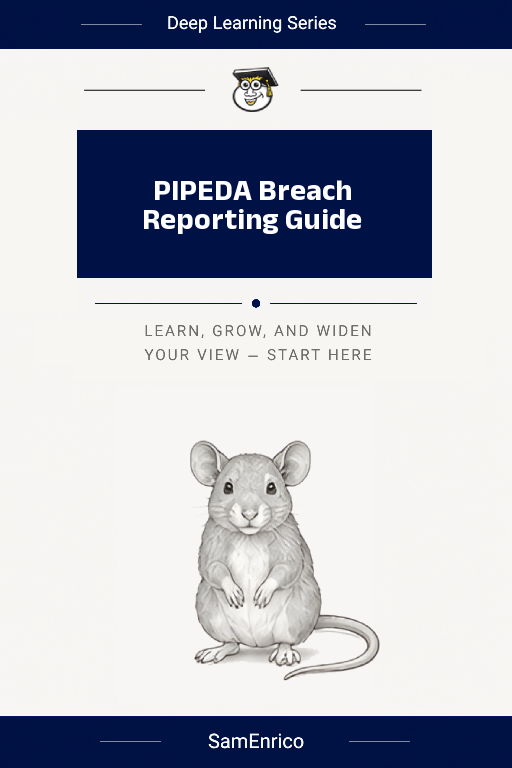
Non-FictionCompliance & Risk ArchivePIPEDA
PIPEDA Breach Reporting Guide eBook
Report material data breaches to Canadian Privacy
by Bacon Madie
Report material data breaches to Canadian Privacy Commissioner and affected individuals under PIPEDA.
Formats
Free sample
Chapter 1: The Million-Dollar Email...--–- The email arrived at 2:17 PM on a Tuesday. "We have identified unusual activity originating from a third-party vendor's credentials. Customer data, including full names, addresses, dates of birth, and in some cases, Social Insurance Numbers, may have been accessed without authorization between March 15 and April 2. We are continuing our investigation and will provide updates as they become available."For most people who receive such an email, it triggers a moment of personal panic. They check their bank accounts, consider freezing their credit, and wonder if their identity is about to be stolen.But for the person who receives this email as the designated Privacy Officer, the Chief Information Security Officer, or the General Counsel of the organization that just suffered that breach, the reaction is entirely different.
The heart doesn't just race. It stops. Because sitting in that innocuous email from the IT department is the seed of a cascading series of legal obligations, regulatory deadlines, and potential personal liability that could end careers, cost hundreds of thousands of dollars, and land responsible individuals in a courtroom.The question is not whether you are prepared for a breach. The question is whether you will be prepared for the seventy-two hours that follow. Because those seventy-two hours will determine everything: whether you face criminal charges, whether your company survives the next fiscal year, and whether you personally will ever work in information security or privacy again.This book exists because the vast majority of Canadian organizations are not prepared for those seventy-two hours.
They have a privacy policy somewhere on an internal drive, a vague understanding that PIPEDA exists, and a hope that they will never be the ones to receive that email. Hope is not a compliance strategy. And under the Personal Information Protection and Electronic Documents Act, particularly its breach reporting provisions, ignorance is not a defence.This is a book about what happens after that email arrives. It is a step-by-step guide to navigating the legally treacherous waters of mandatory breach reporting, from the moment you first suspect something is wrong to the moment you file your final report with the Office of the Privacy Commissioner of Canada and notify every affected individual. It is written for the person whose phone rings at 2:17 PM on a Tuesday.
That person needs answers, not theory. That person needs a playbook, not a law review article.The $100,000 Reason You Are Reading This Book Before we dive into the nuances of what constitutes a "breach of security safeguards" or how to determine the "real risk of significant harm," let us first address the single most important reason you are holding this book. It is not about customer trust, though that matters. It is not about corporate reputation, though that matters too. It is about personal, criminal liability.Section 28 of PIPEDA creates a criminal offence.
It states, in relevant part, that every person who knowingly contravenes section 10.1 (the breach reporting obligation) or section 10.2 (the individual notification obligation) is guilty of an offence punishable on summary conviction and liable to a fine not exceeding one hundred thousand dollars. That is not a corporate fine. That is a fine that can be levied against you personally as an individual – whether you are the privacy officer, a director, an officer, an employee, or even a contractor who made a knowing decision not to report a reportable breach.One hundred thousand dollars. Personal liability. Criminal conviction on your record.Let that sink in for a moment.
If you are reading this book because you are responsible for privacy compliance at your organization, you are personally at risk if you make a knowing decision to violate the breach reporting rules. Your employer's insurance may or may not cover such fines. Your employer's legal defence may or may not extend to criminal proceedings against you personally. And the Privacy Commissioner of Canada, who lacks order-making power in most areas of PIPEDA, has specific, binding order-making power precisely for breach reporting.This is not theoretical. In the years since PIPEDA's breach reporting provisions came into force, the Office of the Privacy Commissioner has increasingly signalled that it will refer egregious cases to the Public Prosecution Service of Canada.
The Commissioner's office has developed internal protocols for identifying potential section 28 violations, and while no high-profile prosecution has yet captured national headlines, the legal infrastructure is fully in place. The first executive who makes the calculated decision to bury a major breach will become the cautionary tale taught in privacy law courses for a generation.Do not be that cautionary tale.But fear, while motivating, is not sufficient. You need clarity. You need to know exactly which organizations are subject to PIPEDA's breach reporting requirements, what constitutes a breach that must be reported, who you must report it to, and when. You need to understand the two-part test that determines whether a breach is reportable.
You need to know how to document your decisions so that if the Commissioner ever comes calling, you can demonstrate that your analysis was reasonable, documented, and made in good faith.That is what this chapter provides: the foundational legal framework upon which every subsequent decision rests.Which Organizations Must Comply? The Scope Question PIPEDA does not apply to every organization in Canada. This is a critical threshold question that many privacy officers get wrong, either by assuming PIPEDA applies when it does not, or by assuming it does not apply when it does. Both errors can be costly.PIPEDA applies to two broad categories of organizations. The first is straightforward: any organization that collects, uses, or discloses personal information in the course of commercial activities.
"Commercial activity" is defined broadly as any particular transaction, act, or conduct that is of a commercial character, including the selling, bartering, or leasing of donor, membership, or other fundraising lists. If your organization sells products or services, markets to customers, or engages in any revenue-generating activity involving personal information, you are almost certainly engaged in commercial activities for PIPEDA purposes.The second category is more technical but equally important: federal works, undertakings, and businesses – often abbreviated as FWUBs. This category includes organizations that operate under federal regulatory authority, even if they are not obviously "commercial" in the everyday sense. Examples include banks and other federally regulated financial institutions, airlines, railways, telecommunications companies, interprovincial trucking and bus companies, radio and television broadcasters, and pipelines. If your organization is regulated by the Canada Labour Code, the Canada Transportation Act, the Telecommunications Act, or similar federal statutes, you are a FWUB.There is a critical nuance here that trips up many compliance officers.
For organizations that are FWUBs, PIPEDA applies to all personal information they collect, use, or disclose – including employee information. For organizations that are not FWUBs, PIPEDA applies to commercial activities but expressly does not apply to employee information. Employee information for non-federal organizations is governed by provincial privacy laws, which vary dramatically across jurisdictions. We will explore those provincial differences in detail in Chapter 9, but for now, the key takeaway is this: if you are a provincially regulated business in Ontario, your customer data is under PIPEDA but your employee HR data…
This is the end of the free sample. Get the eBook to keep going. Buy now
About this book
Details
- Author
- Bacon Madie
- Publisher
- SamEnrico
- Language
- English
- Genre
- Non-Fiction, Compliance & Risk Archive, PIPEDA
- Released
- 2026-06-01
- Pages (approx.)
- 155
- Available as
- eBook, Audiobook

Read better in the ZLOADR app
Your eBooks on your phone or tablet. Sign in with your SamEnrico account and start reading.
More by Bacon Madie
 PMS Insomnia Relief GuideBacon Madie$11.99
 Personal Ing For Success ResumeBacon Madie$11.99
 Networking for College StudentsBacon Madie$11.99
 Loneliness And Cooking TogetherBacon Madie$11.99
 Reddit Cake Day CelebrationBacon Madie$11.99
 The First River: When the Amazon Found Its VoiceBacon Madie$11.99
 Love in the Time of Layoffs: The Secret Romance That Saved a StartupBacon Madie$11.99
 Understanding Dystonia Musculorum Deformans Type 1Bacon Madie$17.99
 How to Become a Automobile MechanicBacon Madie$11.99
 Voice123 Explainer GuideBacon Madie$12.99
You may also like
 Hong Kong Handover 1997Dunn Johnnie$11.99
 Zumba For Postnatal Recovery CourseNeal Christian$11.99
 Zumba for BeginnersLadner Nikia$11.99
 YouTube Comment Mining GuideHumes Pandora$12.99
 Worry Box MeditationCarlin Rudy$11.99
 Workplace Stress MeditationNguyen Lynn$11.99
 Workplace Stress and Sleep RepairHawley Ivory$11.99
 Workplace Perfectionism CureDelaney Jeffry$11.99
 Workplace Injustice Anger GuideWallen Isabelle$11.99
 Work Addiction and Burnout LinkGreenwood Ester$11.99
 Women in Yoga and WellnessBeattie Galina$11.99
 Women in Stand Up ComedyChun Evangeline$11.99