
Non-FictionStartup GuidePivot Case StudyUser Behavior
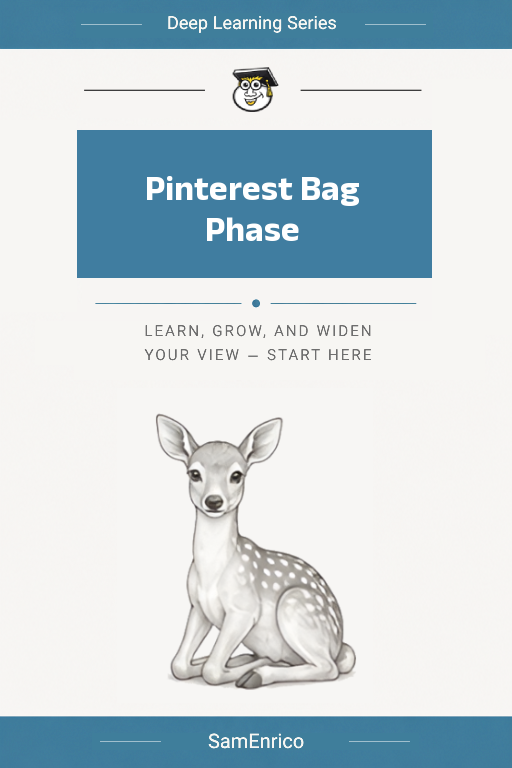
Pinterest Bag Phase eBook
Kill the physical shopping bag app when users kept
Kill the physical shopping bag app when users kept saving images instead.
Formats
Free sample
Chapter 1: The $4 Billion Mistake--– In the spring of 2010, a twenty-eight-year-old former Google product manager named Ben Silbermann sat in a cramped Palo Alto apartment, watching a handful of early users do something that terrified his investors. They were not clicking. They were not buying. They were not sharing with friends in any way that resembled Facebook. Instead, they were doing something far stranger: they were saving images of wedding dresses they would never wear, tattoo designs they would never ink, bedroom makeovers they would never afford, and elaborate recipes they would never cook.
They were collecting for “someday.” And that “someday” behavior, Silbermann realized, was not a bug. It was the entire point.The platform he had built with Evan Sharp and Paul Sciarra was called Pinterest—a portmanteau of “pin” and “interest”—and it was hemorrhaging money. Venture capitalists told him to add a “Buy” button. They told him to shorten the path from discovery to transaction. They told him that users who saved images without purchasing were a failure of the product, a leaky funnel that needed to be plugged.
One investor famously said, “You’ve built a library when you should have built a mall.”That investor was wrong. And that mistake cost the retail industry billions of dollars.The story of Pinterest’s early years is not a story of a company that eventually figured out e-commerce. It is a story of a company that realized e-commerce—at least the version Amazon had perfected—was fundamentally incompatible with how human beings actually make decisions about their homes, their weddings, their wardrobes, and their lives. The shopping bag app that Pinterest later launched failed not because of poor engineering or bad design. It failed because it violated the user’s psychological contract with the platform.
Users came to plan. The shopping bag demanded they transact. The two modes are neurologically opposed.This chapter is about that failure and the billion-dollar insight that emerged from it. It is about why 96 percent of the top searches on Pinterest have no brand name attached to them, and why that statistic is not a problem to be solved but an opportunity to be seized. It is about the difference between competing with Amazon—a fool’s errand—and competing with the user’s future self, which is the only competition that matters.
And it introduces the character who will haunt this book like a ghost of e-commerce past: Debra, the impatient chief marketing officer who believes any campaign that does not produce a sale within seven days is a failure.By the end of this chapter, you will understand why the shopping cart is a hostage negotiator, why the “Save” button is worth $4 billion, and why your current Pinterest strategy is almost certainly backward.The Birth of the Visual Discovery Engine Silbermann was not a natural entrepreneur. He was a quiet, introverted student of philosophy and political science at Yale who taught himself to code because he wanted to build something beautiful. His first startup, Tote, was a mobile app that let users browse product catalogs from different retailers. It had a shopping cart. It had checkout.
It failed spectacularly.But Tote gave Silbermann an unexpected gift: data on how people actually used mobile devices to shop. He noticed that users were not using Tote to buy things in the moment. Instead, they were using it to “save for later”—collecting items into folders, organizing them by project, and returning days or weeks later to make a purchase. The transaction was almost always delayed. The collection, however, was immediate and intense.When Silbermann built Pinterest as a pivot from Tote, he stripped away everything that required immediate commitment.
No “Buy” button. No shopping cart. No pressure to share. Just images, organized into boards, saved for later. The platform grew slowly at first—so slowly that Silbermann personally emailed the first five thousand users to thank them for signing up.
He wrote to a bride in Texas who had saved two hundred wedding dress pins. He wrote to a contractor in Ohio who had saved sixty kitchen renovation ideas. He wrote to a new mother in Oregon who had saved forty nursery layouts. None of them had bought anything. All of them were planning.That distinction—planning versus buying—is the central insight of this book.
Planning is a low-dopamine, high-deliberation activity that engages the prefrontal cortex. It involves comparison, categorization, research, and deferral. Buying, at least in the e-commerce sense, is a high-dopamine, low-friction activity that engages the limbic system. It involves urgency, impulse, and immediate reward. The two modes are not just different; they are neurologically antagonistic.
You cannot be in deep planning mode and transaction mode simultaneously. When Pinterest added a shopping bag, it forced users to switch modes instantly. Most users responded by abandoning the platform entirely for that session. They did not want to be interrupted mid-plan.Today, Pinterest processes over 80 billion monthly searches. That is not a typo: 80 billion.
For context, that is more than the total number of Google searches in 2006. Users are not searching for “Nike Air Max size 10.” They are searching for “vintage running shoe aesthetic.” They are not searching for “West Elm sofa.” They are searching for “boho living room with plants.” They are not searching for “Le Creuset Dutch oven.” They are searching for “cozy winter kitchen vibe.” The difference between these search pairs is the difference between a shopping list and a dream. And dreams, it turns out, are far more valuable than shopping lists—if you know how to organize them.The Failed Shopping Bag Experiment In 2015, under pressure from investors who wanted to see a return on their $1.5 billion investment, Pinterest launched “Buyable Pins.” The feature allowed users to purchase products directly from within the app. A blue “Buy It” button appeared on select Pins. Users could enter their credit card information once and then buy with one click.
It was, by all technical measures, a success. The engineering was clean. The checkout flow was fast. The partners—Nordstrom, Neiman Marcus, Target, and thousands of smaller retailers—were excited.The feature failed.Not because of technology. Not because of pricing.
Not because of competition from Amazon. It failed because users did not want to buy things on Pinterest. They wanted to save things on Pinterest. The “Buy It” button sat beneath a Pin like a fire hydrant in a library. It was useful in theory and ignored in practice.
One internal Pinterest study found that fewer than 2 percent of users ever clicked a Buyable Pin, and of those who did, fewer than 10 percent completed a purchase. The vast majority of users who did complete a purchase had already saved the Pin to a board and returned days later. They were not buying in the moment. They were buying after planning.Pinterest quietly de-emphasized Buyable Pins in 2017, replacing them with a more subtle approach: Product Pins that linked to external retail sites, Shop the Look Pins that allowed users to browse products without leaving the app, and eventually, a full Conversions API that tracked the multi-week journey from save to purchase. The company had learned the hard…
This is the end of the free sample. Get the eBook to keep going. Buy now
About this book
Details
- Author
- Borges Katherina
- Publisher
- SamEnrico
- Language
- English
- Genre
- Non-Fiction, Startup Guide, Pivot Case Study, User Behavior
- Released
- 2026-06-01
- Pages (approx.)
- 127
- Available as
- eBook, Audiobook

Read better in the ZLOADR app
Your eBooks on your phone or tablet. Sign in with your SamEnrico account and start reading.
More by Borges Katherina
 Anger After Work Shift GuideBorges Katherina$11.99
 NVC For Self Talk GuideBorges Katherina$11.99
 RLS And Peripheral Neuropathy DifferentiationBorges Katherina$11.99
 Francis Stigmata AccountBorges Katherina$11.99
 Tenzing First Summit DisputeBorges Katherina$11.99
 Cash Flow for GymsBorges Katherina$11.99
 Dual Column Technique AngerBorges Katherina$11.99
 Telemedicine Capital AllocationBorges Katherina$11.99
 Churchill Finest HourBorges Katherina$11.99
 The Great Barrier Reef's Guardian: J.E.N. Veron and the Coral AtlasBorges Katherina$11.99
 The Last Dance of the Ice: The 1998 Nagano Olympics and the Rise of the Russian Hockey MiracleBorges Katherina$11.99
 The Hostile Bid: How a Tech Giant Nearly Swallowed a Rival WholeBorges Katherina$11.99
You may also like
 Hong Kong Handover 1997Dunn Johnnie$11.99
 Zumba For Postnatal Recovery CourseNeal Christian$11.99
 Zumba for BeginnersLadner Nikia$11.99
 YouTube Comment Mining GuideHumes Pandora$12.99
 Worry Box MeditationCarlin Rudy$11.99
 Workplace Stress MeditationNguyen Lynn$11.99
 Workplace Stress and Sleep RepairHawley Ivory$11.99
 Workplace Perfectionism CureDelaney Jeffry$11.99
 Workplace Injustice Anger GuideWallen Isabelle$11.99
 Work Addiction and Burnout LinkGreenwood Ester$11.99
 Women in Yoga and WellnessBeattie Galina$11.99
 Women in Stand Up ComedyChun Evangeline$11.99