
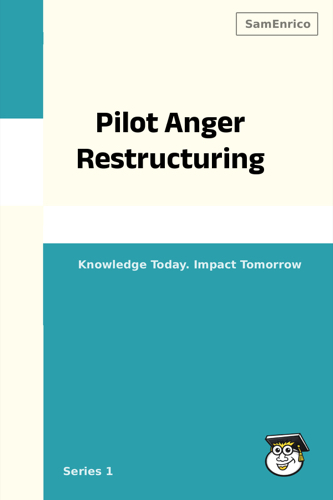
Pilot Anger Restructuring eBook
Manage frustration with air traffic control, crew,
Manage frustration with air traffic control, crew, or passenger behavior.
Formats
Free sample
Chapter 1: The $16,000,000 Emotion...--The first officer saw it happen in slow motion. Captain David Westbrook, a 22-year veteran with an impeccable record, had just been denied his requested altitude change for the fourth time by Chicago Center. The controller’s voice was clipped, tired, and utterly indifferent to the fact that Westbrook was carrying light turbulence reports from three other aircraft. The captain’s jaw tightened – a micro-movement the first officer had learned to recognize as the opening scene of a bad play. Then came the sigh, audible on the intercom but not yet on the radio.
Then the sarcastic mutter: “Unbelievable. Absolutely unbelievable.” The first officer opened his mouth to suggest they just accept the altitude and move on, but Westbrook keyed the mic before he could speak. “Center, we’ve asked four times. You gonna work us or just file flight plans all day?” There was a beat of silence on the frequency. Then the controller’s voice, now ice-cold: “November three Charlie Tango, say again?” Westbrook doubled down.
“You heard me. We need the climb. Turbulence is moderate. Do your job.” The controller did not respond for ninety seconds – an eternity on frequency. When the reply came, it was a terse reroute that added forty-seven miles to their flight path, burned an extra eight hundred pounds of fuel, and guaranteed a late arrival.
The first officer said nothing. The captain spent the next hour brooding, his scan pattern narrowing, his responses to ATC clipped and aggressive. Neither pilot noticed that they had drifted two hundred feet below their assigned altitude until the GPWS called “SINK RATE.” They corrected, but the damage was done. The FAA received three complaints from other pilots about the captain’s “hostile tone.” The airline’s ASAP program flagged the event. Captain Westbrook spent a month on administrative leave, attended anger management classes he resented, and retired two years early – his medical certificate still valid, his spirit broken.
The aircraft, a Boeing 737-800, was never in danger. The passengers never knew. But the cost – in fuel, reputation, career longevity, and human dignity – was $16,000,000 by conservative airline estimate. That is the cost of a single uncontrolled outburst. Not in legal damages.
In operational waste, career destruction, and avoidable risk.The Silence Before the Crash We do not talk about pilot anger in polite aviation company. We talk about crew resource management, threat and error management, situational awareness, and procedural compliance. We talk about everything except the raw, pulsing, human emotion that sits in the jumpseat of every cockpit, every single day. This is not because pilots are not angry. It is because pilots – and the industry that trains, certifies, and employs them – have constructed an elaborate mythology around emotional control.
The mythology goes something like this: professional pilots do not get angry. They are above such pedestrian reactions. They are cool, collected, rational beings who process information like computers and communicate like diplomats. A pilot who gets angry is not a real professional. He or she is an anomaly, a statistical outlier, a bad apple who should have been weeded out during training.This mythology is dangerous nonsense.
It is dangerous because it transforms a normal, predictable, universal human response into a shameful secret. And secrets, in aviation, kill people.Every pilot who has spent more than a hundred hours in a cockpit knows the truth that the mythology denies: anger is not rare. It is not abnormal. It is not a sign of weakness or incompetence. Anger is the natural response of a high-conscientiousness, high-control personality – the exact personality that makes a great pilot – encountering a system that is often arbitrary, inefficient, unfair, and occasionally stupid.
Air traffic control makes mistakes. Crew members forget things. Passengers act like entitled children. Maintenance delays eat your overnight rest. The gate agent gives your reserved parking spot to another airline.
The weather forecast was wrong. The routing makes no sense. The fuel truck is late. The catering forgot your meal. The lavatory service left the caps off.
The list of legitimate, objective provocations in a single duty day is longer than the preflight checklist. A pilot who never feels anger is either lying, lobotomized, or not paying attention.The problem is not the presence of anger. The problem is what we do with it.This book is built on a single, unshakeable premise: anger is not a personality flaw. It is an operational hazard. It is more immediately dangerous than a slow oil leak, more distracting than a flickering instrument, and more contagious than a virus in a crew rest facility.
And like any operational hazard, anger can be identified, measured, managed, mitigated, and – with sufficient practice and self-awareness – fundamentally restructured. You will never eliminate anger from your cockpit. You should not want to. Anger contains useful information: something is wrong, something is unfair, something is threatening your goals. But raw, unprocessed anger is also a neurochemical event that shuts down the very parts of your brain you need most to fly an aircraft safely.
The amygdala hijack – a term coined by psychologist Daniel Goleman and well known to aviation psychologists – describes what happens when the brain’s threat-detection system overrides the prefrontal cortex, the seat of executive function, planning, impulse control, and complex decision-making. In plain English: when you get truly angry, you get stupid. Not morally stupid. Neurologically stupid. Your IQ effectively drops by ten to fifteen points.
Your working memory shrinks. Your ability to consider alternative explanations for events collapses. Your time horizon shortens to the next five seconds. You become, in the most literal sense, a less capable pilot.The Multi-Million Dollar Emotion: A Cost-Benefit Analysis Let us put a number on this operational hazard. The $16,000,000 figure in this chapter’s title is not hyperbole.
It is a conservative estimate derived from de-identified airline data and FAA enforcement records. The calculation includes the following components. First, direct operational costs: fuel burned due to reroutes imposed after angry radio exchanges, maintenance inspections triggered by aggressive landings or taxi maneuvers, and crew rest overrides when an angry captain volunteers for a delay that then forces a duty day extension. Second, indirect operational costs: the productivity loss when a first officer or flight attendant spends cognitive energy managing the captain’s mood rather than flying or serving, the degraded decision-making that leads to small errors (missed altitudes, incorrect frequencies, omitted checklist items), and the increased fuel burn from flying “angry” – harder climb profiles, less efficient cruise altitudes chosen out of spite for ATC. Third, career costs: remedial training, administrative leave, early retirement, medical certificate jeopardy from elevated blood pressure, and legal fees for FAA enforcement actions.
Fourth, human costs: the divorce that follows a pilot who brings his anger home, the children who learn to walk on eggshells, the first officer who leaves the industry because she cannot tolerate another abusive captain, the flight attendant who files a complaint, the mechanic who gets yelled at and then takes an extra fifteen minutes to sign off a logbook – not out of malice, but out of the normal human response to being treated poorly.When you add these costs across a twenty-year career, a single pilot with…
This is the end of the free sample. Get the eBook to keep going. Buy now
About this book
Details
- Author
- Shields Delmer
- Publisher
- SamEnrico
- Language
- English
- Genre
- Non-Fiction, Self-Help
- Released
- 2026-06-09
- Pages (approx.)
- 137
- Available as
- eBook, Audiobook

Read better in the ZLOADR app
Your eBooks on your phone or tablet. Sign in with your SamEnrico account and start reading.
More by Shields Delmer
 Atomic Habits For Energy ManagementShields Delmer$11.99
 DoorDash Delivery Efficiency PlaybookShields Delmer$11.99
 Nightmare Journal ProcessingShields Delmer$11.99
 Jamaican Plumber In TorontoShields Delmer$11.99
 Namib Desert Foot TraverseShields Delmer$11.99
 NamUs Exhumation OrdersShields Delmer$11.99
 Bariatric Master GuideShields Delmer$11.99
 The Ghosts of Tarawa: Blood and Coral in the Pacific (1943)Shields Delmer$11.99
 Nefertiti's Shadow: The Queen Who Shaped the SunShields Delmer$11.99
 How to Produce Network SwitchesShields Delmer$11.99
 How to Produce Aluminum PipesShields Delmer$11.99
 Kenyan Remote Worker Recruitment GuideShields Delmer$12.99
You may also like
 Hong Kong Handover 1997Dunn Johnnie$11.99
 Zumba For Postnatal Recovery CourseNeal Christian$11.99
 Zumba for BeginnersLadner Nikia$11.99
 YouTube Comment Mining GuideHumes Pandora$12.99
 Worry Box MeditationCarlin Rudy$11.99
 Workplace Stress MeditationNguyen Lynn$11.99
 Workplace Stress and Sleep RepairHawley Ivory$11.99
 Workplace Perfectionism CureDelaney Jeffry$11.99
 Workplace Injustice Anger GuideWallen Isabelle$11.99
 Work Addiction and Burnout LinkGreenwood Ester$11.99
 Women in Yoga and WellnessBeattie Galina$11.99
 Women in Stand Up ComedyChun Evangeline$11.99