
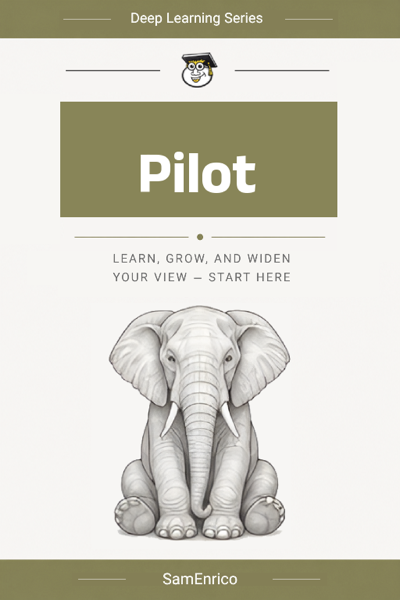
Non-FictionInformativeEducational
Pilot eBook
A Coursebook on Pilot
by Nealy Shyla
A Coursebook on Pilot
Formats
Free sample
Chapter 1: The Unspoken Crash...--The most dangerous part of your flight training is not a spin, a stall, or an engine failure at night. It is the silence between your first dream of flying and your first real lesson. In that silence, thousands of future pilots vanish every year—not because they lacked the talent, the coordination, or the courage, but because they never built a plan. They walked into a flight school, wrote a check, and assumed the rest would take care of itself. And then, six months later, they walked away, convinced that flying was not for them.This book exists to ensure that does not happen to you.Flight training is not just about learning to fly.
It is about running a successful, expensive, and time-sensitive project. You are the project manager. Your budget, your schedule, your choice of instructor, and your understanding of the medical certification process will determine whether you succeed or join the silent majority who quit. The difference between a private pilot certificate and a story about how you "almost learned to fly" is not talent—it is planning.Let us be brutally honest about the numbers. According to the Federal Aviation Administration, roughly 80,000 to 100,000 people start flight training every year in the United States.
Fewer than 30,000 finish with a private pilot certificate within 12 months. That is a dropout rate of over 70 percent. Those who quit do not fail because they cannot land. They fail because they run out of money, lose momentum between lessons, discover a medical issue too late, or simply lose faith in themselves. Every single one of those problems can be prevented with the right blueprint.This chapter is that blueprint.
It will not teach you how to fly. It will teach you how to become a pilot—by making the right decisions on the ground, long before you ever touch the controls. By the end of this chapter, you will know exactly which flight school to choose, how to budget realistically, what medical certificate you need, how to schedule your training for consistency, and how to tell if your instructor is helping you or holding you back. You will also meet the two most important people in your flying career: your Certificated Flight Instructor (CFI) and your mentor. They are not the same person, and understanding the difference will save you years of frustration.Let us begin.The Two Paths: Part 61 Versus Part 141The first major decision you will make is choosing between two federally regulated training pathways: Part 61 and Part 141.
These numbers refer to sections of the Federal Aviation Regulations. Neither is inherently better than the other. The right choice depends entirely on your goals, your learning style, and your schedule.Part 61 flight schools are the most common. They are often local flight schools at smaller airports, sometimes run by a single instructor or a small family business. Part 61 training is flexible.
You can schedule lessons around your job, your family, and your budget. There is no set curriculum length. You progress at your own pace. The minimum hours required for a private pilot certificate under Part 61 are 40 flight hours, but the national average is closer to 65 hours. Part 61 is ideal for hobbyist pilots, career changers who need to keep working while training, and anyone who values flexibility over structure.Part 141 flight schools are more formal.
They are typically affiliated with universities, community colleges, or large aviation academies. Part 141 schools have an FAA-approved curriculum that must be followed in a specific order. Lessons are standardized. The minimum hours required are lower: 35 hours for a private pilot certificate. However, Part 141 schools demand more ground school hours and stricter attendance policies.
They are ideal for career-bound pilots who want structure, for international students who need visa compliance, and for anyone who learns best with rigid deadlines and a classroom environment.Here is a decision matrix to help you choose. Ask yourself three questions:First, what is your career goal? If you dream of flying for a major airline, Part 141 may give you a slight advantage because airlines know the curriculum is standardized. But many airline pilots trained Part 61. There is no wrong answer.Second, how do you learn?
Do you thrive on structure, deadlines, and a fixed syllabus? Choose Part 141. Do you prefer to learn at your own pace, sometimes skipping ahead and sometimes repeating lessons? Choose Part 61.Third, what is your schedule? Can you commit to a full-time training schedule of three to five lessons per week?
Part 141 will work. Do you need to train around a full-time job, with lessons on weekends and evenings? Choose Part 61.One more consideration: cost. Part 141 schools often appear more expensive on paper because they bundle ground school, flight time, and instructor fees into a single tuition payment. Part 61 schools charge as you go, which can feel more manageable but often ends up costing more because students take longer to finish.
Neither is cheap. Both will require serious financial commitment.Red Flag: Any flight school that guarantees a private pilot certificate in exactly 40 hours for a fixed, low price is lying. The national average is 65 hours. If they promise 40, they are either incompetent or dishonest. Walk away.The Medical Certificate: The First Hurdle Before you take a single flying lesson, you must obtain a medical certificate from an Aviation Medical Examiner (AME).
This is a doctor authorized by the FAA to determine whether you are physically and mentally fit to fly. The most common reason student pilots quit is not lack of skill or money—it is failing the medical exam or discovering a disqualifying condition halfway through training.Do not start training without your medical certificate in hand.There are three classes of medical certificates. Third Class is required for private pilots. It is the least restrictive and allows you to fly for recreation or travel, but not for compensation. Second Class is required for commercial pilots who fly for hire, such as crop dusters, banner towers, and charter pilots.
First Class is required for airline transport pilots (ATPs) who fly for scheduled air carriers. If you aspire to fly for an airline, you need a First Class medical—and you need to get it before you spend a dollar on training, because some conditions that are disqualifying for First Class are perfectly fine for Third Class. Know your goal. Get the right medical.Common conditions that can delay or deny a medical certificate include high blood pressure, diabetes, depression, anxiety disorders, ADHD (especially if treated with medication), sleep apnea, heart conditions, and a history of substance abuse. Having any of these conditions does not automatically disqualify you.
Many are manageable with proper documentation and treatment. But you must be honest on your medical application (FAA Form 8500-8). Lying on this form is a federal crime. The FAA can and does cross-reference medical records and prescription databases.What the FAA doesn't tell you: You can schedule a consultation with an AME before you formally apply for a medical certificate. In a consultation, the AME reviews your medical history and tells you whether you are likely to pass.
If you have a disqualifying condition, the AME can advise you on what paperwork or waivers you need. You then…
This is the end of the free sample. Get the eBook to keep going. Buy now
About this book
Details
- Author
- Nealy Shyla
- Publisher
- SamEnrico
- Language
- English
- Genre
- Non-Fiction, Informative, Educational
- Released
- 2026-05-11
- Pages (approx.)
- 146
- Available as
- eBook, Audiobook

Read better in the ZLOADR app
Your eBooks on your phone or tablet. Sign in with your SamEnrico account and start reading.
More by Nealy Shyla
 Escape Conditioning Binge TriggersNealy Shyla$11.99
 Crick And Watson DNA PrizeNealy Shyla$11.99
 Habit Stacking Success GuideNealy Shyla$11.99
 Doctor Waiting Room Conversation HandbookNealy Shyla$11.99
 Walking Meditation for DepressionNealy Shyla$11.99
 The Last Broadcast: The Day the DJs Went SilentNealy Shyla$11.99
 The Celestial Forge: Vishwakarma's Sky-Piercing SpireNealy Shyla$11.99
 Low Bandwidth Freemium GuideNealy Shyla$12.99
 One Page Local Marketing ManualNealy Shyla$12.99
 Understanding Goldenhar SyndromeNealy Shyla$17.99
 How to Start a Cellulose Fibre-cement Articles Business (Beginners Guide)Nealy Shyla$11.99
You may also like
 Hong Kong Handover 1997Dunn Johnnie$11.99
 Zumba For Postnatal Recovery CourseNeal Christian$11.99
 Zumba for BeginnersLadner Nikia$11.99
 YouTube Comment Mining GuideHumes Pandora$12.99
 Worry Box MeditationCarlin Rudy$11.99
 Workplace Stress MeditationNguyen Lynn$11.99
 Workplace Stress and Sleep RepairHawley Ivory$11.99
 Workplace Perfectionism CureDelaney Jeffry$11.99
 Workplace Injustice Anger GuideWallen Isabelle$11.99
 Work Addiction and Burnout LinkGreenwood Ester$11.99
 Women in Yoga and WellnessBeattie Galina$11.99
 Women in Stand Up ComedyChun Evangeline$11.99