
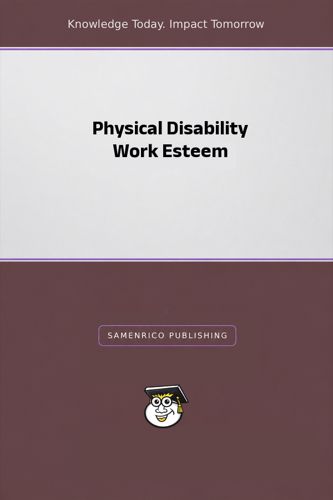
Non-FictionSelf-HelpDisability at Work
Physical Disability Work Esteem eBook
Accommodate disability without shame and maintain
by Bonilla Chas
Accommodate disability without shame and maintain professional confidence.
Formats
Free sample
Chapter 1: The Neutral Lie--–- The first time someone called me brave, I was folding a towel with one hand while my other arm hung uselessly at my side. I had just dropped a glass of water—the third one that week—and I was mopping it up with my sock because bending down to get a rag would have taken me forty-five seconds longer than it should have. My coworker, a well-meaning woman named Patricia who had never once asked me about my actual work performance, watched me struggle and said, “You are so brave. I don’t know how you do it.” I did not feel brave. I felt slow, exposed, and deeply, quietly ashamed.
And that is the problem this book exists to solve.The Two Monsters That Live in Every Office Every professional with a physical disability carries two monsters to work each morning. The first monster whispers, “You are a burden.” The second monster, paradoxically, whispers, “You are an inspiration.” Both monsters are liars. Both monsters destroy what I call “work esteem”—the specific, hard-won professional self-confidence that comes from knowing you are effective, respected, and accommodated without a single drop of pity. Most books about disability and work focus on only one of these monsters. They either teach you to fight internal shame (the burden narrative) or they teach you to demand external rights (the inspiration trap is left intact).
This book does something different. This book kills both monsters at the same time by introducing a single, radical idea: your limitation is not a moral fact. It is a neutral one.Let me say that again because it will be the foundation of every chapter that follows. Your limitation—whether you cannot walk, cannot lift, cannot stand for long periods, cannot type without pain, cannot see certain contrasts, cannot hear certain frequencies, or cannot predict when your energy will collapse—is not a reflection of your character, your worth, or your potential. It is a parameter.
It is no different from being five feet tall and needing a step stool to reach a high shelf. It is no different from needing reading glasses after age forty. It is a logistical puzzle, not an identity crisis. The moment you internalize this distinction, you stop apologizing for existing and start optimizing for excellence.But you do not believe me yet. Of course you do not.
You have spent years—maybe decades—being told otherwise by well-meaning parents, sympathetic doctors, awkward HR representatives, and a society that cannot decide whether to pity you or canonize you. So let us spend this first chapter doing the hard, necessary work of separating physical reality from internalized shame. Let us name the two monsters, understand why they are so powerful, and then dismantle them using a tool I call the Limitation Audit. By the end of this chapter, you will no longer see your disability as a source of moral weight. You will see it as a set of neutral facts to be managed.
And once you do that, the rest of this book—the accommodations, the negotiations, the leadership strategies—will feel not like charity but like engineering.The Burden Monster: When Society Treats You Like a Problem to Be Solved The burden monster is the older, more familiar enemy. It manifests every time someone sighs when you ask for an accommodation. It appears in the subtle reluctance of a manager who has to “figure out” how to make your workstation accessible. It lives in the statistic that disabled people are unemployed at twice the rate of non-disabled people—not because we cannot work, but because employers perceive us as expensive, complicated, or inefficient. The burden monster tells you that you take up too much space, cost too much money, and require too much patience.
Over time, you internalize this message. You start apologizing before you ask for anything. You minimize your needs. You tell yourself, “I should be grateful they hired me at all.”I have seen this monster destroy brilliant careers. A senior software engineer with repetitive strain injury refused to ask for voice-to-text software because she did not want to be “high maintenance.” She typed through the pain for eighteen months until she could not lift a coffee cup.
She went on medical leave, then short-term disability, then long-term disability, and then she never returned to work. Her employer spent more money on her leave and replacement than they would have spent on a three-hundred-dollar software license. The burden monster did not save anyone money. It just convinced a talented woman that she was not worth three hundred dollars.The burden monster thrives in the dark. It needs you to believe that your needs are exceptional, excessive, and embarrassing.
But here is the truth that the burden monster does not want you to know: most accommodations cost nothing. According to the Job Accommodation Network, the majority of workplace accommodations cost zero dollars. The ones that do cost money average around five hundred dollars—less than the cost of replacing a single employee. And even expensive accommodations, like ergonomic workstations or accessible software, pay for themselves within months through increased productivity, reduced absenteeism, and lower turnover. The burden monster is not just cruel.
It is mathematically wrong.But knowing the statistics is not enough to kill the monster. Statistics do not change how you feel when you have to ask your boss for a special chair while your able-bodied coworkers sit in whatever was left in the supply closet. To kill the burden monster, you must first understand that your limitation is a neutral fact, not a moral failing. This is harder than it sounds because society has spent centuries attaching moral weight to physical difference. We have religious traditions that frame disability as punishment for sin.
We have medical models that frame disability as a defect to be cured. We have capitalist models that frame disability as inefficiency to be eliminated. You have absorbed these messages whether you wanted to or not. Your job now is to unabsorb them.The Inspiration Monster: When Society Turns Your Struggle into a Spectacle The inspiration monster is newer, sneakier, and in some ways more damaging than the burden monster. It manifests every time someone says, “You’re so inspiring,” just for showing up to work.
It appears in viral videos of disabled people doing ordinary things—walking, cooking, dancing—with captions like “This will restore your faith in humanity.” It lives in the assumption that your life is so tragic that merely existing constitutes heroism. The inspiration monster tells you that you are not a normal professional with normal strengths and normal weaknesses. You are a symbol. Your job is not to produce excellent work. Your job is to make able-bodied people feel grateful about their own lives.The inspiration monster is seductive because it feels like praise.
Who does not want to be called brave? Who does not want to be told they are special? But here is the poison inside the compliment: inspiration is a ceiling, not a floor. When someone calls you inspiring for doing your job, they are telling you that they expected nothing…
This is the end of the free sample. Get the eBook to keep going. Buy now
About this book
Details
- Author
- Bonilla Chas
- Publisher
- SamEnrico
- Language
- English
- Genre
- Non-Fiction, Self-Help, Disability at Work
- Released
- 2026-06-07
- Pages (approx.)
- 130
- Available as
- eBook, Audiobook

Read better in the ZLOADR app
Your eBooks on your phone or tablet. Sign in with your SamEnrico account and start reading.
More by Bonilla Chas
 Blackout Curtains for KidsBonilla Chas$11.99
 Change Resistance AngerBonilla Chas$11.99
 Exam Trance TechniqueBonilla Chas$11.99
 Pinterest Comparison Addiction GuideBonilla Chas$11.99
 Xochiquetzal and Tezcatlipoca: A Divine Love Forbidden by the SunBonilla Chas$11.99
 Understanding Microphtalmos Bilateral Colobomatous Orbital CystBonilla Chas$17.99
 How to Start a Centrifuge (except Laboratory Type) Business (Beginners Guide)Bonilla Chas$11.99
 Critical Minerals Investment GuideBonilla Chas$12.99
 Marketing Humor AI GuideBonilla Chas$12.99
 The Wisdom of the Torah and TalmudBonilla Chas$11.99
You may also like
 Hong Kong Handover 1997Dunn Johnnie$11.99
 Zumba For Postnatal Recovery CourseNeal Christian$11.99
 Zumba for BeginnersLadner Nikia$11.99
 YouTube Comment Mining GuideHumes Pandora$12.99
 Worry Box MeditationCarlin Rudy$11.99
 Workplace Stress MeditationNguyen Lynn$11.99
 Workplace Stress and Sleep RepairHawley Ivory$11.99
 Workplace Perfectionism CureDelaney Jeffry$11.99
 Workplace Injustice Anger GuideWallen Isabelle$11.99
 Work Addiction and Burnout LinkGreenwood Ester$11.99
 Women in Yoga and WellnessBeattie Galina$11.99
 Women in Stand Up ComedyChun Evangeline$11.99