
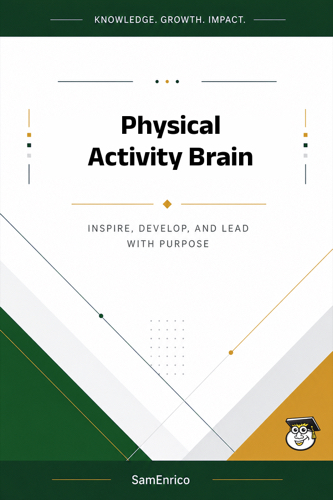
Non-FictionHealth & WellnessExercise
Physical Activity Brain eBook
Teaches aerobic exercise for hippocampal volume.
by Mayers Zita
Teaches aerobic exercise for hippocampal volume.
Formats
Free sample
Chapter 1: The Sitting Plague...-- In the spring of 2016, a 44-year-old graphic designer named Michelle walked into a cognitive testing lab in Pittsburgh, Pennsylvania. She had no complaints about her memory. She could find her car keys, remember her mother's birthday, and navigate her neighborhood without GPS. By every conventional measure, she was fine. Then she climbed onto a treadmill.
For twelve minutes, researchers measured her oxygen consumption while she walked at increasing speeds. They calculated her VO2 max—a precise metric of aerobic fitness. Then they slid her into an MRI scanner and measured the volume of her hippocampus, the seahorse-shaped structure deep in her brain that acts as the master controller of long-term memory. The results were sobering. Michelle's VO2 max placed her in the bottom twenty percent of women her age.
And her hippocampus was smaller than ninety percent of her peers. She was not demented. She was not even mildly impaired. But her brain had already begun a slow, silent process of atrophy that would, if left unchecked, rob her of her memories a decade or two earlier than necessary.What Michelle did not know—and what this book will prove to you—is that her sedentary lifestyle was not merely a matter of physical health. It was a neurological emergency happening in slow motion.
Every hour she spent at her desk, every evening on the couch, every elevator taken instead of stairs, was sending a signal to her brain that said: We do not need these neurons. Prune them. Let them die.The good news—and there is extraordinary good news—is that Michelle reversed course. Over the next twelve months, she began walking during her lunch break, then jogging, then cycling. She did not become an athlete.
She became a person who moved for thirty minutes, three or four times a week, at a pace where she could talk in short sentences but could not sing. One year later, she returned to the same lab. Her VO2 max had moved into the top thirty percent. And her hippocampus had grown by nearly five percent—the equivalent of reversing three years of age-related decline. She had not taken a pill.
She had not undergone surgery. She had simply walked, jogged, and cycled her way to a bigger, better, more resilient brain.This chapter will explain why Michelle's experience is not a miracle but a biological inevitability. We will trace the hidden epidemic of sitting, introduce the concept of evolutionary mismatch, unveil the master molecule of brain growth (BDNF), and establish the antifragile principle that governs all brain adaptation. By the end of this chapter, you will understand why your chair is not merely uncomfortable—it is neurologically dangerous, and why the simple act of moving your feet is the most powerful cognitive intervention available to any human being.The Hidden Epidemic You Have Never Heard Of Let us begin with a number that should terrify you. The average adult in the United States, United Kingdom, and other developed nations now sits for 9 to 11 hours per day.
This is not an exaggeration. The sum of commuting, desk work, meals, television, and screen time exceeds half of all waking hours. Between 1960 and 2010, the proportion of jobs requiring moderate physical activity in the United States fell from fifty percent to less than twenty percent. We did not evolve for this. We evolved for something radically different.For approximately 99 percent of human history, our ancestors walked, ran, climbed, and migrated between ten and twenty kilometers every single day.
The hunter-gatherer body was not a body at rest. It was a body in nearly constant motion, punctuated by brief periods of high-intensity exertion during hunts or escapes from predators. The brain that sits inside your skull today was shaped by this environment. It expects movement. It requires movement.
When movement does not arrive, the brain does not remain neutral. It begins to dismantle itself.This is not a metaphor. It is a biological fact that we can now observe directly using modern neuroimaging. The human brain consumes approximately twenty percent of the body's energy while representing only two percent of its mass. It is an expensive organ to maintain.
Evolution is ruthlessly efficient. If a brain structure is not being used, the body will reallocate those resources elsewhere. The hippocampus—the seahorse-shaped memory center we will explore in depth in Chapter 2—is particularly vulnerable to this pruning process because it is one of the few brain regions that continues to generate new neurons throughout life. These newborn neurons require activation to survive. Without movement, they die.Consider the research from the University of California, Los Angeles, which followed more than one thousand five hundred older adults for ten years.
Those who sat for more than ten hours per day and engaged in little to no physical activity had hippocampal volumes that were, on average, eight to ten percent smaller than those who sat for fewer than five hours and exercised regularly. That difference is not trivial. It is the difference between remembering where you parked your car and wandering the parking lot for twenty minutes. It is the difference between recognizing your grandchild's name and struggling to retrieve it. It is the difference between independent living at eighty and assisted living at seventy.But here is what most people do not understand: the damage begins long before old age.
In a 2024 study from Boston University School of Medicine, researchers scanned the brains of two hundred and fifty adults between the ages of thirty-five and fifty. None had any cognitive complaints. All were employed, educated, and functioning normally. Yet those with the lowest aerobic fitness levels—the bottom twenty percent—had hippocampal volumes comparable to the least fit adults in their mid-sixties. Their brains were, in effect, biologically fifteen to twenty years older than their chronological age.
They did not feel old. They did not look old. But their memory centers were quietly shrinking with every passing month of sedentary life.The Evolutionary Mismatch That Is Rewiring Your Brain The concept of evolutionary mismatch—first articulated by evolutionary biologists in the 1960s and popularized for general audiences in the last decade—explains why our bodies and brains are so poorly adapted to modern life. An evolutionary mismatch occurs when a trait that was adaptive in ancestral environments becomes maladaptive in novel environments. Our craving for sugar and fat was adaptive when calories were scarce and unpredictable.
It is maladaptive in a world of vending machines and processed foods. Our tendency to conserve energy by sitting whenever possible was adaptive when food was hard to obtain and unnecessary movement meant unnecessary risk. It is maladaptive in a world of desk jobs and streaming services.The brain did not evolve to be sedentary. It evolved to coordinate complex movements across varied terrain while tracking predators, finding food, navigating social relationships, and remembering the location of water sources. These tasks required a large, metabolically active hippocampus.
In ancestral environments, the hippocampus was engaged constantly—not merely during deliberate "exercise" but throughout the waking day. Every walk to a new berry patch, every detour around a fallen tree, every hunt that required remembering the topography of…
This is the end of the free sample. Get the eBook to keep going. Buy now
About this book
Details
- Author
- Mayers Zita
- Publisher
- SamEnrico
- Language
- English
- Genre
- Non-Fiction, Health & Wellness, Exercise
- Released
- 2026-06-06
- Pages (approx.)
- 152
- Available as
- eBook, Audiobook

Read better in the ZLOADR app
Your eBooks on your phone or tablet. Sign in with your SamEnrico account and start reading.
More by Mayers Zita
 Managing Interruptions for FirefightersMayers Zita$11.99
 Spin Climb Ride GuideMayers Zita$11.99
 Anki For AnthropologyMayers Zita$11.99
 Skeleton Coast Desert TrekMayers Zita$11.99
 Ageism at Work Self EsteemMayers Zita$11.99
 The Alcohol and Depression LinkMayers Zita$11.99
 Creativity and Data ScienceMayers Zita$11.99
 Nefertiti's Veil: The Architect of the Forgotten PyramidMayers Zita$11.99
 Flames Over Algiers: The War That Shattered France's EmpireMayers Zita$11.99
 The Essential Guide to FusionMayers Zita$11.99
 How to Produce ErasersMayers Zita$11.99
 Remote Interview Techniques WorkbookMayers Zita$12.99
You may also like
 Hong Kong Handover 1997Dunn Johnnie$11.99
 Zumba For Postnatal Recovery CourseNeal Christian$11.99
 Zumba for BeginnersLadner Nikia$11.99
 YouTube Comment Mining GuideHumes Pandora$12.99
 Worry Box MeditationCarlin Rudy$11.99
 Workplace Stress MeditationNguyen Lynn$11.99
 Workplace Stress and Sleep RepairHawley Ivory$11.99
 Workplace Perfectionism CureDelaney Jeffry$11.99
 Workplace Injustice Anger GuideWallen Isabelle$11.99
 Work Addiction and Burnout LinkGreenwood Ester$11.99
 Women in Yoga and WellnessBeattie Galina$11.99
 Women in Stand Up ComedyChun Evangeline$11.99