
Non-FictionSelf-HelpPhone SkillsVocal
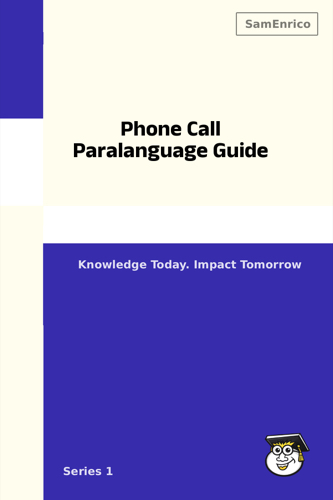
Phone Call Paralanguage Guide
Use tone, pacing, and silence to convey meaning wi
Use tone, pacing, and silence to convey meaning without visual cues.
Formats
About this book
Free sample
Chapter 1: The 80% Lie...--–- You just finished a phone call. You said the right words. You were polite, clear, and professional. And yet, something felt off. The other person seemed distracted, skeptical, or maybe even irritated.
You hung up with a vague sense that you failed—but you cannot explain why.You are not imagining it. And the problem is not your vocabulary.Here is a hard truth that most people never realize: In every phone conversation, the words you speak account for less than twenty percent of the message received. The other eighty percent is transmitted through how you sound—your tone, your pacing, the texture of your voice, and the silences you leave between your sentences. This invisible layer of communication is called paralanguage, and it is running constantly, whether you know it or not. More importantly, it is being judged constantly, whether you intend it or not.This chapter will reveal why your voice is the fastest, most honest, and most dangerous communication tool you own.
You will learn why the absence of video does not make phone calls easier—it makes them more revealing. And you will begin to understand the phenomenon of telephone disinhibition, where callers say things on the phone they would never say in person. By the end of this chapter, you will never hear a phone call the same way again.The Neuroscience of Being Heard Let us start with a fact that will change how you think about every phone call you make from now on. The human brain processes vocal emotions faster than visual ones. When you hear a voice, the amygdala—the brain's emotional processing center—reacts within 150 milliseconds.
That is faster than a blink. That is faster than you can consciously decide to feel something. Your listener's brain has already formed an emotional judgment about you before you have finished saying your first syllable.This speed advantage exists because the voice is a direct biological signal. When you speak, your vocal cords, your diaphragm, your breath, and your emotional state are physically connected. Fear tightens your throat.
Confidence relaxes your chest. Doubt lifts your pitch at the end of a sentence. These are not choices; they are…
This is the end of the free sample. Get the eBook to keep going. Buy now
Contents
- Chapter 1
- Chapter 2
- Chapter 3
- Chapter 4
- Chapter 5
- Chapter 6
- Chapter 7
- Chapter 8
- Chapter 9
- Chapter 10
- Chapter 11
- Chapter 12
Details
- Author
- Durant Oralee
- Publisher
- SamEnrico
- Language
- English
- Genre
- Non-Fiction, Self-Help, Phone Skills, Vocal
- Released
- 2026-06-10
- Pages (approx.)
- 134
- Available as
- eBook, Audiobook

Read better in the ZLOADR app
Your eBooks on your phone or tablet. Sign in with your SamEnrico account and start reading.
More by Durant Oralee
 Gacy Interview TranscriptsDurant Oralee$11.99
 Loudspeaker Van AnnouncementsDurant Oralee$11.99
 Mindful Smoking CessationDurant Oralee$11.99
 The Warrior Queens of the Sahel: The Untold Battle for Equality in Medieval African SportsDurant Oralee$11.99
 How to Start a Closed Circuit Television Equipment (CCTV) Business (Beginners Guide)Durant Oralee$11.99
 AI for Prescription DocumentationDurant Oralee$12.99
 Learn to Play the ShankhaDurant Oralee$11.99
 Email Marketing SpecialistDurant Oralee$11.99
You may also like
 Hong Kong Handover 1997Dunn Johnnie$11.99
 Zumba For Postnatal Recovery CourseNeal Christian$11.99
 Zumba for BeginnersLadner Nikia$11.99
 YouTube Comment Mining GuideHumes Pandora$12.99
 Worry Box MeditationCarlin Rudy$11.99
 Workplace Stress MeditationNguyen Lynn$11.99
 Workplace Stress and Sleep RepairHawley Ivory$11.99
 Workplace Perfectionism CureDelaney Jeffry$11.99
 Workplace Injustice Anger GuideWallen Isabelle$11.99
 Work Addiction and Burnout LinkGreenwood Ester$11.99
 Women in Yoga and WellnessBeattie Galina$11.99
 Women in Stand Up ComedyChun Evangeline$11.99