
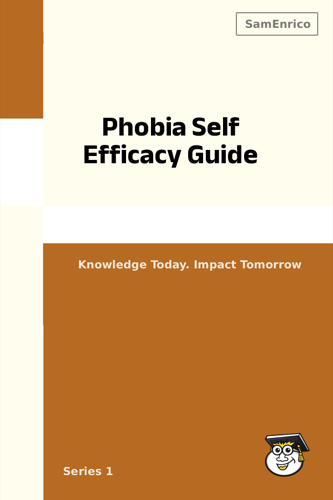
Phobia Self Efficacy Guide eBook
Build confidence in your ability to cope with fear
by Denson Lita
Build confidence in your ability to cope with fear moments.
Formats
Free sample
Chapter 1: The Decoder Switch--–- The first time my heart slammed against my ribs for no reason, I thought I was dying. I was twenty-three, standing in a grocery store aisle, comparing pasta sauces. One second, normal. The next, a tidal wave of electricity crashed through my chest. My vision tunneled.
My hands went cold. Every instinct screamed: Run. Now. I abandoned my shopping cart and fled to my car, where I sat shaking for twenty minutes, convinced I had just narrowly escaped a heart attack.I hadn’t. It was a panic attack.
And the most terrifying part wasn’t the pounding heart or the dizziness. It was the belief that I couldn’t survive what was happening to me.That belief—the conviction that fear will destroy you—is the engine beneath every phobia. Not the elevator, not the spider, not the crowded room. The fear of fear itself. And for years, I tried everything to eliminate it.
Meditation apps. Breathing techniques. Positive thinking. Avoidance. Everything except the one thing that actually works: learning to decode fear instead of fighting it.This chapter is about flipping a switch.
It’s the difference between asking “Why am I so broken?” and asking “What is my nervous system telling me right now?” Fear is not your enemy. It is a chemical and physical signal—raw data. Once you learn to read that data, you take the first, most critical step toward self-efficacy: the unshakable belief that you can handle whatever fear shows up.The Lie You’ve Been Told About Fear We live in a culture that treats fear as a malfunction. If you feel afraid in a situation that isn’t objectively life-threatening, the message is clear: something is wrong with you. Fix it.
Suppress it. Breathe it away. Think positive thoughts until it disappears.This is a lie.Fear is not a design flaw. Your brain’s alarm system evolved over hundreds of millions of years to keep you alive. The problem isn’t that you have an alarm system.
The problem is that your alarm system sometimes triggers false alarms. And false alarms feel exactly like real ones.Let me say that again. False alarms feel exactly like real ones. Your body cannot tell the difference between a genuine threat (a car swerving toward you) and a perceived threat (an elevator that reminds you of a past panic attack). The same surge of adrenaline.
The same racing heart. The same screaming voice in your head saying get out now.This is why willpower fails. You cannot think your way out of a physiological response that your body has already launched. But you can learn to interpret that response differently. And interpretation changes everything.Beyond Fight or Flight: The Complete Fear Response You’ve probably heard of the “fight or flight” response.
It’s a useful shorthand, but it’s incomplete. Fear actually has four primary expressions: fight, flight, freeze, and faint.Fight is when you confront the threat. Flight is when you flee from it. Freeze is when you become immobilized—your body’s way of hoping the threat doesn’t notice you. (Think of a deer in headlights.) Faint is the most extreme response: a sudden drop in blood pressure that causes you to lose consciousness, which in evolutionary terms might make a predator lose interest.For most people with phobias, the dominant response is flight (avoidance) or freeze (feeling stuck and unable to act).
Understanding which response your body defaults to is useful information. But more important is understanding the sequence that leads to that response.The Anatomy of a Panic Attack: A Step-by-Step Breakdown Let me walk you through exactly what happens in your body during a fear moment. This is not abstract theory. This is the mechanical reality of your nervous system. And once you understand the mechanics, the fear loses some of its mystery.Step 1: The Trigger Something happens.
It could be external (you walk into an elevator) or internal (your heart rate increases for no apparent reason). Your brain’s threat-detection system—centered in a tiny almond-shaped structure called the amygdala—scans this event against your memory database of past dangers.Step 2: The Alarm If your amygdala perceives even a vague resemblance to a past threat, it sounds the alarm. This happens in milliseconds, far faster than your conscious mind can intervene. You do not choose to feel afraid. The alarm happens to you.Step 3: The Adrenaline Surge The amygdala signals your adrenal glands to release adrenaline (epinephrine) into your bloodstream.
Adrenaline is an extraordinary chemical. It increases your heart rate, dilates your airways, shunts blood toward your large muscles, and sharpens your senses. All of this is designed for one purpose: to help you survive a physical threat.Step 4: The Physical Sensations This is where it gets uncomfortable. The adrenaline surge produces a cascade of sensations:Racing heart (so blood can move faster)Rapid breathing (to oxygenate your muscles)Sweating (to cool your body for action)Dizziness (from changes in blood flow)Tunnel vision (to focus on the threat)Trembling (from muscle tension)Nausea (because digestion shuts down in an emergency)None of these sensations are dangerous. Every single one is your body doing exactly what it evolved to do.
But they feel terrifying—because of what happens next.Step 5: The Interpretation Your conscious mind notices these sensations and asks: What does this mean? If you interpret the sensations accurately (“My heart is racing because my amygdala sounded a false alarm”), the fear wave begins to subside. But if you interpret them catastrophically (“My heart is racing—I’m having a heart attack”), your brain sends a new signal: More danger! And the cycle repeats.This is why panic attacks can feel like they spiral out of control. You’re not just feeling the original alarm.
You’re adding a second layer of fear about the fear. That secondary fear is what turns a manageable wave into a tsunami.Step 6: The Behavior Based on your interpretation, you take action. If you believe you’re in danger, you will fight, flee, freeze, or faint. For most people with phobias, the action is avoidance: you leave the situation, you never enter it again, or you develop elaborate safety behaviors to feel protected.And here’s the cruel irony: avoidance provides immediate relief, which teaches your brain that avoidance was the correct response. So next time, the alarm sounds even faster.
The fear grows stronger. Your world gets smaller.The Most Important Concept You Will Learn in This Book I need you to remember one phrase. Write it down. Put it on your bathroom mirror. Repeat it to yourself when the fear comes.“This is uncomfortable, not dangerous.”That’s it.
That’s the decoder switch.Every time you experience the physical sensations of fear—racing heart, dizziness, breathlessness—your brain will offer you a catastrophic interpretation. I’m dying. I’m losing control. I’m going crazy. I’ll pass out.
Everyone can see how terrified I am.Those are interpretations, not facts. They feel true because your body is screaming danger. But they are not true.Your heart can race at 160 beats…
This is the end of the free sample. Get the eBook to keep going. Buy now
About this book
Details
- Author
- Denson Lita
- Publisher
- SamEnrico
- Language
- English
- Genre
- Non-Fiction, Health & Wellness
- Released
- 2026-06-09
- Pages (approx.)
- 147
- Available as
- eBook, Audiobook

Read better in the ZLOADR app
Your eBooks on your phone or tablet. Sign in with your SamEnrico account and start reading.
More by Denson Lita
 Lumen5 Social Video GuideDenson Lita$11.99
 Earplug Assisted Sleep GuideDenson Lita$11.99
 Goal Setting for PerfectionistsDenson Lita$11.99
 The Retirement Downsizing Decision GuideDenson Lita$11.99
 The Last Oracle: The Mysterious Disappearance of the Delphic PriestessesDenson Lita$11.99
 Understanding Internal Carotid AgenesisDenson Lita$17.99
 Consumer Spending Long Term OutlookDenson Lita$12.99
 Waitlist Coping WorkbookDenson Lita$12.99
 How to Start a Hobby in Motor sportsDenson Lita$11.99
 Counter-surveillance DetectionDenson Lita$11.99
You may also like
 Hong Kong Handover 1997Dunn Johnnie$11.99
 Zumba For Postnatal Recovery CourseNeal Christian$11.99
 Zumba for BeginnersLadner Nikia$11.99
 YouTube Comment Mining GuideHumes Pandora$12.99
 Worry Box MeditationCarlin Rudy$11.99
 Workplace Stress MeditationNguyen Lynn$11.99
 Workplace Stress and Sleep RepairHawley Ivory$11.99
 Workplace Perfectionism CureDelaney Jeffry$11.99
 Workplace Injustice Anger GuideWallen Isabelle$11.99
 Work Addiction and Burnout LinkGreenwood Ester$11.99
 Women in Yoga and WellnessBeattie Galina$11.99
 Women in Stand Up ComedyChun Evangeline$11.99